
For a richer electoral system: proportional and preferential
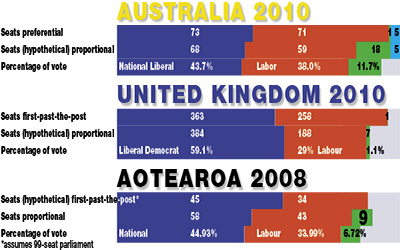
Greens Eaten: While New Zealanders risk loosing the strict proportionality of their electoral system, Australian Green voters lament they have only one member in the House of Representatives, instead of the 18 or so they are due. chart Mahurangi Magazine
Aotearoa sports the Rolls-Royce of proportional voting systems.
Mixed member proportional is the only system that guarantees, potentially, that minor parties receive their fair proportion of parliamentary representation. But that is not to say that the system is optimal. As implemented in Aotearoa, one of its inefficiencies is the large number of list seats required to achieve that strict proportionality. Ironically, the solution involves adding a component that features in alternate systems that are inferior in respect to proportionality.
Two of the four options to mixed member proportional on offer in the referendum on Saturday fortnight are preferential voting systems. In both preferential voting and single transferable voting, voters may rank more than just the one candidate. As a means of electing local body representatives, where political parties tend to be kept in the background, single transferable voting is a superior system, in that it avoids the vote being split and the election of candidates who attract only minority support. But as a means of electing parliamentary representatives, where parties are all-important, it is deeply unsatisfactory to third and minor parties. The Green Party would lose most of its representatives, and the minnows would receive none—the exception being those with sufficiently charismatic candidates to win the occasional seat.
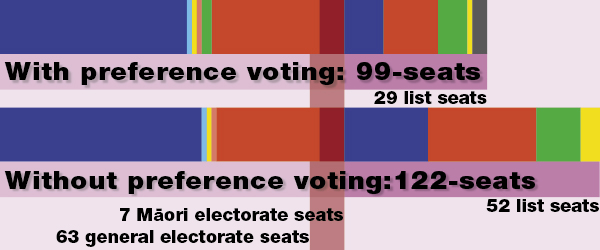
Less is More: Parliament could be knocked back to 99 seats, and be more representative, was Aotearoa to meld the best features of the Australian system, preferential voting, with the best of mixed member proportional. Note how the undeserving Act Party (yellow) prospered from New Zealand First (grey), in 2008, thanks to the dotty coattails provision, which would be scrapped. chart Mahurangi Magazine
Preferential voting as proposed in the referendum, and as practiced in Australia, is even more unfair to third and minor parties. Its one virtue is that it prevents the least popular of two major parties to governing in its own right. The Australian Greens, despite enjoying about twice the support of its Aotearoa counterpart, took until 2010 to have its first member elected the House of Representatives.
An electoral system should be fair. The proportion of members representing each party should reflect voters’ intentions, as accurately as can be achieved—given that electing just part of a politician isn’t an option. And the candidates representing each electorate should reflect voters’ intentions. Mixed member proportional best meets the first requirement, but fails somewhat regarding the second. Take an electorate that exhibits stronger than average support for the Green Party, but is somewhat ambivalent regarding the two biggest parties, National and Labour. Because the Green Party enjoys rather more support from Labour supporters than from National, National is likely to be the beneficiary of the split vote. Hence the need for fifty or more list seats, to restore that strict proportionality.
The solution is to allow voters to rank their subsequent preferences for their electorate representative, rather than accepting only their first preference. That way it would be possible to maintain the integrity of mixed member proportional, but with a parliament of 99 members…
…as called for by the 81.5% who voted in the last referendum on the electoral system.