
After-match looked dicey but Deacon saves dance
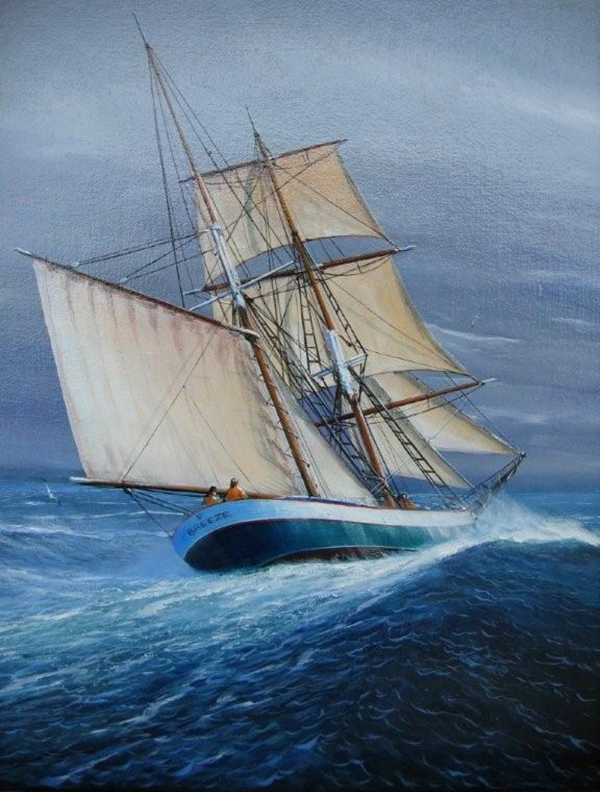
Regatta Regular: Ever since she was built, by Ralf Sewell and friends, and launched, in 1981, the brigantine Breeze has attended the Mahurangi Regatta. marine artist Paul Deacon
For a while there, the vendors had inveigled their way in.
Invariably, there is somebody looking to cash in on the event, but it was the strongly-held view of the generation that revived the Mahurangi Regatta that it should be a good old-fashioned leave-your-wallet-at-home picnic regatta—that parents shouldn’t have to spend the day deflecting demands for money for all manner of over-priced wares.
This preference meshed nicely with park policy, including that of not giving exclusive use, even for a day, to one group of park users.
So when Paul Deacon asked if he could hold an exhibition of his marine art at the 2009 Mahurangi Regatta, this determination to keep the regatta non-commercial needed to be politely but firmly explained. But the artist could not have been less concerned, and was more than happy for there to be no exhibition entry fee, nor was he planning to plaster prices of the artwork about. It was settled—in a meeting at the proposed venue (Scott Homestead) between park staff, Friends of the Mahurangi and the Mahurangi Cruising Club—the exhibition of marine art would, it was warmly agreed, nicely-complement the prize-giving and dance.
Half a year on, however, the after-match function was looking decidedly unaffordable. It had been envisaged that it would be the Jane Gifford ball. But with the scow’s re-commissioning still a ways off, it was unreasonable to seek district council support towards the hiring of the marquee. Then the artist made contact, to confirm some minor details but also to say:
I have completed a small painting of the Breeze for use as a prize-giving, auction or raffle.
When thanked for this contribution and becoming aware of the substantial shortfall in the event’s funding, Paul promptly offered another, large oil-on-canvas of the 1933 J-class yacht Endeavour:
…thrashing along in a stiff breeze—about a metre square and worth a couple of grand in the galleries.
Now a prize-giving and dance was assured. The more misanthropically inclined might wonder why the organisers bother with the prize-giving dance at all. The prime motivation in its revival, of course, was tradition. Before it lapsed during World War Two, the prize-giving and dance was an integral part of the regatta. But due to the lack of a suitable venue in the Mahurangi, it was held at the Gaiety Hall at Waiwera—the hotel’s wharf having survived beyond the steamboat era to the 1950s.
The celebration of Warkworth’s 150th provided the opportunity, with the 2004 Mahurangi Regatta Ball. The following year, a request by the Auckland Regional Council to help launch its five-year Mahurangi Action Plan with a similar event resulted in the 2005 Mahurangi Regatta Prize-Giving and Dance. It was a non-ticketed affair—in contrast to the $65-a-head ball—thanks to the regional council picking up most of the costs, including of the marquee.
By reviving the Mahurangi Regatta, in 1977, Friends of the Mahurangi was keen to demonstrate that the organisation was also about the enjoyment of the harbour, and not totally pre-occupied with ‘preservation’. But somehow, someone must summon the audacity, on a day otherwise devoted to enjoyment, to briefly and brightly trumpet the collective work of those determined to fight for the Mahurangi:
- The Jane Gifford reconstruction
- Jade River : A History of the Mahurangi
- Mahurangi Action Plan
- The Mahurangi Magazine
- Mahurangi punt revival
- Mahurangi Regatta
- Mahurangi Regatta Prize-Giving and Dance
- Open-ground indigenous plants project
- Oyster farm cleanup
- Warkworth to Snells Beach Walkway
- Wilson Cement Works
- Wilson Cement Works Walkway
With the exception of the Mahurangi Action Plan, these are all community initiatives. For the Mahurangi Action Plan, and the 900 hectares of Mahurangi regional parkland, thank the Auckland Regional Council.