Connectivity exemplar saved by Wilma
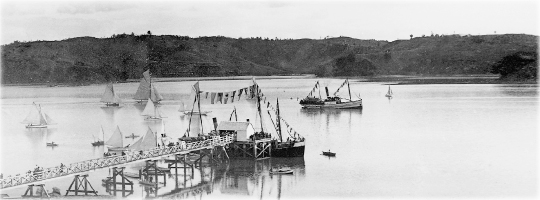
Ghosting to the Line: Renowned marine photographer Henry Winkelmann captured the 1901 Mahurangi Regatta, in this possibly earliest extant image of the event. Winkelmann was secretary of the Warkworth-based Coastal Steamship Company, which brought hundreds of his fellow Aucklanders to the event as spectators. photographer Henry Winkelmann
It may not have proved to be the best advertisement for it. The 2011 Mahurangi Regatta would have been the first under the auspices of the new Auckland Council. And as such, it would have been the perfect opportunity for city hall to demonstrate that it can also do country. But given that the new council had been in operation for less than three months, the Mahurangi and Auckland Anniversary regattas were unlikely to be the best example of urban–rural collaboration possible.
In the event, it was academic. Not entirely unexpectedly, a tropical cyclone, Wilma, cancelled play. Forming northwest of Fiji ten days before the regatta, Cyclone Wilma killed three people in American Sāmoa, inflicted major damage in Tonga, and destroyed several homes and caused widespread flooding and the evacuation of hundreds in Aotearoa.
The decision to cancel the Mahurangi Regatta Prize-Giving and Dance was the easiest and earliest decision—it was taken some 40 hours out. Aside from the cyclone tracking very consistently over the preceding days, a near miss would likely have seen much reduced numbers come ashore at Scotts Landing, and insufficient income from the traditional bar and burgers to pay the more than $6000 required to pay for hire the marquee, barbecues, the musician’s expenses, sound equipment, portable toilets etc.
Next cancelled, at 6.55 am on regatta morning, were the shoreside events held at Sullivan Bay—the beach, kayak and rowing races—quickly followed by the small sailing boat races. Soon after the regatta cancellation was total, besides the only yachts in the harbour were those that had arrived earlier in the week—by Friday afternoon when most would set out for Mahurangi, the weather was too wild for all but the most improvident skipper.
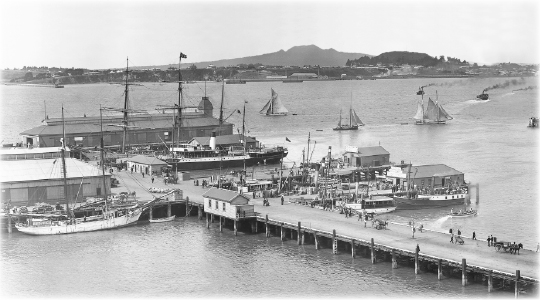
Similar Vantage: The meeting room for today’s regatta discussion with Auckland Tourism, Events and Economic Development major events people has a vantage similar to that used by Henry Winkelmann when he photographed Queen Street in 1905. Warkworth-based Coastal Steamship Company operated from the inshore tee on the down-harbour side. In this era of unsealed roads, the steamers were the principal means of transport between the city and the Mahurangi. publication Changing Times
The Auckland Anniversary Regatta and the Mahurangi Regatta have in existence for about the same length of time. But while the history of Auckland event is very thoroughly known, the date of the first Mahurangi Regatta was not recorded. However, as Dr Ronald H Locker writes in Jade River : A History of the Mahurangi:
Joseph Gard noted in his diary that he saw the event in progress on New Year’s Day, 1858, while passing up-river on his way home from Auckland.
The Mahurangi Regatta appears to have been held somewhat sporadically, and effectively lapsed during World War Two. But since 1977, when it was revived by Friends of the Mahurangi, it has been an annual, and steadily more popular, event.
From as early as that recorded in the 1901 inaugural edition of the Rodney Times, the regatta warmly embraced Auckland ‘Yachtmen’:
The ‘Heads’ is one of the most suitable places within so short a distance from Auckland for regatta purposes. It being within reach of the Auckland Yachtmen, who are certain to take advantage of the outing, and should the committee decide to make it an annual event, as indeed they have every encouragement to do.
That regatta was also recorded by Auckland-based photographer Henry Winkelmann. It features on the dust jacket of Locker’s history, published 100 years on.
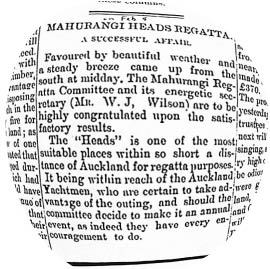
Mahurangi Regatta 1901: When Devonport Yacht Club commodore Martin Foster conceived the race to Mahurangi, in 1966, he was continuing a long-standing relationship between city ‘Yachtmen’ and their first harbour north. publication Changing Times
Coincidentally, the same year the regatta was revived, Devonport Yacht Club moved the start of its annual Mahurangi race to the Friday evening of Auckland’s anniversary weekend—the club had been racing to Mahurangi since 1966, but on the Saturday. Two regattas later, Friends of the Mahurangi and the Sandspit Yacht Club, which organised the sailing races, finally embraced the obvious synergy and set the Saturday of Auckland Anniversary weekend as Mahurangi’s permanent Regatta day.
For the next 25 years the Mahurangi Regatta steadily grew while retaining essentially the same format: Beach races for the children, picnic lunch, sailing races in the afternoon and with more beach events, and the grand finale the fiercely contested tug of war, invariably won by the Sullivan clan, from which Sullivan Bay takes its name. However, a marked a change in flavour occurred in the yacht racing dating from the introduction of a Mahurangi Cup for craft of pre 1955 design. From its revival, the regatta had been a magnet for historic and traditional-styled vessels, but 1988 onward, events for these craft have dominated the programme.
The evening of the regatta was a mix of informal gatherings of various boat crews clubs at various locations, with the Mahurangi Cruising Club prize-giving at Scotts Landing functioning as the main after-match event. Then, in 2004, a Mahurangi Regatta Ball was held as the finale of a calendar of events held to celebrate Warkworth’s 150th anniversary. The ball was conceived in the tradition of the prize-giving dances that were integral to the regatta until it lapsed. In keeping with the era in which the dances end, the event was 1940s themed, with a swing band and World War Two re-enactment servicemen.
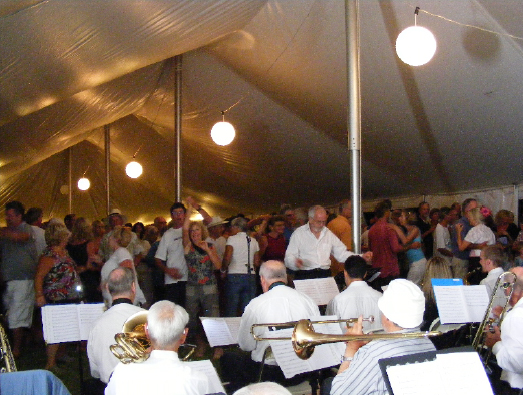
In Full Swing: The 2009 Mahurangi Regatta Prize-Giving and Dance marquee packed with dancers, thanks to Dr Trevor Thwaites and the Prohibition Big Band. The band, being essentially acoustic, is perfect for the venue and has played every fixture from the 2004 Mahurangi Regatta Ball onwards. photographer Jason Brown
Hugely enjoyed, the consensus was that it should be an annual event. The organisers, however, were less sanguine about the ball’s sustainability, annually, and were inclined towards a rather longer interval. However, that year the Auckland Regional Council initiated the Mahurangi Action Plan, intended to be a five-year kick-start of riparian protection and restoration to address the harbour’s elevated sediment accumulation rate. To help launch the initiative, the action plan coordinator suggested another ball. The counter-suggestion was a prize-giving and dance, in order that admission to the event be free—so as to be inclusive, but also to reach as wide an audience as possible.
The Mahurangi prize-giving dance has proved to be enormously popular, making for an entirely family-friendly evening. It seems to be particularly appreciated by the female crewmembers—the music and dancing an attractive alternative to the all-too-male tendency to stand in clumps pontificating on the afternoon’s action on the water. The spectacle of a live orchestra—Trevor Thwaites’ Prohibition Big Band played at the ball, and all subsequent events since—clearly enthrals the younger children, and the teenagers present appeal blithely unconcerned that the music they are dancing to is of an era seven decades past.
Such is the success of the Mahurangi prize-giving dance that a common lament heard from visiting yacht crews now is the absence of comparable after-match function back in the Waitematā Harbour.
Although the regional council contributed to the costs of the first prize-giving and dance, and Rodney District Council contributed to the costs of the next, the responsibility for recruiting and deploying volunteers, and the financial risk, fell heavily on just one organisation, Friends of the Mahurangi—likewise for the four subsequent events. It has now become critical that the event be restructured along more sustainable and equitable lines.
The help of Auckland Tourism, Events and Economic Development has been sought, with a first formal meeting this afternoon. The council-controlled organisation has responsibilities for the Auckland Anniversary Regatta, so it is hoped that the thoroughly complementary nature of the Mahurangi event will be recognised and supported. Pivotally, Events and Economic Development director John Law was responsible for today’s meeting. In addition to seeing the linking the regattas as a reflecting the regions rural–urban character, Mr Law sees it as an opportunity to demonstrate the connectivity by the sea concept he has long championed. As mayor of Rodney District Council, John Law immediately responded to the editor’s pitch for the boardwalk that now links Scotts Landing proper with the beach, and thus Scott Homestead. While the boardwalk was essential to the holding of the regatta ball, held in a large marquee next to the homestead, long-term it was required to facilitate access to Scotts Landing by other than private car—with the addition since of the Scotts Landing wharf, folk can now access the park by ferry, which will one day be a regular service.
Had Cyclone Wilma not intervened, the 2011 regatta after-match function would have been a severe test of the depleted pool of volunteers. It had been made abundantly clear to the 2010 bar and burger boatswain that many of the stalwarts were volunteering for the last time. Running the event on a knife-edge and barely breaking even hadn’t helped. Nor had the tendency of the occasional guest to treat volunteers as the hired help. Then again, had the weather on 29 January 2011 been less than cataclysmic, and had the fresh team of volunteers promised weighed in…
The regatta is the only event annual that brings together the Mahurangi Harbour community. Simultaneously, it also brings together the Mahurangi’s wider community—those thousands of Aucklanders living in other parts of the region who consider Mahurangi their special place. This combined Mahurangi community essentially values the same three things: The natural harbourscape; clear, un-muddied water; and a joyous regatta.
Mahurangi Regatta, thus, is the natural opportunity to champion what by then will be seventeen years of work—including the 10 years of science that underpinned it—funded by the regional council and now by Auckland Council, to keep soil on the hills, thus out of the harbour. And epitomised by…
…the Mahurangi and Auckland Anniversary regattas: Connectivity by the sea.
Historical footnote Governor William Hobson did himself a favour, and Aucklanders a great service, when he fixed their anniversary as the Monday nearest 29 January, the date not of the city’s founding, which was in September, but the anniversary of his own arrival in Aotearoa—in the Bay of Islands.
Mahurangi Regatta supporters and collaborators
Auckland Council
Browns Bay Boating Club
Bucklands Beach Yacht Club
Classic Yacht Association
Corporate AV Services
Devonport Yacht Club
Ester Electrical – Scotts Landing prize-giving-and-dance lighting
Gulf Harbour Yacht Club
Mahurangi Action—principal organiser, revived regatta in 1977
Mahurangi Cruising Club—host club and sailing organiser
Mahurangi East Residents and Ratepayers Association—co-host of prize giving and dance
Mahurangi Oyster Farmers Association
Milford Cruising Club
Nautica Shipping & Logistics
New World Warkworth
Panmure Yacht and Boating Club
Pine Harbour Cruising Club
Prestige Loos
Richmond Yacht Club
Royal New Zealand Yacht Squadron
Sandspit Yacht Club
Teak Construction—principal regatta sponsor
Weiti Boating Club
West City Jazz Orchestra