Contents author Cimino work-in-progress published 20240709 renamed 20250705 rewritten 20260202
We are fools to make war
On our brothers in arms
Mark Knopfler, 1982
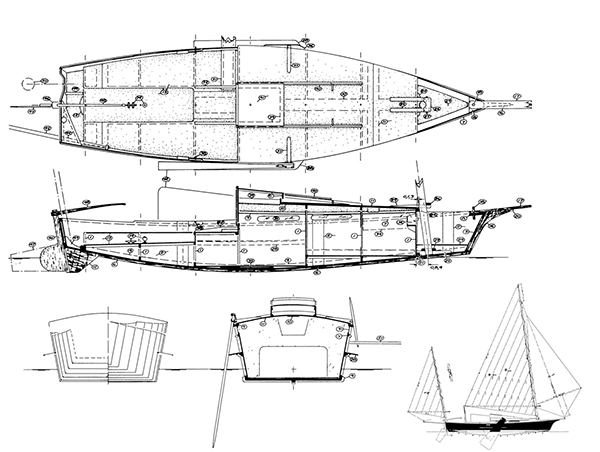
Flat-Bottom Infatuation: Rather than Cimino’s obsession—Philip c Bolger’s dashing Black Skimmer sharpie depicted here—a more pedestrian but vastly fitter-for-purpose build of Bolger design was commissioned. So, after the Mahurangi-oyster-barge-derived Tigger, the second vessel to be built in Cimino’s Huawai Bay boatshop was an example of the first of Bolger’s box sharpie mini-cruisers, Cynthia J. Of an almost flat-calm Mahurangi Heads, the high-peaked, 4.4 loh catboat Charlie Chan outsailed most who imagined she’d make easy pickings.
plans and profile Philip C Bolger | HH Payson & Company
Before forsaking the sea, and since his fourth-form high-school year, Cimino’s hobby—and sporadic vocation—had been boat design. In an undisciplined effort to learn about naval architecture, he’d read every book on small-boat design he could lay his hands on. Until, in the late 1970s, he became infatuated by Philip c Bolger’s rakish Black Skimmer sharpie design, an example of which suddenly appeared on a Scotts Landing mooring, across and up-harbour from Cimino and Sarah’s Mahurangi Westformerly …Heads West… Road aerie. In short order, Bolger’s then two bookswere to become, seven, detailing a fraction of his 670 or so different boat designs became Cimino’s bibles.
Cimino was in Bolger’s thrall, however, as much for aspects of the Massachusettsan’s ethos, as his skill in designing myriad craft at home in ankle-deepyes, a salute to the great Uffa Fox estuarine water. Cimino had been a passionate rower since gaining access to the kauri clinker dinghy that could be glided from its berth out through the garden gate at the rear of Lady Llewellyn Jones’ Waiwera Estuary property, of a full, evening tide. In his final year, foisted on a grammar school long past its rowing glory days, Cimino was lucky to land a seat in its coxed four where his dinghy experience didn’t automatically disqualify him—from experiencing the comprehensive physiological exhaustion peculiar to the sport. Having been gently admonshed to eat his greens first so’s not to invariably be left with a bilious chore while his savvy siblings embarked upon the desert his mother had lovingly prepared but was mandated to withhold by his father, Cimino was surprised and delighted by Bolger’s heretical recommendation. When setting out on an ambitious daylong row, Bolger began by rowing down-wind. His rationale was that by the return leg, the wind may have moderated—or better, reversed, but if not, body and mind would have become sufficiently atwould love to employ the verb Bolger uses in passage alluded to, should a Philip Bolger aficionado stumble upon this!tunedwould love to employ the verb Bolger uses in passage alluded to, should a Philip Bolger aficionado stumble upon this! to make comparatively light work of the homeward leg.
Having failed a second dismal time to make headway describing the Great Polycrisis, Cimino decided to take a leaf out of Small Boats and set the chapter aside. It was going to be exceeding brief, in any event, the light-the-fuse goal being to fire up imaginings of the Great Mobilisation. In the respite afforded, the opportunity to weave the millennial dimension into a powerful term for the polycrisis dawned. Name it for its millennium, thus: either Third-Millennium Polycrisis, or Great 3rd Millennium Polycrisis. Cimino invariably wrote far more confidently once an article—in this case, chapter —acquired a compelling title. As pleased as he was with himself with his term for the polycrisis-to-end-all-polycrises, Cimino was fully cognisant of the possibility that, by the end of the decade, English speakers and their dictionaries may well have disdained polycrisis , much less in any of its compoundssuch as Anthropopolycrisis or combinations—the Hundred Years’ War, after all, took half a millennium to be consistently named.
This was no Hundred Years’ War; this was a thousand. Failure of the news media—mainstream, alternative, or fakeactual fake news, not that labelled as such by smarting individual demagogues, in their appropriation of a democracy, be it putative or process-honouring—to remind audiences that anthropogenic atmospheric carbon dioxide, in significant part, persists for more than a thousand years must rank as the greatest single item of misinformation in the history of global heating. Joos et al, 2013:
Whether the failure is the result of climate-science ignorance, wilfully depraved indifference, or the woefully misplaced policy of prioritising the supposed imperative to not demoralise and disincentivise the populace, the netnet-zero! result is to invite anything from inaction or desultorily climate-virtue signalling, thus jeopardising any remaining prospect of salvaging a survivable climate. While it could be protested that even without anthropogenic global heating, modern civilisation has already precipitated a millennium-long polycrisis—say the Sixth Great Extinction, aside from any lesser crises—only global heating, unchecked, guarantees an ultimately uninhabitable biosphere.
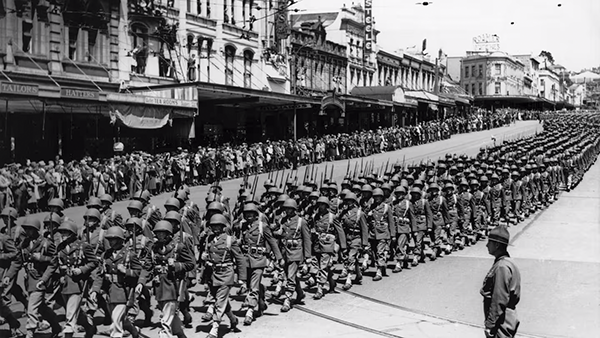
Hundreds Upon Billion: Sixty million—a little fewer than the known number of those currently serving or in reserve, worldwide—would represent the mother-of-all mobilisations to date. Given the existential stakes, one billion—an eighth of all humanity—would not be an unreasonable target for the number of active personnel enlisted to salvage a survivable climate. Pictured in-shot here parading on Queen Street, 1942, are about 300 American troops—about a 200 000thof the number of people currently in uniform globally. image New Zealand Herald archive
Although poly lacks the cracker-impact of hyper, mega, super, and some other prefixes to be sure, Cimino is nevertheless convinced of the need to incorporate the term polycrisis, which Lawrence et al., 2022 define generically as:
Currently, those saluting polycrisis, appear to be favouring either Polycrisis or Climate Polycrisis . Cimino leans toward the latter given climate’s multiplier effect on species extinctions and sea-level rise, to mention just two fiendishly entangled crises, but has always considered climate as intrinsically too comfortable. Maybe, to be consistent with Great Mobilisation, and to reinforce the relationship between the problem and its solution, great is as good it gets, and Great Polycrisis would do a greater amount of work than the alternatives.
Of the entangled crises, the hothouse climate, comprehensively, is the greatest crisis visited by civilisation upon itself, guaranteeing suffering on scale not previously recorded by history. Only in the paleorecord, is there an analogue that comes anywhere close. Cimino determinedly rejects the recent fashion for demonising the fossil-fuel industry that had nurtured civilisation in good faith for centuries. Granted it has foolishly, needlessly, recast itself as a villain, but so has much of the greenwash renewables fraternity, without the excuse of scientific ignorance. When Cimino first began concertedly studying the unfortunately termed enhanced greenhousenot only is “greenhouse effect” not a particularly close analogy of the phenomenon, “enhanced” to describe a dire impact is decidedly unhelpful and should have been replaced with “perturbed” long since. In hindsight, ”hothouse” and “enhanced hothouse effect” would have better communicated the harm effect, there was every indication that a century-old dictum could be extended to:
Truth is the first casualty of the war on carbon.
Demonising fossil fuel and its suppliers, Cimino considered, was dishonest, undignified, and all-too-foreseeably prove disastrously counterproductive. Building a low- greenhouse-gas-emissions world was always going to be an epically monumental undertaking, and one that was beyond-urgent, to boot.
Not only was it fair and honest, Cimino believed, to acknowledge that anthropogenic global heating was the mother of all unintended consequences, fossil fuel would be indispensable in building the zero-carbon infrastructure desperately needed. The undisciplined response, which is refusing to evolve into the surgically strategic mobilisation necessary, is a rerun of the sorry recycling saga that sees Aotearoa shipping its unsavoury waste to low-wage countries to sort—at least that which it doesn’t spend a fortune burying a fortune, in leachate-oozing landfills. The case for a searingly strategic Great Mobilisation is writ large in the current, end-to-end vanity projects, with no net reversal in global greenhouse emissions, much less their radical reduction.
Civilisation seems to be beset by pursuing historic struggles: Christian versus Muslim, Black versus White, East versus West, not least Left versus Right. These struggles—which in Aotearoa include indigenous versus colonist—are deemed by their protagonists as core struggles that have already waited too long for resolution. Somehow, however, and exceedingly quickly, humanity must accept that, given the urgency to act decisively, some cans will need to be, if not kicked, then dribbled down the road, while the survivability of the biosphere is secured, supposing that such is still possible. With 2325 hindsight, one, and only one struggle will be agreed to have been so urgent that it had to be the first mandatory policy-box ticked: salvaging a survivable climate. Even in the disappearingly unlikely eventuality that anthropogenic global heating does prove to be an easy nut to crack, 2025–2026 is no time to roll the dice on such a fortuitous outcome—akin to playing Russian roulettewith the distinct possibility that, at best, only one chamber remains empty…
Crises of the Anthropopolycrisis a to z
anthropogenic global heating Also known less confrontationally as global warming and climate change, anthropogenic global heating can fairly be described as the mother-of-all unintended consequences. It began in earnest with industrialisation and large-scale burning of coal. Coal and other ubiquitous fossil fuels—for example fuel oil, petrol, diesel, and natural gas—has facilitated the massive growth of human and domesticated animal populations and in material consumption, and travel. Despite climate science warning that significant regions of Planet Earth will become too hot to be habitable within several lifetimes, even low-grade coal is still mined and burned at scale. In a local, every-little-bit-hurts example, ‘100% Pure’ New Zealand, since 2016, has burnt about six million tonnescuriously, the y-axis scale of Dr Earl Bardsley’s chart is marked in “tons” of Indonesian coal, diesel-trucked the last 90-odd km from the Port of Auckland to the imminently navigable-by-rivertwo founding members of Mahurangi Action campaigned vigorously for canals connecting the Makaurau isthmus harbours and the Waikato river Huntly Power Station…
Disclosure The author of this novel modello is no longer the secretary of Mahurangi Action Incorporated or the Mahurangi Coastal Path Trust. The content published here, however,is that of the editorially independent, independently funded Mahurangi Magazine.