Contents author Cimino work-in-progress published 20250612 subedited 20260103
Dear Sir or Madam,
will you read my book?
It took me years to write,
will you take a look?
John Lennon
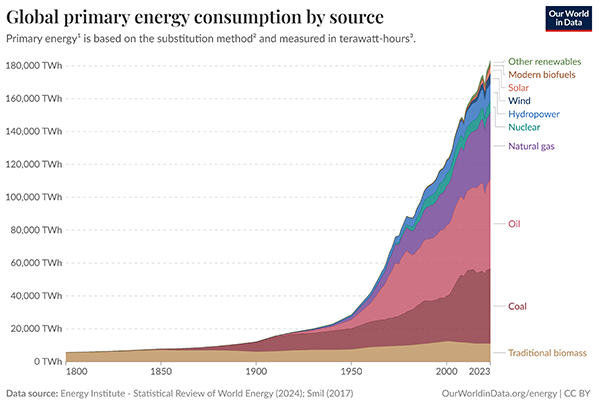
Biomass and Coal Plateau. Oil and Gas Climb Ever Higher: Despite 40 years of climate conferences and relentless renewables hype, 77% of primary energy in 2023 was from fossil fuels. Solar that year contributed 2.3, having enjoyed a nearly 130% increase since 2019. In that time, however, solar only added 2404 terawatt-hours, whereas fossil-fuel added 3931. covid-19, meantime, demonstrated what it takes to put a Great Mobilisation-sized crimp in fossil-fuel use—oil shocks and economic crashes barely checked energy demand, never mind the effortless net-zero hubris.
chart Our World in Data
Tammadge Lodge. Cimino’s mother detested it. Not the spacious Californian-bungalowed, carriage-swept, park-like property located on the eastern picturesque Kūiti valley shoulder of the town’s, narrowed downstream end. No, Noeline Adelaide Cole née Cimino positively, radiantly imbued its gables. After a succession of crabbed, neglected rentals—the lastsouth end of Carrol Street a few steps awy from the pumice-dirt stock route that now forms part of State Highway 3 by-passing Kūiti’s main street in particular—she was deeply grateful to reside in such a fittingly gracious residence where family and friends could visit, stay overnight and enjoy genteel lodgings and hospitality. No, what irritated ‘Noel’ was her husband’s octave-lower telephone voice and airs:
Tammadge Lodge ; Mac Cole speaking.
Had the richly detailed Arts and Crafts bungalow been namedTammadge Lodge by its original town-Henry Thorne Morton: town mayor 1938–1946; National Party representative for Waitematā 1943–1946fatherHenry Thorne Morton: town mayor 1938–1946; National Party representative for Waitematā 1943–1946 owner, Noel might possibly have supressed her staunchly egalitarian sympathies and accepted use of the appellation. When employing it, Mac was wise to ensure his study doors were closed, lest Noel’s instant upbraiding be overhead by the caller. Mac was the youngest of his family of six, as was his son Cimino, of fourfour children, that is, although Cimino was aged four when the family moved into 12 Tammadge Street. Unsurprisingly, each had been doted on by their respective, golden-hearted mothers. Such boys can possibly be forgiven somewhat for a tendency towards narcissism.
Grand schemes and grand narratives were Cimino’s every waking moment. Hand written, illustrated, and bound, his first book, at the age of eight or nine, was a we-didn’t-mean-to-go-sea epic. Although the urge to write such odysseys—and serial manifestos—hadn’t diminished, Cimino had long since overcome the conceit that the world needed his first, or first-and-only, novel. Had his childhood best friend lived a full life, no novel would have been attempted. Deeply undeserved, Skerman’s tragic death had demanded a response. Light the Fuse is partly tribute to their respective, charismatic hearts-of-gold mothers, partly a duty to field a concept that could be key to civilisation salvaginga survivable climate, no less.
Machiavellian , might be one word for Cimino’s plan but that would probably be praising it. Megalomaniacal, certainly, but circuitous , and very possibly too circuitous for its own good, is probably the pertinent adjective here, in describing the convoluted, immediate mission of this work of near-term-future fiction. Readers are reminded that the mission of writing Light the Fuse is not for it to not to be published, much less be read by more than a few hardy or quirky souls. Writing it is one man’s moonshot-attempt to intrigue an award-winning author sufficiently, that her publisher, in turn, becomes similarly curious, to convince she—or maybe some blocked bard yet just possibly capable of redemonstrating once-exceptional powers—to accept the commission. The sweet fruits become the best seller, provoking the movie, the sequels, prequels, miniseries, and more.
Blockbuster literature and cinematography is not an end in itself, of course, the world already has more than enough entertainment. Rather, the entire purpose of the fuse-lighter envisaged is to determinedly help build a mandate for the Churchillian leadership so patently needed. These antipodean Aotearoa islands have the cachet to democratically initiate an equitable proto-Great Mobilisation. From there, regional, Australasian–Southwest Pacific-Great Mobilisation. Ultimately: light the fuse of the beyond-urgent, global, Great Mobilisation!
So yes, dear sir or madam, please read my book, but only if you promise to remember that it not intended as the great New Zealand Great Mobilisation novel, but as a desperate prayer to an award-winning author that such book, movie, et cetera , et cetera , might materialise to help precipitate the Great Mobilisation.
Disclosure The author of this novel modello is no longer the secretary of Mahurangi Action Incorporated or the Mahurangi Coastal Path Trust. The content published here, however,is that of the editorially independent, independently funded Mahurangi Magazine.