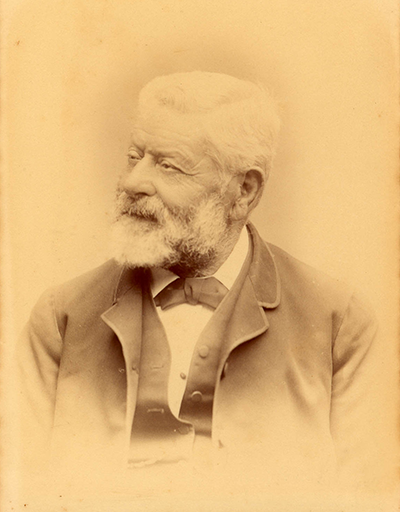
By His Real Name: Whether the use of Salvatore Cimino as a Mafioso pseudonym is widespread in Sicily, or not, is unknown to me. Its inclusion in evidence given against the Sicilian Mafia, as reported by The Guardian, is altogether too tantalising to not gratuitously include here, in these notes concerning the possibly all-too-confusing fictional /nonfictional uses of the name Cimino, in and around this story. Pictured is the author’s great-great-grandfather, Wellington’s first Italian resident.
image Te Papa
Museum of New Zealand Te Papa Tongarewa
Contents author Cimino work-in-progress published 20240717 updated 20251130, 20260102
Once, while for reasons of security I was hiding in the flat opposite mine, I saw Salvatore Cimino [not his real name]bracketed note as published by The Guardian and three others coming up the stairs, Cimino was carrying a grey Magnum .357…
Davide De Marchi
Salvatore, was the given name of my mother’s father, grandfather, and great-grandfather. Ouraside from uncountable cousins, myself and, by ascending age: Jane, Catherine, and Michael great-great-grandfather, however—Salvatore Michele Saverio Cimino, born Capri 1808—wasn’t the son-of-a-Salvatore, rather he was the third son of a naval captain, Michele Cimino, and his wife, Anna Soldano.
In my first attempt to commence this proto near-future novel, I used Salvatore, rather than Cimino, to refer to myself in both the autobiographical chapters and those deploying other forms, such as the future-if indeed future-counterfactual is, or could be, a valid term!counterfactualif indeed future-counterfactual is, or could be, a valid term!. However, I was also using pseudonyms for the other characters, which, in this iteration, I am endeavouring to avoid. As I began this second attempt, I thought it entirely probable I would revert to using Salvatore. Meantime, given the maniacal urgency of this unabashedly megalomaniacal endeavour, when picking up the project again in 2025, I persevered with Cimino and the narrative mode, trusting that the way forward would reveal itself. It did, but not until the tail endtoxic arse-end, if I’m honest of November 2024, as enormity of the necessity of my Sarah and I hastily escaping to southern climes and assuming new identities, that our new reality finally sank in.
Uninvited predations by two fellow humans—one with familial connections and the other, geographical—necessitated our relocation to “somewhere in the South Island”. Sarah, a Mainlandera native of the larger, less populous of New Zealand’s two largest islands, had given me her best 50 years in my Mahurangi mudpuddle; now it was her turn. Of the many upsides of the seismic upheaval, I belatedly realised, was that I had long since been handed a more-than-adequate excuse to persevere with the third-person Cimino. Given my distinctly ordinary-mansaluting Peter Hames and Christy Moore-sized ego, I had adopted a third-person perspective for the better part of my two decades of Mahurangi Magazine writing. Besides, from a typographic perspective I cringe to see a page of mine rivered with I, I, I, I, I, I, I s—that and my congenital self-consciousness. Whether Salvatore or Cimino, changing from third-person would slow my already snail’s-pace output, and I would literally—and possibly literarily—be going backwards.
So, short of an ego upgrade, third-person Cimino is expedient—this, after all, is not the great New Zealand novel. Referring to oneself in the third person is, of course, generally frowned upon, but is often harmless and can be helpful and even endearing. It was a darling habit of my erstwhile neighbour J Barry Ferguson, from who I enjoyed acquiring a little refinement, and how to stringently reserve the ultimate taboo adjective for when it will guarantee to cause a banquet hall to erupt in laughter. Meanwhile, what it says about me, that illeism comes so easily as to put me, in that regard, in the deeply dubious company of Donald the Great… To be continued…
Disclosure The author of this novel modello is no longer the secretary of Mahurangi Action Incorporated or the Mahurangi Coastal Path Trust. The content published here, however,is that of the editorially independent, independently funded Mahurangi Magazine.