Contents author Cimino originally published 20150111 as a Mahurangi Magazine article further subedited, republished 20260811 footnoted 20260815
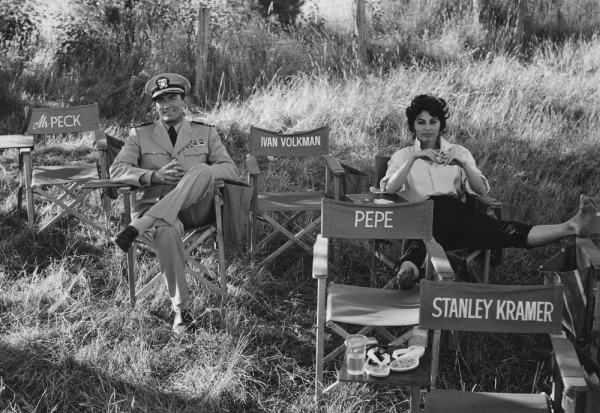
Falling Well-Short of Shute: The Lawrence Johnston feature-length documentary Fallout , on Nevil Shute and the Hollywood adaptation of his epic On the Beach , with its predictably anti-nuclear-everything message misses the point that, was the great novelist writing today, it would be of runaway-global-heating, rather than nuclear , apocalypse. The tragically ironic legacy of Shute’s substantial contribution to mobilising a generation against nuclear weapons, is that humanity’s survival is now dependant the nuclear power his magnum opus collaterally spiked.
image United Artists
Story-telling goes back at least as far as the 200 000-year-old species itself. Yet humanity’s biggest story ever, how Homo sapiens sapiensas opposed to Homo sapiens, to acknowledge Homo sapiens idàltu, and to avoid the more cumbersome alternative of ‘anatomically modern human being’, and for sheer cussedness discovered and exploited the power of fossil fuels, inadvertently placing itself on the one guaranteed path to extinction, is neither a major news story nor the pervading subject of popular storytelling.
Unsurprisingly, the subject of the world’s oldest surviving story, at 4100 years, is of kingly adventures, and that story, the Epic of Gilgamesh , continues to be recycled today. Now urgently existential, the question is whether stories of kings and other things can be muscled aside by stories of how humanity could yet swerve from its dogged, decidedly suicidal determination to overheat the atmosphere and to cook and acidify the oceans. Without heroic such stories, whether in literature, film and television, or in the mainstream media, it will remain all-but impossible for political parties to fashion mandates from which to radically proscribe and replace the use of fossil fuels.
On so many levels, the furore over the 2013 Man Booker prize-winner’s condemnation of New Zealand’s neoliberal leaders, and the attendant backlash, demonstrates the extent of the wilderness in which any serious discourse on climate mobilisation languishes. Similarly, the pro-small-business theme of opposition leader Andrew Little:
The Labour I lead is about jobs. Good jobs. Skilled jobs. Well-paid jobs. Ten years ago New Zealand had the lowest unemployment rate in the developed world. Today we’ve slipped to ninth.
Meanwhile, Dr Russel Norman’s more-time-with-the-family resignationwas replaced by James Shaw as party co-leader on 30 May 2015, prior to Norman becoming executive director of anti-nuclear-power Greenpeace Aotearoa New Zealand as Green Party co-leader, didn’t go within a mile of anthropogenic global heating, unless his excitement about big business—anywhere other than in Aotearoa—embracing sustainability, can somehow be counted as substantive climate action.
Jobs and more jobs, meantime, all heavily dependent upon fossil-fuel exploitation, is what has put humanity on its collision course with a survivable climate. The only recent appreciable dip in greenhouse gas emissions was a direct result of the global economic downturn. Andrew Little’s cautiously crafted bid for the hearts and minds of middle Aotearoa, his Future of Work Commission, misses the bleedin’ obvious. There is an enormous amount of work that must be commissioned immediately, if emissions are to be slashed sufficiently quickly to avoid a scenario in which the future of work is academic. Little talks of five streams, the fifth being “economic development and sustainability”, when the Great Mobilisation, for the foreseeable future, that is, for this and the next several centuries, must be the prime priority. Without that objective, Little’s initiative is on the wrong side of history, and ultimately will fall well short of what is required to make the Labour relevant to the young people who must be heavily recruited, if party politics is to be anything but a race to the bottom.
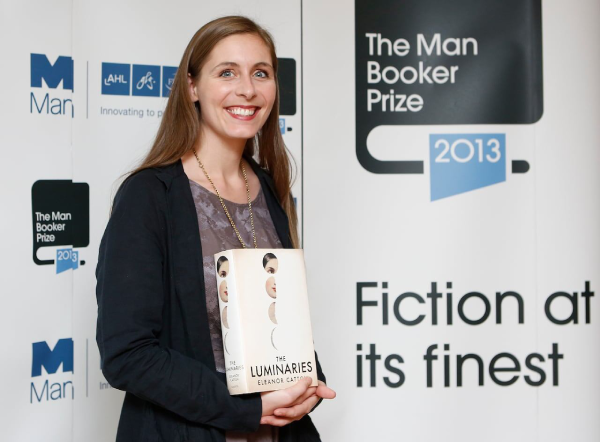
Best hyphenation here demanded by adjectival use of phrase, given that when Catton won her prize, Man was formally still part of what is now the Booker PrizeMan-Booker for the Job: One man’s traitor and ungrateful huais another man’s freedom-writer and mark for writing the actual Light the Fuse, for caring sufficiently about Aotearoa to be ashamed of representting the country’s unrepentant neoliberal dogmatists—Man Booker-prize-winning novelist Eleanor Catton.
image Reuters
Failure of the phenomenon of anthropogenic global heating to grasp the public imagination has been much studied and dissected. Recently it has become fashionable to blame the messengers for all manner of miscalculations and transgressions including the use of the occasional long word, particularly of the use of anthropogenic . The preferable term, many urge, is human-made. The plain English word was once manmade, which everyone understood to mean made by human endeavour, rather than by the non-human natural world. Sadly, the gender-neutral police have stomped on man accidently presciently, this written four years before the Man Booker Prize became the Booker Prize. Man pertained to Man Group, founded by James Man in 1783. Crankstart has sponsored the Booker Prize since 2019, despite the word originally meaning human, rather than male adult of the species. Given that the current geological epoch is increasingly being referred to as the Anthropocene, shying away from anthropogenic is misguided and counterproductive. Besides, the fact that the one-syllable/three-letters-longer centrepiece of neoliberal jargon, entrepreneurial , is a long word is seldom-if-ever cited as the reason the whole bankrupt, free-market edifice—nor late capitalism generally—has failed civilisation.
Reasons the unfolding drama of global warming is failing to motivate the world’s most influential mainstream, media and movie storytellers are many and varied, and often nefarious. Signal reason, however, must be that instinctively, the notion that a colourless, odourless substance, at a concentration of a mere 0.04% in the atmosphere could render the world’s climate unliveable for much of humanity is preposterous. Possibility that an asteroid could smote the planet within current lifetimes is far easier to take seriously, despite the odds being infinitesimal—the odds of the nearest large ‘near-Earth asteroid’, 1950 DA, impacting, in about 11 lifetimes time, is about 1 in 4000. But, in its appeal to hearts and minds, the almost non-existent chances of a killer asteroid strike, versus the equally slim chance that the global warming locked in by the carbon dioxide already accumulated in the atmosphere won’t be catastrophic, asteroids put bums on seats, carbon dioxide don’t, at least not yet.
In The Luminaries , Eleanor Catton conspicuously employs astrology as the scaffold on which to organise her 848-page novel. If astrology, which is taken seriously by only about one in four, can be used as a device to win the world’s most coveted fiction award, then anthropogenic global heating, which is accepted by, for example, 84% of Britons polled in 2014, must be able to be at least as effectively deployed. Possibly all that is required is for the writer to be even younger, and at least as photogenic and eloquent, as Catton. For a litany of reasons, global heating is the perfect problem, in addition to its aforementioned intuitive preposterosity. Foremost perhaps is that, at least in the developed and developing world, virtually all are complicit in fossil-fuel use. This, presumably is why activists can drive to a beach in droves to protest the possibility of an oil spill resulting from exploratory drilling, but why there are not weekly marches down Queen Street demanding the immediate cessation of all non-essential fossil fuel use.
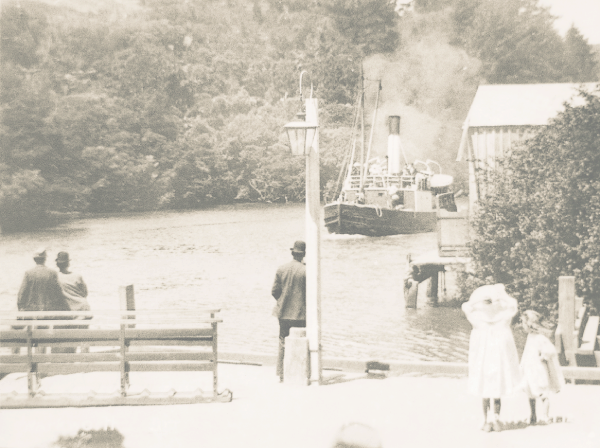
Solitary Lamp of Warkworth: When Sir Edward Greyapparently no relation to ‘New Zealand’s’ Sir George Grey foresaw the metaphoricallamps going out all over Europe, Warkworth then only had the one, which was on the wharf. Here the steamboat Ōrewa arrives after her four-hour run from Auckland.
image Changing Times
It is a publisher’s prerogative to provide the headline of an article, and the venerable Guardian generally does a better job of it than most of its columnists could. However, last week’s The Lamps Are Coming On All Over Europe, self-titled by George Monbiot, was not improved upon by the subeditortraditionally, for practical reasons, the typesetter, and post digital, the subeditor, got first crack at setting the headline or editor responsible whereby it became Follow Your Convictions – This Could Be the End of the Politics of Fear. Aside from the fact that few Monbiot Guardian headlines resemble those George has given his pieces when first published on his own website, the phrase ‘lamps are coming on’, as the inverse of Sir Edward Grey’s prescient “the lamps are going out all over Europe” was going to struggle to run The Guardian ’s subeditorial gauntlet. But while it is to be hoped that Monbiot is correct that voters all over Europe are waking up to the reality that neoliberalism is a self-serving dogma masquerading as pragmatism, there is a stronger parallel to Grey’s observation, made on the eve of the First World War. The lamps are going out all over the world, as unabated greenhouse-gas emissions and unchecked population growth forces an uncomfortable end to civilisation’s two centuries of fossil-fueled prosperity.
Lamps, as a metaphor, worked powerfully in a world in which street lighting was still very much a work in progress. In Warkworth, for example, William Thompson Rauparaha Cook, who became owner-editor the Rodney and Ōtamatea Times in 1917, campaigned for street lighting in the pages of his publication—the town then only having the one gas lamp, on the wharf where steamboats such as the Kapanui provided the only year-round service to the outside world, in the decades before all-weather roads. The equivalent technology today is arguably the internet, but it is unlikely to be the first casualty of global warming, and so the spectre of smartphones failing to find service lacks the piquancy it might otherwise pack. This underlines the perfection of the global warming problem. Global warming’s spluttering lamps are droughts and forest fires, rising sea level, ruinous storms, and starvation, but these, humans by their hardwiring are encouraged to think, will happen to somebody else. The exception, of course, are those unfortunates who are poor, live at sea level, or in a population already subject to food insecurity.
It is the urgent responsibility of the novelist to tell convincing stories about this perfect problem. The scope is infinite, from science fiction all the way back to counterfactuals constructed from, for example, the sweltering summer of 1988 when Dr James Hansen first warned Congress, and the civilised and kindly world that could by now be being enjoyed. Monbiot’s marvellously rich writing, not least of all his non-fiction work on rewilding, Feral: Rewilding the Land, the Sea, and Human Life , a print edition of which has just been published by the University of Chicago Press, might yet shame some New Zealand novelist into writing a Man Booker prize-winning epic—one whose subsequent movie could have ecotourists cycling and walking Aotearoa, and participating in forging its low-carbon future, in their millions. If Tolkien tourism can account for 6% of New Zealand’s 2.7 million visitors per year, then a vibrant indigenous film industry telling the story of one country’s bid to save its uniquely vulnerable landscape—part pristine and part already savagely modified, in the world’s youngest significant habitable, most recently peopled, and most recently colonised, landmass—could be much, much bigger.
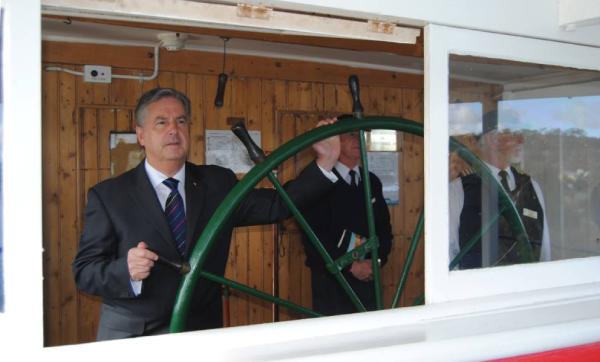
Rear Admiral to Helm Royal Commission: Ex-Governor of South Australia, Chancellor of the University of Adelaide, Rear Admiral Kevin Scarce, will head the royal commission into the state’s potential in the nuclear industry. With South Australia sitting on much of Australia’s 31% of the world’s terrestrial uranium reserves, humanity’s chances of averting climate catastrophe heavily depend on the outcome of the Scarce-led commission. Rear Admiral Scarce helming
the Murray River paddle steamer Marion . image Murray Valley Standard
Geographic isolation inherent to its appeal to tourists, poorly positions Aotearoa as a low-carbon tourism destination. But given that half of all its tourists are Australians, a pair of high-speed nuclear-powered trans-Tasman ferries, operating between Whangārei and Sydney, could slash the emissions of the average overseas tourist. This is not to deny that there is also a niche for wind, as opposed to nuclear powered shipping, but only the well-off are likely to be able to afford its charms—being time-wealthy would also undoubtedly help. Once shipping is required to go forgo its egregious use of bunker oil for propulsion—a fuel that is so hideously polluting that it is only used at sea—nuclear is the only practicable alternative. A plus is that while nuclear ships are in port, their surplus power production will go into the grid, thus reducing the emissions footprint of the country in question, and more than power the public transport needs of each influx of visitors.
As of Sunday, Sydney’s 119-year-old coal powered urban rail system, mostly via electricity by the 1930s, is now on course to be nuclear powered. At least that is the probable outcome of a long-awaited breach in the anti-nuclear-power position maintained by Australia’s major political parties. Unexpectedly, Labor state premier Jay Weatherill announced a wide-ranging royal commission that signals South Australia is likely to lead the way for the continent to emerge from its deeply contradictory position of selling uranium to the world while professing to be anti-nuclear. Given that the future of humanity itself depends on the rapid de-carbonisation of everything from agriculture to cement and steel manufacture, win or lose, Weatherill couldas originally published, a tad too inflexibly: will go down in history a hero. That notwithstanding, South Australian Greens, and the Australian Youth Climate Coalition, have instantly condemned the inquiry, thus proving that anti-nuclear dogma trumps any quest for energy objectivity.
Imagination, is the particular expertise the novelist brings to the challenge of communicating enormity of global heating. If it was easy to imagine, then challenge of global warming wouldn’t be the almost impossible-to-resolve problem it is. The majority clearly need the assistance of those who are highly skilled in their use of imagination, to visualise some of the many scenarios that could play out. Ironically, one scenario that has achieved early success, pictures photovoltaic panels magicking away the need for fossil fuels, with the solar-evangelists defiantly and successfully seeing off nuclear power in the process. But there are two problems with this pervasive imagining. Firstly, while intrinsically attractive and highly saleable to a section of the community, the scenario doesn’t end well. Not only does it fall well short of the greenhouse-gas-emissions reduction needed, impoverished Germans, for example, are being submerged ever-deeper in energy poverty. If, after a century of cheap and dirty fossil-fuel powered electricity generation, a million living are still living without any, the prospects for the growing percentage of poor, of a near-doubling population, are forlorn in the extreme. Secondly, a less sanguine proportion of the population remain entirely unconvinced that the sorts of measures typically discussed, such as nudging the free market towards a low-carbon future, are remotely capable of bringing about the stupendous task of rebuilding the world’s energy and transport infrastructure, almost from scratch, and the following predicand a known lacuna when piece first published, 2015 whilst generating the smallest-practicable volume of greenhouse-gas emissions in doing so. To be convincing to most readers, the plot will need to contain measures of truly heroic proportions.
Because global warming is underway with a vengeance, as the dramatic loss of Arctic sea ice attests, and will rewrite the history of humanity in the coming decades, it will become the prevailing theme of literature and cinematography. Rebecca Priestley, in her thesis Mad on Radium: New Zealand in the Atomic Age , talks of the enormous influence of one novel, written six decades years ago:
The possibility of nuclear war was now becoming part of popular culture, and books like Neville Shute’s 1957 novel On the Beach , and subsequent film of it in 1959, had a powerful effect on the public imagination.
Tragically, the award-winning film adaptation, starring Gregory Peck, Ava Gardner, Fred Astaire, and Anthony Perkins, so enraged the author, it is claimed, it killed him. Yet to be known, is whether any novelist can now match Nevil Shute Norway in impact, and mobilise mankind sufficiently energetically to limit the degree of destruction it, and the natural world, sustains from that which is far more dangerous than nuclear warfare: anthropogenic global heating . To be further footnoted…
Lucky, Greedy, or Both: Countries reporting to be happiest are those with the most equitable economies. But rather than an all-boats-lifting rising tide of equitability between nations, particularly neighbouring nations, a race to the top, epitomised by the strong instinct towards nationalism, is jingoistically paraded by the ilk of America’s maga , Australia’s One Nation, and New Zealand’s nz First. Meantime, few lamps, much less fuses, are being lit for the all-for-one-and-one-for-all Great Mobilisation that long since is beyond-urgent. Graphically mapped here, the infamous inequity between the obdurately exceptionalist usa and bordering Mexico is worth a thousand words, unless they are the 220 with which John Hiatt sculpted Across the Borderline ’s haunting lyrics that débute on Ry Cooder’s Get Rhythm album, 1987.
map World Population Review | data 2022
Race to the middle Since 1992, “It’s the economy, stupid”—or in its original, even more sparce phrasing, “The economy, stupid”—has proved spectacularly successful in impoverishing liberal politics. By precipitating a pocketbook-issues race to the middle, the race to the populist bottom has been comprehensive—indeed, a veritable stampede. As recently as 28 July 2026, in The Essential Report , Australian importance-of-issues questions were utterly dominated by “Inflation and cost of living” with 48% of respondents ranking it of top importance. Second-placed ‘medicare and health services’ was ranked first by 11%, and ‘climate change and the energy transition’ fifth, by 7%. In comparison with, topically, Palestinians, Australians are about the luckiest humans on the planet. Those at the mercy of genocidal regimes or interventionist rogue states could be excused for not rating climate and energy their prime concern. But, in a population enjoying the average-adult-net-worth of Australians, that only 7% rate climate and energy as their leading concern, underlines the magnitude of the mission: to convince folk worldwide, rich and poor, living in peace or in the torment of war—much less the unspeakable atrocities of genocide—of the beyond-urgent need for global mobilisation. Hence the premise of Light the Fuse: a moonshot that might of the myriad routes that might lead to an at-scale attempt to salvage a survivable climate, there may or may not be a better premise than that of Light the Fuse, which stresses the need for a compelling story told by compelling storytellers just succeed in convincing even inveterate warmongers to cease fire, without uncontemplatable loss of face. Be that as it may, humanity, for all its mutual ev glad-handing, has barely tapped the brakes. Civilisation has left itself no option but to stand hard on the brake pedal, trust in the abs and bring the growth-for-growth’s-sake experiment to a shuddering halt, praying it is in time to salvage a survivable climate for itself and its fellow, mutuallymany will argue that the biosphere stands a better change was humanity to perish, and sooner the better. This writer imagines that humanity, behaving rationally and radically, probably provides the better prospect for minimising mass multispecies extinctionsdependentmany will argue that the biosphere stands a better change was humanity to perish, and sooner the better. This writer imagines that humanity, behaving rationally and radically, probably provides the better prospect for minimising mass multispecies extinctions species. Between now and then—to continue the brake-system metaphor—the world’s smartest abs engineers must be conscripted at Manhattan Project-scale to devise every practicable, minimal-fossil-fuel means of slashing fossil-fuel use whilst simultaneously safeguarding at-risk… To be continued… Return to text
Disclosure The author of this novel modello is no longer the secretary of Mahurangi Action Incorporated or the Mahurangi Coastal Path Trust. The content published here, however,is that of the editorially independent, independently funded Mahurangi Magazine.