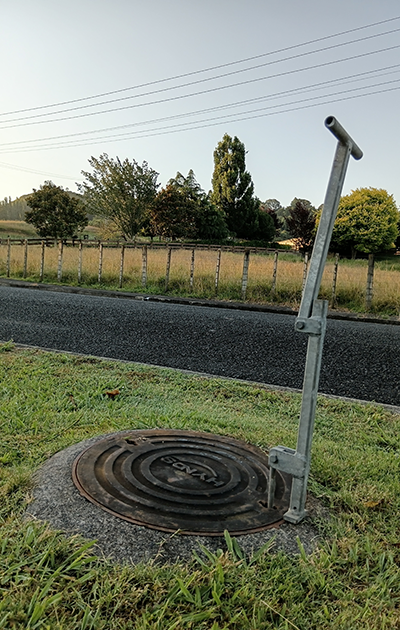
Cast-Iron Guarantee with Heavy Lifter: Typically sold without so muchmuch less a reference to either Cimino or Archimedes as a simple instruction diagram, this tool may or may not be unthinkingly inflicting half as much costly havoc as its impossible-to-use undamagingly , five-foot-tall predecessor. Pivotalsorry!, positioned correctly , is that the fulcrumthis spot-the-fulcrum would make a great engineering trick-question bears solely on the cast-iron cover surround rather than the weak, unreinforced-concrete collar.
image Mahurangi Magazine
This tool is designed for the foot of the lifter to be placed on the frame of the manholecolloquial for the access hole into a manhole, rather than the concrete surround. Used as designed, this significantly reduces the risk of damage to the surround by placing pressure only on the metal rim of the manhole [cover frame].
Cimino Cole | Trig Instruments
First component suggested itself on the eve of the 50th anniversary of the Auckland Regional Parks. Cimino had convinced his fellow Friends of Regional Parks committee members that it was an auspicious time to propose a 50-year plan for the 41 000-hectare regional parks network. Cimino, however, failed to convince his colleagues that their organisation should advocate for the establishment of a perpetual fund to acquire additional regional parkland, over that next semicentury and beyond.
Cimino had conceptualised a regional-parkland-acquisition fund, powered by a veritable regional-park-users union recruited from the parks’ six million visitors per year. The members’ very modest annual subscriptions—in their entirety—would leverage co-funding from charitable funders, public-spirited corporates, and regional and central government. That the concept implied the need for a formidable fund-raising tool—a comprehensive campaign-management platform—was a given.
Next iteration of the concept came courtesy of the key Mahurangi Coastal Path infrastructure: the Judge Arnold Turner Footbridge that Auckland Council was never going to fund by itself. From his years living in Hong Kong, a fellow coastal-path trustee was considerably impressed by the Community Chest operating in that metropolis, with its famous disparity of wealth. He was particularly taken with its ethos of passing donations to the individual charities without a cent being skimmed off for admin—that cost being picked up by the well-heeledcouldn’t resist an oblique reference to spurs, albeit those adorning the heels of fighting cocks Hong Kong Jockey Club. Mahurangi Coastal Path Trust had been honoured by receiving the advice of Adam Gard’ner and Duane Major, who made the Buy this Beach campaign look easy. Their heroic, round-the-clock work away from the cameras, belied the effortless face they presented to the public—a master class they very humbly shared with the coastal path trustees, one opportune afternoon in Auckland. While, in raising the more than $2 million required to buy Awaroa Beach while most of Aotearoa was on its summer holiday, Gard’ner and Major had been spectacularly successful, they emphasised that they had had the support of a very strong community, and that, if they’d had their druthers, they would have done a great deal more planning and preparation.
Waiwera Going Begging: Pioneering a Moonbeams Moonshot platform by which, for example, the Waiwera Hot Pools could again charm current and future generations should not be beyond the wit of New Zealanders.
photographer Frederick George Radcliffe
A Buy Waiwera iteration was floated relying on a build-as-you-go platform, thus prototyping Moonbeams Moonshot 3.0, if you will. Fully scoped, the tool would manage a campaign from its inception, including drawing up a shortlist candidate campaigns, and their “faces”. From that democratically selected shortlist, the next Moonbeams Moonshot campaign would be voted for and be painstakingly prepared for the launching pad. Suffice to say that Cimino’s blessed concept ultimately exhausted his colleagues’ enthusiasm for Think Big Mahurangi style.
BlessedWiktionary: blessed 6.) (informal, euphemistic) damned (as an intensifier or vehement denial) or inspired, the Moonbeams Moonshot machine could be the people’s best tool with which to wrest power from the determinedly undemocratic. Deployed and improved and deployed improved until the beyond-urgent Great Mobilisation sees daylight—sees Homo sapiens sapiensas opposed to Homo sapiens, to acknowledge Homo sapiens idàltu, and to avoid the more cumbersome alternative of ‘anatomically modern human being’, and for sheer cussedness and their fellow species enjoying, at the very least, a valiant fighting chance.
Spot Where the Highfield Action Should Be: Cimino always believed, particularly when one took the liberty of standing on the shoulders of Archimedes, that intellectual property laws were an unconscionable rort. Image is placeholder while Cimino draws the elegantly simple, immensely powerful-where-it-most-needs-to-be Highfield action that action that superseded the short-lived compound-lever seriously-stuck-manhole-cover-unsticker-and-lifter concept.
image Mahurangi Magazine
Highfield-lever manhole-cover lifter Cimino missed a trick when the engineering workshop, unrequested, added the folding component to his manhole-cover-lifter design. Cimino’s three-decade-old model, with its mechanical advantage of ± 15:1first draft put it at 17.333 but that was arrived at entirely erroneously. New figure is taken from full-scale drawing indicating initial lift exerted by handle movement through 100 millimetres, used correctly, must have saved a mint in damages to covers, frames and, especially , the frames’ concrete collars. Basking in a little self-congratulation, Cimino sobers as he spots the trick he and the jobbing engineer missed as they were developing the design. Said engineer had insisted on producing a folding option, which Cimino saw as unneeded, heavy, and fiddly to use—the non-folding version easily dropped into the boot of his small car.
Reflecting now on the un-folding action, and a Wikipedia mention of compound levers, sparked the realisation that if the last say 200 millimetres as the handle straightens deploys such compound leverage, the result would massively increase the initial lifting force. While manhole-cover lifter broadly describes versions 1.0 and 1.1, it fails to mention the tool’s forte: its power to unstick rust-frozen cast-iron covers from their cast-iron frames. All too often, the first course of action is to reach for the 20-pound sledgehammer. Wielded out of impatience, machismo, or depraved motivation to add to the cache of cast iron “scrap” augmenting the drainage gang’s booze kitty, the outcome is seldom pretty.
When attempting to draw the compound-lever action, Cimino realises that, as slack-jaw enraptured as he was with his own ingenuity, the resultant tool risked being too expensive to manufacture to have any prospect of displacing the only marketed—the folding version he so despised—of his 1.0 design. Pondering at his digital drawing board, he elects to shelve a folding version and employ a Highfield lever attribute—the one not stressed in online references to the ingenious electrical engineer and 1930s rear-commodore of the Royal Thames Yacht Club, j s Highfield—but the gargantuan leverage placed on a gaff rig’s running backstays as the lever is pressed through its last few degrees on its way to over-centre, against the scarred teak deck. Employing the Highfield-lever effect, it appears that the initial lift exerted on a “frozen” manhole cover might be ± 40:1 and the tool easy to wield into the bargain. Manufacturing the Highfield-lever manhole-cover lifter at a less-than eye-watering-to-the-accountant cost, would be challenging—barring the exceeding unlikely happenstance whereby the accountant had witnessed the wilful economic waste firsthand during a holiday job in a drainage gang, for the want of a better tool.
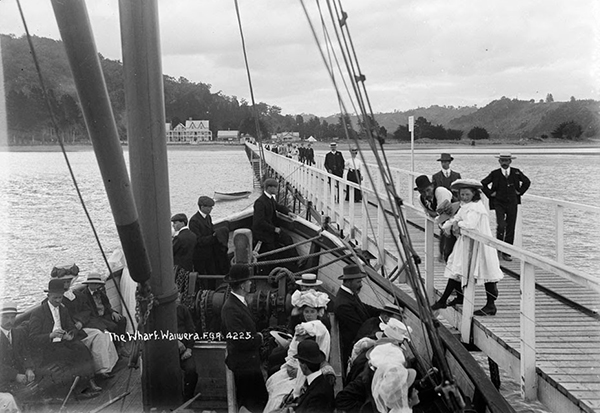
Buy Waiwera 2025 Despite the news that its new owners plan exactly that which was feared by its local and Auckland-region devotees, Waiwera may yet survive its currently assigned future: host to yet another shrineshrine/temple, the alliterative and rough-rag alternatives are finely balanced to entitlement and social stratification. Granted, New Zealand’s first tourist spa, which Robert Graham established there in 1848—whether visited by coach or by steamer—was affordable only by the wealthy of the day, in contrast to its pre-colonialnot that pre-Pākehā society was the picture of egalitarianism use. Waiwera’s wonderfully egalitarian era was the late 1950swhen the first two 20th century pools were opened through to the waterslide era of the early 1970s, when families could arrive per cheap public transport or by community or church-organised busloads. Towards the end of the golden era, admission for adults was 40 cents—less than $10 in today’s2025 money—but children only 15 centsor $3.60 in 2025, with a family required to pay for no more than their first four. Admittedly, Waiwera would have been considerably more egalitarian had the pools been publicly owned, given the pools’ operating costs were barely more than a third of the gate take. Be that as it may, from a clientele a quarter of the heyday of the old Waiwera Mineral Pools, and the new owners expecting to “generate” average of nearly $1000 per head, not a whole lot of “affordable wellness” will be available to median families and young people, there, much less those struggling.
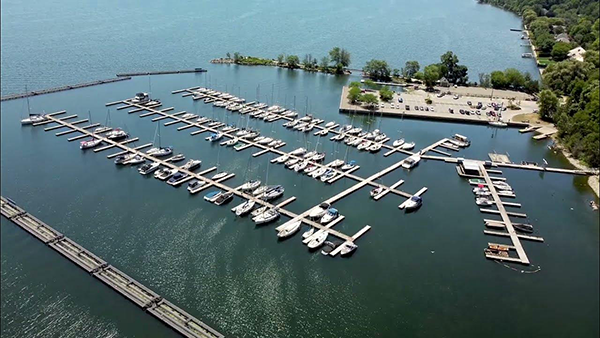
Buoyant But Gratuitously Geometric: New buoyant breakwater protecting volunteer-run, not-for-profit LaSalle Park Marina, Burlington Bay, Ontario might have been a thing of beauty were they fashioned from constant-camber sections as opposed to these, astringently straight. Instructive, nevertheless, as to how a buoyant breakwater might beautifully protect the acutely vulnerable foreshore at Waiwera, and a new, buoyant, Waiwera spa. image Kropf Industrial
What will seem preposterous, within a very few decades, is how consenting authorities in 2025 could begin to countenance amenities being built at near sea-level given the extreme uncertainty surrounding rates of sea-level rise this century—Grandey et al (2024):
Waiwera would have been, and may well still be, an exquisite exemplar of how to future-proof a coastal village, and thrive while doing so. Buoyancy is key to building new future-proofed foreshore structures, and to future-proofing those existing. Compared to steel-reinforced concrete floors and footings—long seen as the only legitimate foundation for permanent buildings—buoyant foundations can confer numerous advantages beyond buoyancy. Relocatability is the prime advantage, and with most sea-level-rise at-risk new builds this means that small and large buildings can be built efficiently, under cover adjacent slipwaysrequisitioned and repurposed, or greenfield-built and towed coastwise to their respective sites. In contrast, slab-concrete buildings typically cannot be economically relocated, much less recycled . Demolition is costly environmentally and fiscally, and just more desperately unwelcome landfill waste-stream mass. Engineered timber buoyant-foundationed buildings, in contrast, could be designed to last centuries, in their inaugural or subsequent locationor locations. During those centuries—irrespective of this century’s success in slashing icecap-melting emissions, or its evidentiarily indicated entirely likely continued failure to do so—sea level will continue its inexorable rise—Guðfinna et al. (2021):
In the near term, whether Waiwera will get another chance to play a heroic role in demonstrating responsible coastal development and societal cohesiveness may now depend upon how intelligently and ethically Auckland Council assesses the resource consent application lodged 1 December 2025. However, having the “full backing” of the mayor of the metropolis even before such assessment process begins presumably means council officers are effectively on notice that small trifles such as near-term storm surge events, and longer-term permanent inundation…
To be continued… Return to text
Disclosure The author of this novel modello is no longer the secretary of Mahurangi Action Incorporated or the Mahurangi Coastal Path Trust. The content published here, however,is that of the editorially independent, independently funded Mahurangi Magazine.