Contents author Cimino originally published 20201218 as a Mahurangi Magazine article footnoted 20201218 last-para rewrite 20260720
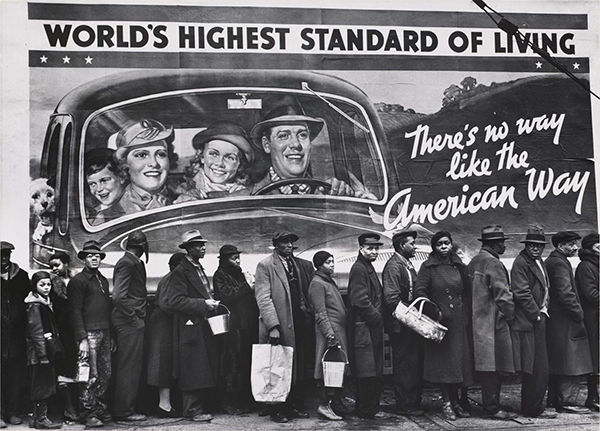
Serial Democratic Irony: While a Green New Deal is widely seen as the answer to 25 years of fruitless climate conferences and inexorably rising global temperatures, it was World War II-mobilisation that actually energised the American economy. Ironies abound, with the billboard backdrop here being part of the National Association of Manufacturers’ unprecedented anti-New Deal propaganda campaign, and the At the Time of the Louisville Flood breadline only the proximate exacerbation of the privations suffered by the queuing flood-refugees. Background hardship was provided by the 1937 recession that dogged fdr’s Second New Deal. Final irony is that the beyond-urgent global mobilisation would be entirely wholesome for global manufacturing and might yet salvage a survivable climate.
photographer Margaret Bourke-White
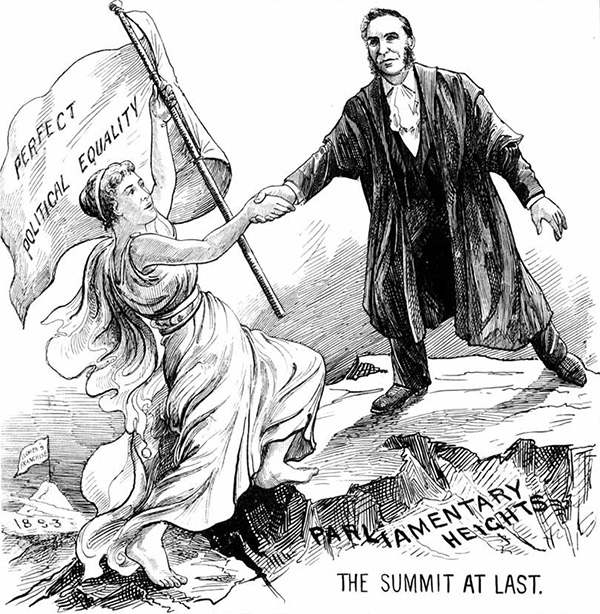
Annual parliamentary elections, thus presenting the most effectual check to bribery and intimidation, since no purse could buy a constituency under a system of universal suffrageactually “universal manhood suffrage”, but rather too archaic for the long-since superseded, male-only franchise model to be usefully featured here in every twelve months.
People’s Charter of 1838, sixth reform
Four depravedly indifferent years of failed-fake-reality-show-host-led democracy in the United States is but the most recent demonstration of the race to the bottom that is populist politics. The line, however, between depraved populism and unprincipled party politics has long been blurring, particularly since inherently dangerous middle-ground political strategies infected dominant parties worldwide.
Democracy is demonstrably not fit-for-purpose—accepting, that is, the imperative for humankind to salvage a survivable climate. Without a survivable climate, all other imperatives, and particularly the, largely unchallenged, putative one of preserving an ever-growing market economy, are of decidedly secondary importance. With greenhouse-gas-emissions focus on long-term targets for 2040 and 2050, and sea-level rise by 2100, it is small wonder that proximate priorities, such as surviving the covid-19 pandemic, can be pursued with scant or indifferent regard for the climate emergency. Green-lighting billions of dollars of motorway construction by the New Zealand Labour Party-led government, is but one craven example.
With there being no guarantee that climate tipping points are not already being crossed, and the consequences of that possibility being so dire, nothing short of radical climate emergency action is conscionable. This, however, is antithetical to the unchallenged centrist, offend-the-least-number-of-voters politics prevailing. Aotearoa, however, could led the way, by rapidly, radically deepening its once world-leading democracy. The proximate opportunity is to use the rise and rise of enthusiasm to have fewer elections. But rather than simply hold a referendum that gives voters the choice of replacing the three-year-term with a four-year one, a royal commissionroyal commissions report to the New Zealand parliament, as opposed to the government of the day and parallel citizen’s parliament should urgently explore why Aotearoa has slipped so far down the democracy index. Then a Swiss-style referendum process, and a final decision by Parliament.
Summat to Reflect On: With the achievement of actual universal suffrage—suffrage that included women—Aotearoa became the world’s first full democracy. One who helped women scale that mountain, Dr James Wallis—whose caricature this cartoon may depict—was not repaid with support for his bid to make parliaments accountable, by the simple expedient of holding frequent elections.
image The New Zealand Graphic
If reforming democracy sounds like fiddling while climate burns, it is in fact the inverse. To reflect its terms of reference, the exploration would be titled, or to like effect:
Urgently Rendering Democracy in Aotearoa Climate-Emergency Fit-for-Purpose.
Some would say that no amount of reform can make democracy fit-for-climate-emergency-purpose. Nor is there a shortage of inclination to dispense with representative democracy altogether, such as when central government sacks an elected council and appoints commissioners. But, when it comes to convincing an entire population to heed and adhere to a cause, democracy has inherent advantages over dictatorship—New Zealand’s acclaimed response to covid-19 providing a glimmer of what the team-of-five-million approach is capable of achieving. Deeper democratisation, however, would see Professor Michael Baker’s advice concerning the 56% more transmissible United Kingdom sars cov-2 variant headlined, rather than buried 500-words-deep in Stuff:
In an ideal world, Aotearoa would have practiced a programme of constant improvement of its democracy since its electoral-reform heights of 1893. Had New Zealand’s democracy continued to be world-leading, it would long since boast robust government policy statements covering all realms crucial to the climate emergency. But when short-termism temerity saw Labour, National, and New Zealand First collectively kick even the timid 2021 mmpmixed-member proportional reform recommendations into the rough, it was accepted by New Zealanders with barely a whimper. The irony of the self-same parties now being more than a little in favour of offering up a referendum to reduce democracy, with a four-year term, would be amusing was it not, tragically, likely to succeed. Longer terms of office are lethal to the imperative to engage youth in representative democracy. Given that engaging youth is the only evidence-based route to reversing the global long-term decline in voter turnout, resorting to the unproven expedient of reducing the frequency of elections before implementing proven methods of addressing short-termism should be neither countenanced nor tolerated:
Shadow-Voting Studiosus Magnificus: So as not to scare the 18-year-old-and-over horses, particularly over 70-year-olds, National supporters and Aucklanders, politicians in Aotearoa could, with very little risk of backlash, readily introduce voting for 16–17-year-olds, as shadow voting. Estonia successfully introduced shadow voting for 16–17-year-olds in 2011, after an earlier attempt was partially sabotaged by politicians and headmasters. The sky didn’t fall, and 25%* of 16-year-old Estonians, from 2015, were given the right to vote in local elections. A worker on the 2013 shadow elections, former Tallinn University Student Union president Triin Bõstrov, awarded Studiosus Magnificus" for her exemplary service as team-leader of the student-union international relations society suggests she is amply qualified to advise Democracy 2.0 proponents in Aotearoa. *Only a country with the courage to reimagine representative democracy to the extent of making every Democracy Day an election day can deliver on giving all 16-year-olds the vote.
image Tallinn University Student Union
Politicians, almost by definition, are the least likely grouping to be capable of envisaging democracy differently, free from the grotesquely wasteful, dishonest three- or four-year electoral charades. A Commission for Urgently Rendering Democracy Climate-Emergency Fit-for-Purpose could see radical changes introduced by the 2023 elections. It could, however, do better than that by, for example, introducing anytime online-voting a year ahead of 2023, then, provided the system was even half as good as Estonia’s, allow New Zealanders 16-years-of-age or older the option of casting their ballots that way in 2023. Only the ballots of those 18-years-of-age or older would have effect, but after a few annual elections without the sky falling, and as part of the ongoing commissioning of reforms, the age of enfranchisement could be lowered, with the fulsome consensus of voters young and old.
While Estonia can teach Aotearoa a great deal about online voting, and digital governance generally, its team of 1.3 million recently risked being torn apart by Trumpist conspiracists. Although Estonia’s rabid finance minister—representing a party that polled less than 18% in the 2019 election, and down 3 percentage points since—has retained his portfolio, his equally far-right interior-minister father resigned before he could be sacked, after depravedly claiming:
[Donald Trump] will win eventually. It will happen as a result of an immense struggle, maybe even bloodshed but justice will win in the end.
Tragically, the malignant Hr Helme may yet be right about the bloodshed he seeks to incite, but he is assuredly wrong about the outcome.
Although Estonia’s experience with proportional representation is four years longer than New Zealand’s, after eight and nine proportional elections respectively, only Aotearoa, potentially, has managed to shake off the propensity to reward rogue-party, tail-wagging-the-dog behaviours. As is true for practically every deficiency of democracy, the solution is more democracy. In this case, the people, rather than the parties, should determine the makeup of a governing coalition—that is, only the voters, and not a rival party, should ever be able to veto a party’s participation in a governing coalition.
Still Too Young to Vote in World’s First Full Democracy: Old enough, bold enough, and knowledgeable enough to lead two years of international climate activism, Greta Thunberg, were she a New Zealander, was still 78 days too young to vote in the world’s first full democracy, in its 17 October 2020 general elections.
video Greta Thunberg
e-voting cannot be mentioned without precipitating an avalanche of assertions that online voting simply cannot be made sufficiently secure to be trusted for something as inviolable as democracy. Pull the poultice off that purport, however, and a miserable metastasis of the grand old cancer of voter suppression lurks. It is the exact same disingenuous strategy currently being weaponised in the hope of inciting a bloody coup to overturn president-elect Joe Biden’s 74-Electoral College-, 7-million-popular-vote victory. In a world where people have quickly learned to trust internet banking—93% of Norwegians, but even probably 63% of Americans, used online banking in 2019—it is insupportable to maintain the elections cannot be securely conducted online. Chance would be a fine thing if a fraction of such concern was devoted to the blatant electoral corruption in the form of largely unregulated and unpoliced campaign financing by big business, elevated to an artform by America’s super pacsofficially, “independent expenditure-only political action committees”; super, Supreme Court sanctioned, political action committees.
With 15 countries already enfranchising 16-year-olds, the world’s first full democracy has been left forlornly flat-footed at the station—Nicaragua enfranchised 16-year-olds from its first, free and fair, post-dictatorship, election in 1984. However, Aotearoa can still be the first to allow voting at 16 for all 16-year-olds, by simultaneously adopting annual parliaments. Again, so as not to scare the horses, the measure should be introduced as a pilot, and only when it coincides with New Zealand’s three-year-term, and for 18-year-olds and over, would those, online, votes have effect.
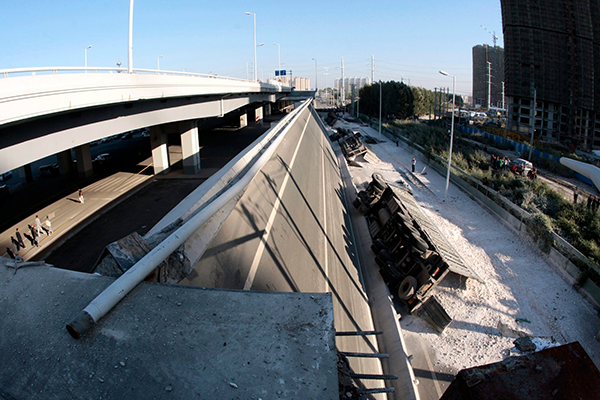
China Cementing Fate of Planet: With China pouring 1.6 million cubic metres of concrete in one project alone, the Beijing Daxing international airport that opened last year, and using 47% more concrete in the three years, 2011–2013, than the United States poured in the entire 20th century, it is amply demonstrating that climate inaction isn’t the preserve of short-termist democracies. Rebooting democracy, while it is still nominally in the hands of the people is the only prudent route, if pursued with urgency. Here, after having been open for less than a year, the 1.88 billion yuan Yangmingtan Bridge after part of it collapsed, killing three people.
image New York Times
How much of the ~us$74 billion global marketing research and public opinion polling industry is political polling is not easily ascertained. Whatever the figure is, few within or without the business are comfortable with its performance, with some calling for a disruption. Anytime-voting would disrupt political polling in an entirely healthy way, providing voters the opportunity to put politicians on notice in real time, politicians the opportunity to more meaningfully engage, and the media with myriad questions for both.
Direct democracy, in the form of a referendum held in response to a hot-button issue, is about the crudest excuse for democracy conceivable, only several shades removed from the lynch mob. If held tomorrow, a term-of-office referendum would exacerbate the decline in voter turnout by further alienating youth, without beginning to address the short-termism that mires representative democracies worldwide. China, meantime, is demonstrating that unlimited terms of office is no panacea for short-termism. Xi Jinping has led his country for eight years already, and has removed all constitutional barriers to being president for life. The world’s most populous and most egregiously greenhouse-gas emitting country is, nevertheless, showing negligible inclination to put salvaging a survivable climate ahead of its cementing its own self-interest.
Currently, New Zealanders have elections two out of every three years, but, averaged2019 local elections, 41.7%; 2020 general election, 82.24% over the last two elections, only 62% voted. Young people would in droves, if they could identify with their potential representatives, and if they were rewarded by a democracy responding radically to their determination to not waste another day in the bid to salvage a survivable climate.
Crude, direct democracy—in the form of a referendum to facilitate a four-year term—is a direct threat to the free, fair, and frequent elections needed to ensure that representatives respond deliberatively to the climate emergency. A plurality, or indeed a majority, would all too predicably vote to have listen to fewer lies, or perceived lies, by holding fewer elections. Instead, a smarter electoral system that keeps the bastards honest by allowing people to engage as heavily or as lightly with parties and policies, and at the time of potential voters’ choosing.
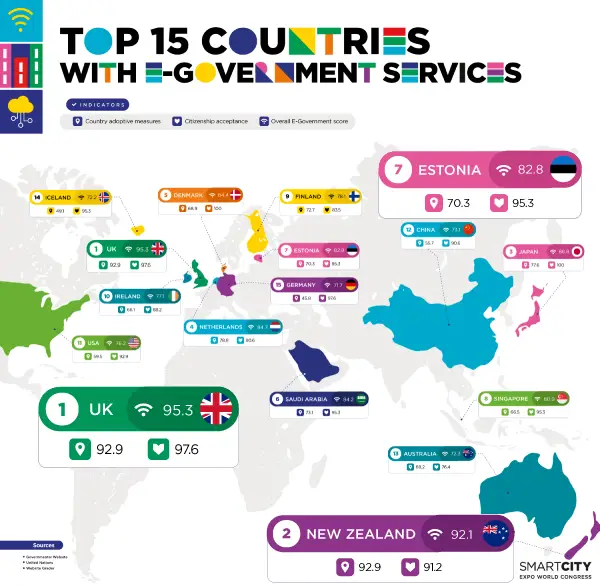
Top 15 Countries Without e-voting Services: Placed seventh, five places behind Aotearoa grossly disserves e-voting world-leader Estonia. Neither first-placed United Kingdom nor second-placed Aotearoa/New Zealand deserves to be mentioned in the same e-government breath as Estonia. Aotearoa has yet to advance beyond local-government postal voting, much less e-voting for general elections, and in the United Kingdom, disgracefully, and solely at the discretion of its prime minister, voters can be deprived of their right to vote for up to five years—and then their voting is by primitive, non-preferential first-past-the-post. Estonia, in contrast, in 2007but in Estonian local-government elections two years earlier, in 2005, courageously pioneered e-voting at general-election level. By arbitrarily removing e-voting services from its smart-government criteria, Smart City Expo World Congress punishes the pivotal innovation it should primarily be rewarding.
map SmartCitiesWorld | label enlargement Mahurangi Magazine
Anytime-voting Anytime-voting, at least the adjectival component of the term, was suggested by Cimino’s grandson. Son of a non-voting mother, he had resolved to vote, in part, due to the perspective he’d acquired as a first-time father and his recent analysis of the policies of the respective political parties. An extremely productive person, balancing a multiplicity of work, home-purchasing and re-building, and family demands, he was later crushed to learn election day had come and gone without his having registered that the opportunity to cast his vote for the party he’d determined to support had eluded him:
You should be able to vote anytime!
By which he meant, entirely reasonably, at the time he’d devoted his attention to his electoral right and made his considered decision. For Cimino, revelling in bleeding-edge, lateral electoral-systems conceptualisation, the realisation that of course a person should be able to cast their vote anytime during the electoral cycle, and amend that vote anytime up until polling closed, should they be moved to do so, was both deeply humbling and highly thrilling.
Just one, profoundly beneficial benefit, of the multiple benefits of anytime-voting is that, at no cost, snapshots would be available through the duration of the political cycle as to voter intention. These data would arguably be both more robust than current 1000-respondent polling methods, particularly those based on self-selected online-poll respondents. In time, when anytime-voting became prevalent, the data would become an indispensable in helping to illuminate inferential anomalies that might indicate any actualvoter suppression is, by far, the greater fraud perpetrated, and invariably in the guise of preventing fraud electoral fraud being attempted. Additionally, such normalised, advanced-voter-intention data would greatly aid voters in local-government elections where a paucity of voter-intention polling—reflecting the considerable contingent cost of such—ensures that, particularly in crude, first-past-the-post jurisdictions, many votes are inadvertently wasted on unelectable candidates.
In addition to the anytime-voting innovation, many other citizen-centric transformations would be incorporated, with a bevy of those addressing the citizen’s right to record their preferences as cursorily or as comprehensibly as they choose. This range should extend from the right to simply record their abstention—with or without as many multi-choice, frequently-cited reasons, or multiple Other . At the other, comprehensive end of engagement, voters could reasonably detail their preferences for coalitions, parties, and for representatives—from local through to cabinet ministers, prime minister, and president/governor generaland where no president, who should hold that office. Deep democratisation just for the electoral process might sound overly demanding on resources, not least to power the ai involved. There is, unarguably, the imperative to fully deploy participatory-democracy in the, beyond-urgent, Great Mobilisation decision-making process, if the greatest possible buy-in is to be obtained. Without putting in the participatory-democracy hard yards, it is unlikely that it would not be understood why scrimping on electrical power, on grid power , is the last economy that should being practised. A just and at-scale transition demands that, rather than subsidising inequitable private-light-vehicle-based transportation for the few, deployment of the likes of double-source trolleybus transportation for the masses, must be prioritised. Rail may be the gold standard, but the sheer ubiquity of non-railed roads demands that such infrastructure be repurposed for primarily grid-powered, in-motion-charging vehicles, beyond-urgently for trolleybuses and trolleytrucks. Return to text
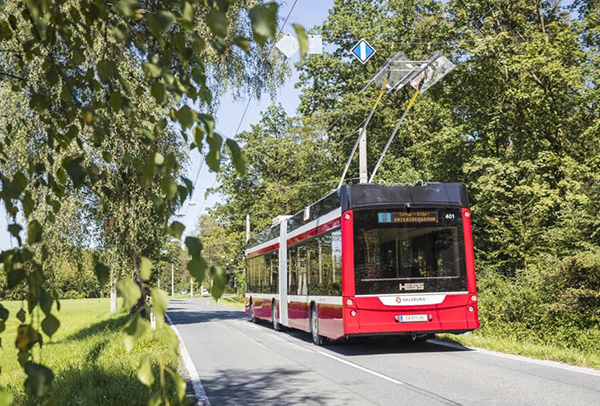
Direct Threat to Joined-Up Thinking: As Wellington demonstrated by removing the last of its trolleybus catenary, shallow understanding of the detail involved in deep electrification missed the inherent superiority of double-source trolleybus deployment. Double-source—trolleybuses both directly grid-powered, and indirectly grid-powered via on-board batteries—can readily operate with a third of the route free of overhead wires, greatly increasing flexibility, and greatly reducing cost and visual clutter, particularly at intersections. Deeper democracy is required to ensure that the prevailing battery-powered-everything thinking, or lack of thinking, is subjected to considerably more rigour. Already proven in the market town of Grödig, the technology is assuredly suitable for that of the Mahurangi district.
image Urban Transport Magazine
Energy for the Great Mobilisation Titled Energy for the World , chapter 43 of Dr James Edward Hansen’s second major non-fiction book for a general audienceis currently in draft form. Mainstream media seldom strays from the conventional wisdom that the climate emergency will be solved without anyone needing to see past the end of the nose of their nice new electric vehicle. Direct, populist democracy, in most, but not all countries, would see nuclear power dealt a drubbing, and evs given a thumping thumbs-up. It is tragically ironic that with the fate of a survivable climate at stake, massively critical areas of enquiry remain woefully underfunded and unexplored. Much is known about the harm caused by even extremely low levels of fossil-fuel and biofuel particulate matter, despite it being tolerated—yea, rewarded—politically. In literally fatally stark contrast, too little is known about the therapeutic effects of low-dose radiation. Dr James Hansen, 2024 draft:
Disclosure The author of this novel modello is no longer the secretary of Mahurangi Action Incorporated or the Mahurangi Coastal Path Trust. The content published here, however,is that of the editorially independent, independently funded Mahurangi Magazine.