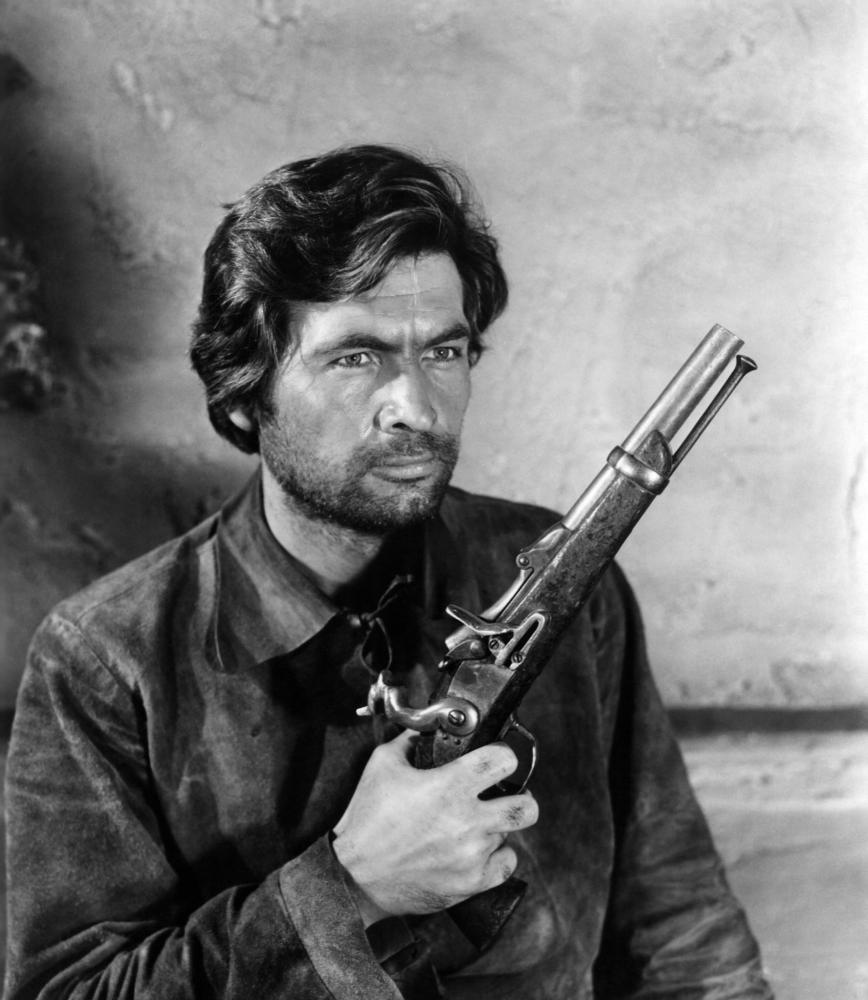
…if I die I ain’t gonna cry
’Cause I got me a pretty woman’s love
Stan Jones, 1971
Southwestward Ho: Although the title song was imminently forgettable, Wringle Wrangle , sung or lip-syncedin any event, written by Stan Jones and sung by him on the B side of his Ghost Riders in the Sky released on Disneyland label. Parker certainly was a singer by Davey Crockett’s actor’s character—John ‘Doc’ Grayson, played by Fess Parker—in Westward Ho the Wagons! but mercifully sans the coonskina former-day MAGA cap, one might argue, not least of all considering his conservative politics, a year on. In the matinée’s immediate afterglow, an impromptu rendition of Wringle Wrangle was an early demonstration of Te Kūiti-son Peter Skerman’s rich musical talent and recall.
image Walt Disney Productions
Kūiti South wasn’t its real name, but Cimino had a plurality of reasons for wanting to live incognito, “somewhere in the South Island”. Having briefly attended the one-room Pākehā school at Ōpārure, and the Saturday matinée in the Pākehā picture theatre seven kilometres southeast in Te Kūiti, and fallen in love for the first time, the town thereafter had been his touchstone. Electing to not stand for God Save the Queen , along with a small cohort of rebels magnetised by Pete Skerman, was delicious frisson paired with the freedom afforded hundreds of children and, barring the unobtrusive theatre staff, nary an adult for miles. From the wild cheering for the serialised Western and its laws-of-physics-defying, literal stagecoach cliff-hanger-recovery to the grand finale of the hour-and-a-half-plus-intermission main feature—life could not be sweeter, with or without the price of an ice cream. For he and his 11-year-old compadres moseying four-abreast northward-hoWestward Ho the Wagons! William Beaudine | Walt Disney Productions, 1956 along Rora Street, Skerman had perfectly memorised ‘Slick’ Jones’:
Ooooh wringle, wrangle
Jing a-jong, jangle
(shepherd-whistle, whip-crack chaps-slap)-haaa!
And if I die I ain’t gonna cry
’Cause I got me a pretty woman’s love.
While Pete and Cimino were in complete accord as to who the eleven-year-old pretty Ōpārure “woman” was, for unrequited years the pair debated which was her proximate ‘Doc’ Grayson—Cimino then being blissfully ignorant of the reality that he didn’t begin to possess Skerman’s star qualities, in looks or in vocal timbre.
A lifetime later, a performance by Kūiti South’s amateur theatrical society has Cimino entranced and reenergised. Generally, plays about plays—and movies about movies—tries his patience. Ingeniously written, brilliantly directed, and sublimely performed, they can of course become classics:
Mr DeMille, I’m ready for my close-up.
This, British, play demands, and is being performed by, superb actors, particularly she who is playing the dim-witted, desperate-to-act player incapable of memorising even half a line of her necessarily very few lines. Cimino, further, can’t supress his long-held divaricationA divergence of opinion—“reservation” is clearly the more accessible word, but in this context possibly too libel to be interpreted as theatre-ticket reservation that amateur theatrics studiously squanders its opportunity to simultaneously provide a home for amateur theatrical creativity. Before recently forsaking their home of 49 years, Cimino and Sarah’s local hall/little-theatre had been the former one-room Mahurangi Heads West School that, until it closed, had also served as a multi-denominational Protestant church, of a Sunday morning-after-milking—Protestant, because nearby Pūhoi was the hub of a strong Catholic community sporting a fine, well-attended dedicated church.
A 1970s residential influx had created an appetite for the cultural events and a coalescing The-Play’s-the-Thing sentiment. Inspired by attending a University of Queensland performance, Sarah’s suggestion of Toad of Toad Hall readily found favour thanks to the popularity of the 1973 bbc radio version. Sarah directed an enchanting, much-applauded performance, but it was an all-adult production a a Milne’s entirely adult adaptation of Kenneth Grahame’s children’s novel Wind in the Willows . That deficiency was promptly remedied by a follow-up season of Toad of Toad Hall .
With the scripts, costumes and sets still to hand, and an eager cohort of children who had enjoyed the drama performed by their animal-depicting parents, if not the dialogue, it was back to Toad and with more Weasels than you could wave a requisite stick at, including every small Mahurangi West – Pukapuka child available. Some were given masks and makeup and pressed into service on the night, following-the-leader in an uninterrupted veritable plague of mustelids, pouring into the tiny hall via a window. One such visiting, press-ganged pre-school recruit subsequently begged she be allowed to “go to the weasels” whenever the family drove past the paddock-surrounded diminutive, cute-as-a-button hall, of a weekend harbour-side visit.
Following closely was The Wizard of Oz , with mostly young actors and not just performing the obvious roles. A soberly wigged, 13-year-old redhead convincingly played a severe, severely malapropping judge:
We see before us, cowering in the dock, one of the most notorious malefactors of our time, the indigenous Toad.
With delightful irony, and right up to and including the dress rehearsal, she mispronounced, not Milne’s malapropic adjective—indigenous for ingenuous—but notorious, as notturous. Notturous forever became a beloved mispronunciation and not confined to little-theatre—Sarah was never self-conscious about her liberal vast repertoire of malapropisms appearing to be accidental to the unsuspecting. Until a decade-long hiatus, Sarah’s heart-and-soul career as an amateur producer–director culminated with a season of The Pied Piper , which her beloved, sartorial father attended dressed, and every bit as hansom as, Laurence Olivier. Meanwhile, Cimino wonders how he missed writing notturous into his, subsequent, Anchor Me!
When, in 2001, Cimino volunteered his time to help stage a production for the children’s children, it was taken as read that it would be youth-oriented and original. Purpose-written for a mostly child cast by the card-carrying anarchist writer/activist/sailor/pianist Wayne Innes, Mud River was the last of the plays performed—all produced and directed by Cimino’s Sarah. Director Sarah, long since, was in fulltime employment; Cimino, in unpaid-early-retirement-self-directed community activity —saving the biosphere, one Mahurangi Harbour at a time—Cimino fancied he could take the locally-written concept a step further and facilitate the children writing the play themselves. The children, hugely enthusiastic, elected to walk three kilometres of their school-bus route, rather than sully their Sundays with parental involvement. Their enthusiasm, however, didn’t extend to anything approaching playwrighting, beyond choosing their own stage names—writing, even talking about writing, smacked far too much of classroom activity. Antics with their immediate bezzies easily swamped what little discipline Cimino could engender. Nor, however, could Cimino supress his alter-playwright ego, once an almost perfectly formed, we-didn’t-mean-to-go-sea concept spontaneously appeared, linking the hall, the road, a little cross-country to the mangroves and an abandoned houseboat, to a nearby desert island. Most of the initial dialogue, in the exact vernacular needed, had been written by the children themselves, overheard by the assistant director whilst performing his tail-end-Charlie, responsible-adult duties.
Few little-theatres can physically be quite as little as the former Mahurangi Heads West School—the stage-less hall is about the dimensions of just the stage of the Kūiti South Little-Theatre. This well suited Toad of Toad Hall ’s riverbank scene and each iteration thereafter deployed increasingly ingenious devices. Then, precipitously perched atop a stepladder outside the upper half of the tall double-sash end-wall window, head, arms of the, adult, the Wizard, of Oz , blended with his somewhat two-dimensional torso and legs reaching the floor inside the theatre. Anchor Me! took set ingenuity literally to another level, inspired by a childhood infatuation with the flotilla of pot-mender-dependent corrugated-iron canoes that periodically did battle on a bend of the Mangaōkewa. Witnessing this marvel of unbridled and unsupervised multicultural rivalry, Cimino’s decidedly naval-architecturally-problematic dream vessel was a two-decked age-of-sail pocket-corvette complete with extensive cutaway section to allow the gundeck crew unrestricted view of the action—or, as in its second physical, Anchor Me! incarnation, the audience unrestricted view of the lower-deck actors. By extending the set stage-right to encompass the kitchen—the school’s former cloakroom—servery, players surplus to the action could disappear seamlessly into the wings/kitchen… To be continued…
Author! Author! Audience participation wasn’t limited to children and English Springer Spaniels. Prolifically bibliophilic Mark Kirby contributed sophistication and humour to top-off the exuberant, standing ovation that followed producer–director Sarah Ransom’s début production of Toad of Toad Hall with his warm, richly enunciated:
Oh bravo, bravo!
…and—equally warm and richly enunciated—with increased authority:
Author! Author!
Mark and Lindsay Kirby’s attendance, involving a return-10.5-kilometre-dinghy-runabout-dinghy-motor-car crossing of the harbour to the hall and back-in-the-dead-of-night, epitomised the community’s devotion to the arts. Their then Georgian harbourside home, Rodmersham, was the closest thing the Mahurangi Harbour had to its own Toad Hall. Mark’s library at Rodmersham… To be continued… Return to text
Flip-side footnote Had Ghost Riders in the Sky featured in Westward Ho the Wagons! alongside Stan Jones’ lighter-weight B-side—Wringle Wrangle —it is less certain Skerman and his cohort would have found themselves rendering the latter. Cimino, whether by wiring or environment—including rapt immersion in a voluminous, obiecta-non-gratain this case, objects banished from the Arts and Crafts bungalow to its darling, pigeon-lofted garage set of early-post-Great War reference works—was by then already susceptible to heroic narratives, hence the impact of the ballad that provided this work’s title. That, and the trauma of becoming a pre-teen motherless child, meant Cimino was subsequently less in the thrall of the ubiquitous, beatific Beatles than of the rough-edged, rhythm-and-bluesifying Rolling Stones. Be that as it may, Skerman’s sonorous voice made it a foregone conclusion he was lead-singer/soloist material, as an early-post-release rendition of RobertRobert Lamm, Chicago Transit Authority, début album The Chicago Transit Authority, 1969LammRobert Lamm, Chicago Transit Authority, début album The Chicago Transit Authority, 1969’s Does Anybody Really Know What Time It Is , when he discouraged crewmates from singing… To be continued… Return to text
Disclosure The author of this novel modello is no longer the secretary of Mahurangi Action Incorporated or the Mahurangi Coastal Path Trust. The content published here, however,is that of the editorially independent, independently funded Mahurangi Magazine.