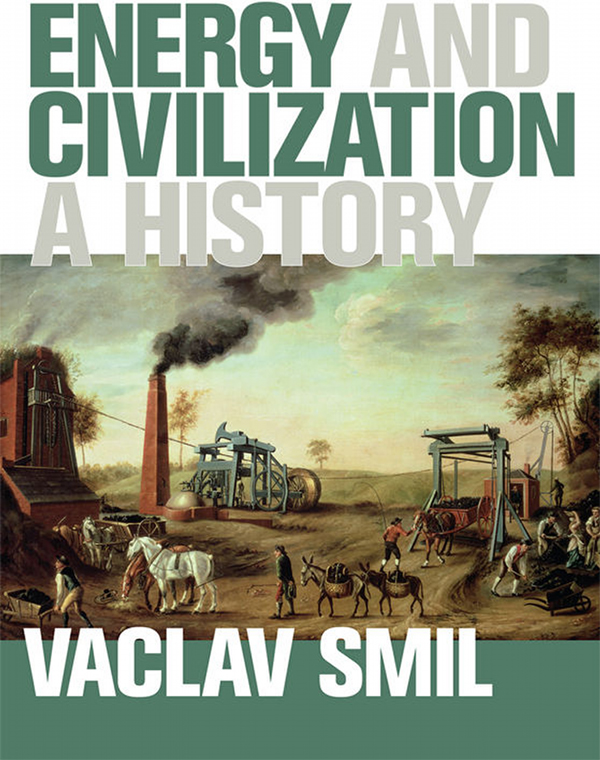
Historic Energetic Civilisational Climate Mobilisation: Rather than react and succumb to the temptation to further publicise a trillionaire already luxuriating in media attention, by featuring his latest sleight of hand, with caption titled “Posterboy for Neodystopianism: ”, Light the Fuse here pays homage to the work of the world’s foremost energy polymath—Distinguished Professor Emeritus Vaclav Smil—praying that the monstrous task of decarbonising energy may yet be mobilised using informed, practicable, scalable, energy-economic technologies, rather than persist with its performative and egregiously time-and-energy-wasting renewables-masquerade. Successfully selling Planet Earth down the river by dangling before transfixed masses the promise of a lavish, everlasting life on an inherently hostile, practicably unterraformable Mars, and beyond, is perhaps the ultimate demonstration of snake-oil salesmanship.
publisher MIT Press
Too much to carry, too much to let go
Time goes fast, learning goes slow
Bruce Cockburn, 1999
After a month of false, briefly exhilarating misstarts, Chapter 20 is no closer to coherently introducing its semi-eponymous megaproject. It doesn’t help that the Causeway of Causeway-a-MāuiTentative suggestion offering that a more literal name, such as Ko te Arawhiti te o Ika-a-Māui ("The Bridge of the Fish of Māui") would be far too unwieldy to ever be in popular use is many things besides a causeway. Even as a causeway, it is unusual, being designed to accommodate 65 metres of sea-level rise. It is also part grid-powering tidal barrage, and, at 200 kilometresnominally, Mahurangi–Tīrau (Warkworth -36.4, 174.666667; Tīrau -37.983333, 175.75), the world’s longestat 164.8 kilometres, the Danyang-Kunshan Grand Bridge is currently the world’s longest elevated railway elevated railway. It is the proposed Light the Fuse geoengineering response to the Great Unplanned At-Scale 200-Year-and-Counting Fossil-Fuel Geoengineering Experiment.
As for the state of the global environment, we often hear about how high-tech advances—from offshore wind mega-farms to cheap green hydrogen, and from high-gain heat pumps to the electrification of everything—will decarbonise global energy use by 2050. However, since the Kyoto Protocol set the first goals for reducing global co2 emissions back in 1997, emissions have risen emphasis added by Light the Fuse. In 2026, the rise in CO2 emissions continues to accelerate, much less deaccelerate, much less do CO2 emissions plateau, much less do they reduce, much less do they cease by 61%. In 2023, they reached yet another record level. The chances of reversing this trend suddenly,comma added are vanishingly small.
Aside from any other implication, this four-decade global failure to tame the trajectory of greenhouse-gas emissions could mean anything from there still just being time to avoid the worst impacts of anthropogenic global warming, or that that it is game-over for civilisation. Fortunately for Cimino, being, by whatever fluke of nature–nurture his inclination has always been towards antidystopianism, meaning that until proof positive is produced that civilisation is doomed in decades and that it will destroy a habitable biosphere in the process, he can allow himself the luxury of advocating antidystopianism. But even if the end is nigh for sentient life on Planet Earth, all the more reason for kindness to prevail. SpaceX and its emperor may well prove to be last man standing, but, borrowing from Smil, vanishingly unlikely to be standing on Mars. Mars, magnificent in its own right, will still be a hell-hole for humanity. Terraforming Mars would be orders of magnitude more difficult and resource extravagant than salvaging a survivable climate on an even savagely depleted and desolated Planet Earth. Regardless, if humanity has an ounce of goodness to bequeath the universe, it will leave clear evidence that, when climate science irrefutably warned that salvaging a survivable climate would require a near miracle, species Homo sapiens sapiensas opposed to Homo sapiens, to acknowledge Homo sapiens idàltu, and to avoid the more cumbersome alternative of ‘anatomically modern human being’, and for sheer cussedness had played to its strength—its evolved ability to cooperate and organise in large groups—and had honed that attribute into an artform. Cimino argues, mostly with himself, that, with dystopianism defeated, the miracle needed might yet materialise.
While waiting for the yawning chasms in the science to be addressed, those who can, using the latest and most robust data to hand to inform their concepts, must sketch out a range of masterplans, and seek a consensus to commence building and bracing for what Dr James Hansen terms Storms of My Grandchildren , with his eponymous first book. Regardless, the New Zealand population most at risk is that of the ill-namedsee The Tears of the Rajas
Mutiny, Money and Marriage in India 1805–1905 by Ferdinand Mount, https://openlibrary.org/books/OL28283070M/The_Tears_of_the_Rajas isthmus-straddling metropolis of Auckland. Only a miracle will see the metropolis majorly undisturbed through to its tricentennial in 2140. If Auckland and the bulk of the world’s coastal cities lack deliberatively derived plans for orderly retreat by 2040 it will bode disastrously for civilisation and the biosphere generally. Causeway-a-Māui is Cimino’s current-best-evolving-thinking, but guaranteed to not go to waste would be the companion project that could be commenced immediately: producing accommodation modules to house those children and babies currently without, both in Aotearoa and in the wider southwestern Pacific.
Retreat, regardless of the setting, it is a universal anathema. For retreat to be humane, individuals must have the greatest discretion as to when they elect to forsake a location. By beginning the planning immediately—in contrast with last four decades devoid of action—individuals, families, communities, schools, businesses, institutions, etcetera, etcetera will enjoy the maximum possible agency. Then, to address, from the very beginning, the cruelty of separation, the causeway will ensure that young and old, strong and weak, rich and poor can safely and comfortably travel between the old, the new, and the interim locations where family, friends, workmates, teachers, and students are subsequently working, living, or studying, will allow much malignedmostly by non-citizens, Aucklanders are frequently referred to as JAFFAs: “just another fucking Aucklander”, for their relative brashness and materialism, compared to citizens of slower-paced regions of Aotearoa Auckland to morph organically into a city worthy of the name Makaurau—the Loved by Many component of the terminally sea-level-rise-compromised metropolis of Tāmaki Makaurautraditional te reo Māori name for what is now Auckland Council governance region. Makaurau is envisaged as the mother-of-all walkable linear-park cities.
Time for Atlantropa 2.0: Conceived a century ago to avoid forever wars over Middle Eastern oil and bring lasting peace to a unitary Eurafrica, Atlantropa’s potential surfeit of hydroelectricity was suddenly marginalised by nuclear—the new wonder energy that had exacted unconditional surrender of the Japanese Empire. Had the us not so determinedly seen the ussr as an adversary, and instead had grasped the un opportunity for peaceful world government, humanity would not now be staring down the depravedly indifferent barrel of the Great 3rd Millennium Climate Polycrisis. That world leaders should be more afeared of embracing a utopian concept than of being mired in forever wars speaks more to their cowardice, than their courage. Meanwhile, with the now clear evidence of irreversible icecap-melting levels of atmospheric emissions released, it is likely only a matter of time before China or America, or each, cravenly resorts to unilateral saistratospheric-aerosol-injection geoengineering, whereas, while it would involve risks, a latter-day Atlantropa would have the world’s peoples working together, with vision and at scale.
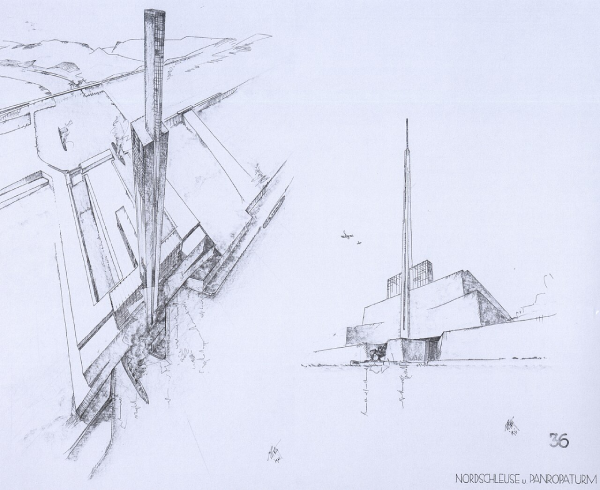
rendering Peter Behrens
A telling test, particularly for the media, would be whether a megaproject could be popularly referred to as other than the Giant Causeway . Regarding the substantive question, as to when such an intervention might be keenly and collaboratively studied, the failure previouslydespite Onslow—or perhaps because of, considering the depths of misogyny in Aotearoa—being mentioned by then Prime Minister Jacinda Ardern during her final, spectacularly successful 2020 leaders’ election debate of the 5-twh Lake Onslow dry-year pumped-hydro-storage scheme to gain widespread, non-partisan support bodes extremely badly.
Lake Onslow would, by far have made for the world’s largest pumped storage, resource, doubling New Zealand’s current capacity, and putting Australia’s Snowy 2.0 in the shade. It would have been globally inspirational on every level but was bitterly opposed by those positioned to extract eye-watering profits by periodically driving up the spot price for electricity. Not even the Green Party had a good word to say for the scheme, comfortable in their privileged solar-powered, bev-transported existences, doctrinairely indifferent even to the benefits of deep storage to their favoured, flimsy renewables.
Onslow is the perfect companion for Causeway-a-Māui by which to illustrate how one small country can go convincingly low-carbon, and convince a continent to revisit one of the great missed opportunities of the future. With trillionaires prepared to put the great unwashed to the laser in their guardrail-free, take-no-prisoners lust for ai supremacy, the world desperately needs champions to challenge the doctrine of market omnipotence. Demagogues will doubtless disagree, but the best prospect for the biosphere is just, deliberative democracy and mobilisation and the and the no-excuses, no exceptions abolition of warfare. Causeway-a-Māui and Atlantropa could be the perfect companion projects to excite immediate public interest in the beyond-urgent Great Mobilisation.
Variations on the pathologically bureaucratic, nothing-to-see-here response to unwelcome questions abound but are nowhere more dangerous than applied to the first unarguably existential challenge to beset Homo sapiens sapiensas opposed to Homo sapiens, to acknowledge Homo sapiens idàltu, and to avoid the more cumbersome alternative of ‘anatomically modern human being’, and for sheer cussedness and their long-suffering fellow inhabitants of the biosphere—anthropogenic global heating. Of the veritable avalanche of crises besetting Planet Earth, one, anthropogenic sea-level rise, is at once the slowest to reveal itself and the potentially longest lasting, given that today’s still accelerating greenhouse-gas emissions will, unless removed at great expense, remain in the atmosphere for tens of thousands of years. Bizarrely, given how profoundly anthropogenic global heating will geoengineer Planet Earth, the least is known about the signal most likely long-term impact: sea level 65 metres higher than at present. While there are myriad variables that could determine whether and within what timeframe a 65-metre sea-level rise might fully manifest, what is categorically known in 2026 is that atmospheric carbon dioxide levels are continuing to accelerate, and—short of some yet-to-be devised practicable means of removing it—most of that additional 43% will remain in the atmosphere for a thousand years.
Wicked Icehouse Ephemerality: Just one of the myriad wicked ironies that have conspired to thwart human comprehension of the complexities of anthropogenic global heating rest unsteadily on the exceedingly recent, and poorly understood science of glaciology. That glaciation, although it may appear eternal and timeless, is itself an exceedingly ephemeral phenomenon. This strongly suggests a remarkably rare set of conditions are required for glaciation to occur. Once seen off by a brief binge of unbridled fossil-fuel combustion, contriving to geoengineer an environment similarly convivial to that which patiently nurtured humanity during the Pleistocene–Holocene, might prove to be enormously elusive, and enormously risky. chart Mahurangi Magazine
Pernicious scientific reticence ensures that there is little overtly published on this existential uncertainty. It is argued that multi-metre sea-level rise should not be discussed lest, like incautious discussion of suicide, it leads to ideation of a changed climate. On the contrary, Cimino considers it likely that history will record scientific reticence as a principal factor in the failure of humanity to mobilise sufficiently decisively to escape the worst of the readily foreseeable global heating immiseration. In the face of nothing-to-see-here denialism and the absence of popular public curiosity, a specific question for New Zealanders is whether or when long-term-sea-level-rise results in a NorthlandNorth Island, New Zealand / Aotearoa New Zealand archipelago riven with tidal races—NorthlandNorth Island, New Zealand / Aotearoa, riven with tidal races rivalling the deadly energy of Te Aumiti / French Pass—or one that harnesses that prodigious renewable resource in the service the courageous generations caused to serve in the Great Mobilisation, the choice could scarcely be more starkseldom is deliberate, alliteration-induced grammar rule-breaking more delicious.
Stark, in the muddiest, most lifeless sense. For if the Pacific is allowed to suddenly begin tidal-boring back and forth into the Tasman Sea through NorthlandNorthland, North Island, New Zealand / Te Tai Tokerau, Te Ika-a-Māui, Aotearoa soft clay hill country, its by-then already grotesquely despoiled eastern and western coastlines will be largely beyond remediation, for millennia. Whereas the unfettered energy coursing through French Pass is channelled through scrubbed-rock tideways that were 15 000 years in the honing.
Profoundly starker choices will proliferate elsewhere, and probably on no grander scale than at the no-brainer Strait of Gibraltar, where the dams and locks required—there, and at the Suez—to safeguard the Mediterranean’s 46 000 kmbut does this metric included the coastline of Mediterranean islands, or only the bordering Mediterranean coastline coastline, involve less lift than the piddlingetymology of “piddle” unknown Panama, and a commensurate scale of the locks and liftsonly recently completed to those installed at the Three Gorges. In both the Mediterranean and antipodean instances, the trillions-of-dollars-of-infrastructure called for is trivial compared the cost of armouring drowning coastlines, much less that of arming and prosecuting foolhardy forever wars.
With their warmongering rhetoric, as ugly as the unga acronym, the latter-day Allies colluding within the 81st session of the United Nations General Assembly have, in their belligerent, all-too Carthaginian-peace vindictivity, surpassed the drafters of the fateful, pig-ignorantput more politely by John Maynard Keynes, of Georges Benjamin Clemenceau 1919 Treaty of Versailles. While protesting for peace may defy the odds and prevail where it has signally failed since the 1960s, some country—some new-enlightenmentAotearoate reo Māori: Land of the Loing White Cloud, officially, New Zealand—desperately needs to demonstrate the aforementioned Great Mobilisation that should, long since, be occupying the minds of leaders with a modicum of awareness of the enormity of the Great 3rd Millennium Polycrisis.
Astoundingly serendipitously, Aotearoa has been handed a profoundly opportune conversation starter with its 20-odd potential Mediterranean collaborators in simultaneously demonstrating the mother-of-allor is that, only-their-mothers-could-tell-them-apart, twin mega-mobilisation projects mega-mobilisation projects. As chance would have it, the Strait of Gibraltar and Tai Tokerauif, in this coupling, the author may be permitted to dock the redundant te—the ‘the’—literally northern tide —are precisely geodetically antipodean. Conceived unabashedly utopianly by Herman Sörgel a century ago, Atlantropa, despite its impossibly dated, hopelessly colonialist, Africa-for-the-Europeans flaw, deserves to be reconceived. Rather than draining the Mediterranean, the concept could be inherently conservative—to conserve the current Mediterranean sea level rather than abandon it to the mercy of anthropogenic sea-level rise. Sörgel’s proximate scheme, in lowering Mediterranean sea level, was to create 660 200 square kilometres of arable/habitable land, whilst generating unprecedently large amounts of hydroelectricity, the latter both to enable the colonisation but also to police and dissuade any warlike proclivities. Mediterranean coastline forms the archaeological backdrop to an era spanning millennia of civilisations, from the Fertile Crescent to the present day. Criticality of conserving that coastal backdrop can’t be trivialised. Sörgel, reconceived, should attempt that, and abolish warfare—his parallel project—for good measure.
By itself, Causeway-a-Māui might struggle to qualify even as an antipodean-scale mega project, but combined with Dr Earl Bardsley’s genius concept for harnessing a freak of nature to serve as the core vessel of the world’s largest, dry-year pumped hydro storage system, Aotearoa could use its pair of low-carbon exemplars to inspire humanity to face the challenge of salvaging a habitable climate and biosphere—as the alternative to depravedly submerging the Earth’s richest coastline, and shorn of its and coupled with an astounding antipodean geological gift of the core component of the world’s largest pumped hydro storage lake—backward-tilting glacial basin Onslow—has the heft to tear the world’s attention away from the current plague of performative warmongers.
While the precautionary principal categorically ruled out Atlantropa, exactly as conceived, failure of the same generation to heed mankind’s mother-of-all-unintended-consequences robbed Sörgel of the place he otherwise richly deserved to serve, as saviour of civilisation and the biosphere. Sörgel was deeply concerned about profligate fossil-fuel-use, but for much the same reason it was popularly known as such until relatively recently: peak oil. Anthropogenic global heating was, and is, not only the mother-of-all-unintended-consequences, it’s also the mother of all wicked, polycrisis problems. Sörgel was right in foreseeing oil had potential to poison West Asian politics. His solution, however, was wrongfooted by the then-new United Nations’ two-fold failure to proscribe the use of nuclear weapons and nuclear power. Not so Albert Einstein, whom he counted as an Atlantropa supporter. To Einstein and many other physicists who’d contributed to the Manhattan Project, allowing nuclear weapons to be wielded by individual countries was utterly unconscionable. However, as the proud son of a vauntedand “vonned”! Wikipedia: “construction of the Walchensee Hydroelectric Power Station[3] and for which he was given a personal enoblement and the right to add “von” to his last name hydro engineer, Herman Sörgel’s unshakable belief was that hydro electricity held the key to curtailing potential warmongering between European states—that errant states could be policed by the threat of switching off power to that country’s grid. Had Aotearoa, through its wartime and vigorously un-shaping prime minister Peter Fraser prevailed, nuclear electricity would have secured an end to all war, Sörgel’s primary Atlantropa, Eurocentric objective. With the Great 3rd Millennium Polycrisis , the stakes were already horrendously high. But with America’s determination that ai is to be guardrail free, China is now the last and only hope for democracy and salvaging a survivable climate.
Regardless of whether it could ever have been morphed, as Herman Sörgel had hoped, into a wholly democratic, post-Third Reichian, négritudinal project—stood on its head to prevent the drowning of the Mediterranean, Atlantropa is arguably the epitome of precaution. So too would have been to act decisively when warned by Hansen et at-large, 1988, but that sulphur-burning ultra-large crude carrier has sailed and along with it any opportunity to geoengineer the reversal of icesheet collapse with any guarantee that the cure might not prove to be considerably more hazardous—think even Slushball Earth, much less Little Ice Age—than the complaint. While some might vote for sea-level rise to do its worst rather than risk holding back oceans, deliberately allowing coastlines, communities, and landscapes to drown is an entirely quantifiable, permanent loss for civilisation, whereas, very understandably, there was no shortage of experts competing to warn against deliberately lowering the Mediterranean 100 and 200 metres.
While, with good reason, it is currently perceived as a more compellingly proximate existential threat than anthropogenic global heating, ai, is an essential tool in closing the enormous gaps in human understanding of the Great 3rd Millennium Polycrisis. From soft, history questions such as:
In 2626, what will year-8 children be being taught about human perception of the dangers posed by the Great 3rd Millennium Polycrisis in 2026?
to hard, climate-science questions:
What year will it (or did it) become practicably impossible to prevent irreversible icesheet disintegration, and with what degree of confidence in the science of a.) proposed climate geoengineering pathways examined; and b.) novel climate geoengineering pathways proposed by 2036, factoring the 10-year delay in taking substantive action?
Of course, had humanity responded immediately to the warnings of climate scientists an entirely rational four decades ago, fossil-fuel use would not still be accelerating and…
To be continued…
Wicked waste and ai In addition to wars of attrition, the damage derived from endless economic wars between nation states and blocs, and that resulting from the unbridled pursuit of private power and wealth callously exacting the ultimate sacrifice from the natural world… To be continued… Return to text
Flawed genius but far from wicked As he toiled to save Europe from itself, Herman Sörgel received unstinting support of fellow architects, engineers, and the man regarded the World’s first industrial designer, Peter Behrens whose sky-scrapingat 400-metres tall, it no doubt would have caused the Empire State Building to have been taller than its then-record 380-metre, which it from 1930 until surpassed by the Ostankino Tower (tower) / World Trade Center (building) Panropaturm der Nordschleuse hydroelectricity nerve-centre was to crown the Dam of Gibraltar. Whether evil genius or evil near-genius, Adolf Hitler’s admiration for Behrens grandiose architecture surely seriously hampered Atlantropa’s opportunity to forge a continent unified by his sublimely simple, humane concept—inexpensive low-carbon energy… To be continued… Return to text
Wicked solution to dismal dry-year dilemmaHalf a million years of tectonic back-tilting, by 1890, had reversed the flow of the Teviot River, leaving Dismal Swamp crying out to be crafted as the first iteration of the present Lake Onslow reservoir. It had been further raised—by five metres, in 1982—before Dr Earl Bardsley apprehended how, at a heroic scale, New Zealand’s hydroelectric infrastructure could be elegantly optimised by robustly proven pumped-hydroelectric technology. Had neoliberal, trash-and-burn purple-politicsred-Labour/blue-purple, two-party politics, to which race-to-the-bottom populist, racist, antiimmigrant, small-government and more could be added not intervened, the project could have been built to maximise the public good of bountiful, affordable, low-carbon, energy… To be continued… Return to text
Dicing with slushball earth With no shortage of possibilities for climate geoengineering, it is all too probable that at-scale trials will proceed on a unilateralsovereign/rogue-state or feudal basis. If this was not already amply evident, rampant ai deployment demonstrates that capitalism has slain all pretence of respecting a rules-based order, much less democracy, much less anything resembling just deliberation… To be continued… Return to text
Great unplanned at-scale 200-year-and-counting fossil-fuel geoengineering experiment Although civilisations have burnt fossil-fuels for millennia, the scale at which they did was trivial until steam began powering the Industrial Revolution, already well underway. Quantitatively, coal was a slow developer, think horse-drawn canal boats of the brief, soon to be rail-eclipsed canal-building era. Two-hundred-year, here, is somewhat arbitrary, but, given the major role initially played by draft animals and human muscle, conflating the fossil-fuel era and industrial revolution can be unhelpful when unpicking both when the Great Unplanned At-Scale 200-Year Fossil-Fuel Geoengineering Experiment began, and for how long it realistically it might run, at scale. Regardless, the 49-character-plus-7-hyphen uri fragment identifying this footnote, in all conscience, couldn’t be of its and-counting phrase without glossing over the all-important point that the unfortunate experiment careers on, imperfectly monitored, and substantively unchecked. To be continued… Return to text
New Enlightenment As ironic as it is instructive, China can lay claim to a New Enlightenment but the West, much less the United States, cannotalthough some may claim that New Deal Progressivism is an approximation. Although the first New Enlightenment was initiated by the Chinese Communist Party in the 1930s, it was short-lived, re-emerging four decades later in the aftermath of the 1976 Tiananmen incident. That it ended badly in Tiananmen Square—synonymous in the West with the eponymous massacre, and subsequent executions, of 700–2600 people—a global New Enlightenment could nevertheless be contemplated. To be relevant, yea indispensable, it would nurture New Democracy and New Climate and Energy Science… To be continued… Return to text
Made-in-China Xiist new democracy Xi Jinping’s relentless mission is to build a self-renewing China—one which will never again suffer indignity of the likes of its Century of Humiliation at the hands of the West. Clearly, Xi has zero intention of dutifully adopting or otherwise emulating the craven excuse for democracy that dogs the Western world. Old democracyMao Zedong’s 1940 term of disparagement for the then-prevailing democracies, in contrast to his proposed revolutionary New Democracy not only ill serves the West though: it does immense disservice to the developing world and dooms the very biosphere upon which any civilisation depends—without, of course, an all-hands-to-the-pumps Great Mobilisation, but even that might not prove to be more than palliative. Setting aside the unabashedly antipodean, principal premise of Light the Fuse, Xi could consummately outmanoeuvre the purported Free World through the process of the unrushed, profound democratisation of the People’s Republic of China. The process could begin by reimagining and gradually empowering Moa’s astonishing extant, 2169-seat Chinese People’s Political Consultative Conference—its solitary vacant seat could even be filled by a latter-day Rewi Alleywho Cimino was introduced to by a magnificent aunt-in-law when he was managing the Waiwera mineral pools, circa 1971 and—you couldn’t write this stuff—Cimino’s now immediately adjacent neighbour is a blood relative. with a penchant for the instruments of direct, participatory, and assembly democracy. Since 1959, the cppcc has convened in the 10 000-seat Great Hall of the People, the venue begging to host a new, practicable, durable government-by -the-people.
Insalubrious First-Plenary Participatory Image: Mao Zedong’s massive participatory-democracy body, when China’s population was little more than half a billion, has endured rather than evolved. Today, the Chinese People’s Political Consultative Conference is ripe for renewal and realisation of the New Democracy Mao dreamed of, only to preside over the all-too-participatory Cultural Revolution that claimed up to an estimated 7.7 million lives. Pictured, the first plenary session, in the original Huairen Hall, 1949—since 1959, the cppcc has convened in the Great Hall of the People.
image Academy of Chinese Studies
As the world’s first full democracy, AotearoaNew Zealand, in te reo Māori might have deserved to lead the profound democratisation demanded by the beyond-urgent Great Mobilisation. Lamentably, despite the dominion also being the first, in 1996, to vote to adoptvia a binding, two-stage referendum. Germany’s, in 1949, was imposed, albeit with party input mixed-member-proportional representative democracy, it has sat on its hands ever since. Thirteen other countries currently sit ahead of what was once an electoral exemplar—New ZealandMahurangi Magazine’s preferred attributive term for Aotearoa’s 69th-ranked deliberative component and its free-falling, 42nd placed participatory component massively diminishing what remained of its former authority. An exemplary, albeit conceived as a stopgap, feature of New Zealand’s system is its dual electoral rolls, which typically only receive attention when abolish-the-Māori-roll sentiment is aired. This is testament to the scant appreciation New Zealanders have of their profound, Enlightenment inspired democratic heritage. In fact, aside from perennial pride in their hyper-hallowed All BlacksNew Zealand’s Rugby union football team. Tool tip to be replaced with tūī-livery foot/end note, the only recent, transgenerational zeitgeist-inducing achievement was its 1984 anti-nuclear everythingDavid Lange’s personal non-opposition to nuclear power yielded, in the New Zealand Nuclear Free Zone, Disarmament, and Arms Control Act 1987, to Campaign for Non-Nuclear Futures momentum to also ban visits by nuclear-powered ships headed by the same prime minister who, also haplessly, presided over New Zealand’s there-is-no-alternative, if-a-little-is-good-a-lot-is-better ultra-neoliberalism free-to-a-good-capitalist state-assets bonfirewhile former prime minister John Key owned the latter, sell-anything-nailed-down-or-otherwise phase, Prime Minister David Lange did the initial heavy lifting. In the maw of the Greatcapitalisation consciously precocious3rd Millennium Polycrisis, it behoves Aotearoa to do all it can to extol Xi to ferment, formulate, and spearhead the essential new New Democracy, globally.
There would be no better venue in no better country than the Great Hall of the People, Beijing, China in which to begin the process of designing a new, fit-for-purpose world body. If it were convened in New York in the blighted halls of the United Nations, it would struggle to be seen by the Global South as other than more-of-the-same, latter-day colonialism project. Whether known as theUnited shorted to UP, possibly pronounced you-pee with a descent you. As to whether being prone to be uttered as in yuppee ki-yay, mother-etc. would a necessarily bad thing…Peoplesshorted to UP, possibly pronounced you-pee with a descent you. As to whether being prone to be uttered yuppee as in yuppee ki-yay, mother-etc. would a necessarily bad thing… or by some other moniker, the new body from the beginning could afford, if anything, to be other than Eurocentric—to be Global Southist. For China, immense opportunity would present to atone for and address the atrocities of the revolution in the spirit of encouraging the same contrition from all nations great and small—where more cathartic than in Tiananmen Square to expose these wrong-turns to the sunlight. New Zealanders of all ethnicities would certainly benefit from a post-colonial Aotearoa reckoning and reconciliation process… To be continued… Return to caption
Disclosure The author of this novel modello is no longer the secretary of Mahurangi Action Incorporated or the Mahurangi Coastal Path Trust. The content published here, however,is that of the editorially independent, independently funded Mahurangi Magazine.