Donald the Great…Summonsing enormous effort to not descend to Donald’s malignant-narcissistic, expletive-laden level, I offer simply: “disappointment.”
Contents author Cimino work-in-progress published 20260715 footnoted 20260715
When a meeting, or part thereof, is held under the Chatham House Rule, participants are free to use the information received, but neither the identity nor the affiliation of the speaker(s), nor that of any other participant, may be revealed.
Chatham House Rule, The Royal Institute of International Affairs
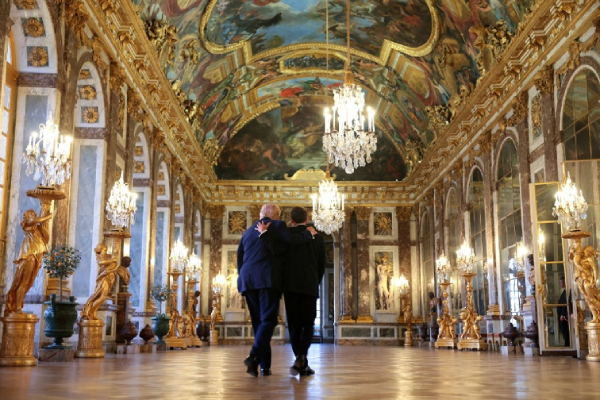
Macron Demeaning a Great-Enlightenment Leader: Last kingly occupant of the palace, Louis xvi, doctrinairely guillotined, would likely have been unimpressed by these two, casual genocide-enablers, two centuries on. Pictured, Donald Trump—possibly musing on how quickly he can get his hands on Fort Knox bullion-depository gold to upgrade his GoldWhite House gilding to the real deal—and PatsyEmmanuel Macron. image Anna Moneymaker
Cimino had hoped to avoid direct mention of the man or his reign of error, much less name a chapter for him. Churchill, in his pre-Poland-invasion alarm-sounding campaign, had serially failed to sufficiently convince his parliamentary colleagues of the threat of warfare planned, but had he not mentioned the name of its principal architect—Hitler—his rhetoric subsequently would not have resounded half as convincingly, in Britain’s darkest hour.
Now, however, with Trump having demonstrated the deadliness of his criminal demagoguery at home and abroad, the luxury of avoiding even derived terms such as Trumpianism has been precluded. Trump’s immediate impeachment and successful conviction is the only measure by which the United States—the once-greatest hope for worldwide democracy—can redeem itself. Tragically, the American empire lost its guardrails long before Trump someoneprincipally by Roger Stone had finally convinced him he could be elected the republic’s commander-in-chief. Demonising Trump for the destruction of the briefly great us democracy is to credit him with kicking down a door already all but unhingedliterally, to remove from its supporting hinges but also an attempt to invoke cognitive-dissonance psychosis by generations of chronically corrupt elected Democratic–Republican party representatives, by lobbyists and their masters, and by party officials/functionaries.
With his misguided West Asian adventure stalled, Trump’s would-be-2 ic Scott Kenneth Homer Bessent is doing his best to emulate Hermann Wilhelm Göring. But it is doubtful that any novel economic weapon will prove to be formidable as the Luftluft literally: “air”waffewaffe, literally: “weapon”, until it wasn’t. Pertinent question, of course, is whether Bessent succeeds where Göring failed—not whether he or his master is ever arraigned for war crimes. If Bessent is successful with his “financial violence”, the world will need to pray that China belatedly begins to put the biosphere ahead of its pursuit of global financial hegemony, because right now, the hands-down, the best chance of salvaging a survivable climate is if the prerequisite Great Mobilisation is led by a radically reformed United States. Currently, rather than leading the building of a great, post-carbon civilisation, the world’s once-unassailable superpower, sliding into autocracy, is inexorably ceding its global economic hegemony to rampantly hyper-developing, super-self-interested China.
Whether full-blown Trumpist, or supporter only inasmuch as sharing—or indeed, greatly surpassing—his criticisms of contemporary Congress, much less one who abhors just about every aspect of the man’s morals, misogyny, politics, greed, dictatorial proclivities etcetera, disappointment probably most encompassingly describes how fair-minded individuals evaluate Trump 2.0. Mired hopelessly in the forever, Israeli/US-Iran War he plunged haplessly into, November’s midterms are shaping up for a Republican drubbing. But nor are they likely to see the principled two-thirds Senate majority necessary to remove Trump from office via impeachment and conviction. If, however, on top of an uncowed Congress, his patent lack of mental fitness and criminal commander-in-chief actions result in a 25th Amendment, Section 4 removal-from-office, the world might find the backbone to cease grovelling before a lone madman—and summon the courage to abolish warfare and mount the beyond-urgent Great Mobilisation.
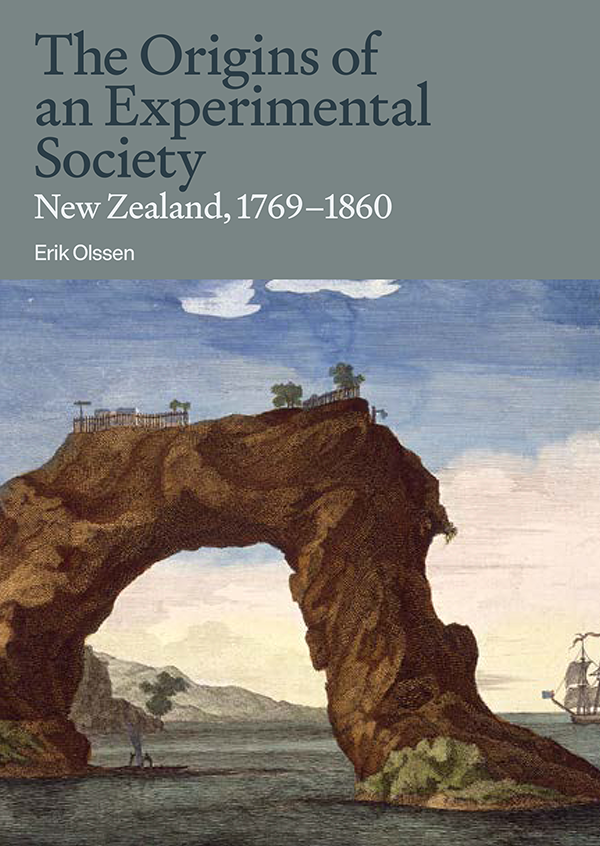
First With the Old Enlightenment Then With the New: After abdicating all state planning to the vagaries of the market, it is beyond-urgent to begin experimenting with the best candidate strategies for mobilising a plan to address its existential consequences—fossil-fueled anthropogenic global heating. A New Enlightenment, embracing New Democracy and New Climate and Energy Science, ubiquitously practiced would inform the beyond-urgent Great Mobilisation. For New Zealanders, The Origins of an Experimental Society: New Zealand 1769–1860 —is the perfect background to how the Enlightenment shaped that experiment. In the words of Philip Temple, Erik Olssen’s work, “free of presentism and bias, blows a fresh wind through the clichés of our history that bedevil current discourse.” The two planned companion volumes, unpublished at the time of Olssen’s death on 29 July 2026, in some form, could form part of the actual , as opposed to modello, Light the Fuse. publisher Auckland University Press |typographic compaction Mahurangi Magazine
Only months away and there being scant indication of its 2026 midterms being about to usher in a comprehensively redeemed United States, Cimino doubles down on his contention that Aotearoa, the world’s first full democracy, should—even in its own entirely selfishNot 100% pure footnote business case for brand enhancement (an honest, not 100% pure) monetising interests—proceed without delay to light the fuse. Aotearoa has long had the incentive to become the land of free, fair, and frequent elections, emphatically reversing its democratic backsliding, not least of all to atone for its failure to democratically forge a constitution worthy of the well-intentioned but hastily contrived and translated 1840 twin treatyan English language “master” document and a te reo Māori one, which was an imperfect reflection of the first-founding documents that, from their signing, have chronically divided, rather than united, the benighted twin-main-island nation. For Cimino, as a preteen schoolboy, a day was an eternity. Attempting to understand the freshly post-war world he’d been born into, he struggled most with why a tyrant on the scale of Adolph Hitler had been allowed to wage war for 2068 days, without being forcibly relieved of his command. Indeed, the most heavily sanctioned act appeared to be the forcible removal of a head of state, particularly by assassination. Surely, he thought, when a leader’s wilful actions are directly responsible for the deaths of tens of millions, he himself must be targeted. That, a lifetime later, the world order is still without a robust procedure for ensuring a rogue head of state cannot legally retain office, is an unforgivable failure of the post-World War II world order. Whether it be the International Court of Justice or its post-un equivalent, refuses to submit to arrest by the highest global authority, it is the duty of that court to convict in absentia and order his incarceration and, if that couldn’t be achieved without collateral loss of life, his in-situ incapacitation.
While the more than 100 000 Israeli and Palestinian conflict deaths since 1948 might appear relatively insignificant against the more-than 18 million to covid-19, much less the 120 million First World War and resultant 1918–1920 flu pandemic deaths. If, however, the elective, Israeli/US-Iran War proves to be the signal campaign that precipitates the unravelling of the world order such that runaway anthropogenic global heating reduces the human population to a small fraction of its projectedUniversity of Washington, Institute for Health Metrics and Evaluation, ~9.7 billion by 2056, Trump, unwittingunwitting, might be to excuse what is probably better described as depraved indifference—to readily apprehended consequential mass downstream deathsly, will have proven to be significantly responsible for greater loss of life than Hitler—callously, as effective co-architect of the West Asian holocaust. Mark Leonard, in his erudite The Abandoned Order: Learning to Live in a Post-American World , argues doctrinairely for the end of architecture, but he does superbly summarise the comprehensive failure to acknowledge the end of the old:
…too many leaders still act as if the old order can somehow be salvaged or even perfected. The un General Assembly still meets every year, despite being increasingly sidelined from diplomatic efforts. The World Trade Organization carries on adjudicating trade disputes, despite a surge in protectionism. un climate change conferences convene to chart an increasingly hopeless path to net-zero emissions. International working groups still meet to discuss grand plans for a two-state solution, even as the Middle East burns.
Leonard is correct about the impossibility of the old order being salvaged or perfected, but limiting, in insisting that artisanship is the only or wisest solution. He also, probably rightly, judges it severely unlikely that China would choose to replace and emulate post-World War II America, as putative protector of a rules-based world order. Both, he categorises, as architecture options of his binary architecture/artisan pair of options. But the construct urgently called for is that to replace the old, nation-state-based, superpower-policed world order, with a people-based, fit-for-purpose alternative. Such should be trialled and demonstrated, rather than abandon all hope to various artisan efforts, as useful and constructive as some of those could conceivably be—others, equally could be hideous, with Iran’s drone support for Russia’s invasion of Ukraine coming all-too-readily to mind. Meanwhile, as Dr Marc Lynch puts it politely in his18 August 2026 Foreign Affairs piece:
It is difficult to imagine Trump, who vacillates wildly between strategies, designing a new regional order of any kind.
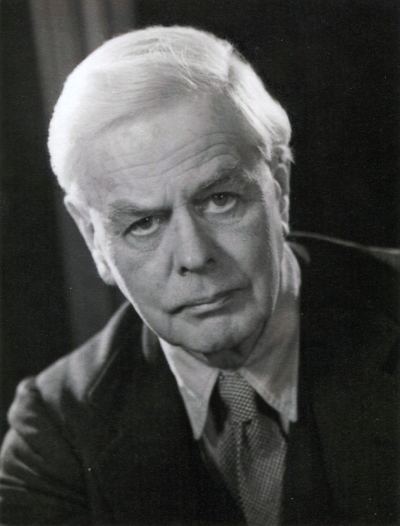
Hound of Heaven-on-Earth: Prior to his death in 1955, Lionel Curtis wouldn’t have had the slightest difficulty warning that the swamp that was, even then, the us Congress, rather than being drained, could today be the domain of gold-leafed demagoguery and crypto-fraudulent nepotism. Nonetheless, had Curtis known that the rapid unravelling of a rules-based world order played out, led by a depravedly indifferent us administration, and without American citizens fighting to return power to the people, it would surely have broken his 83-year-old heart. To that end, and until the end, Curtis hounded his fellow diplomats to seek solutions that built towards greater regional and global federalisation, to progressively deny the ilk of Netanyahu and his enablers the opportunity to wage war on neighbouring states.
image Chatham House
While Trump’s successor might succeed in designing a new regional order, the core assertion of Light the Fuse is that designing new regional orders is more difficultgiven the typically multiple, intractable issue in contention than designing, trialling, and implementing a new global order. A potentially powerful strategy is to entice the protagonists to take a giant step back in order to see the big picture, visualise the necessary mobilisation, and then light the fuse. Light the Fuse is the modello for exactly the new, people-based, world order called for, if the Great3rd Millennium Polycrisis is to play out other than horribly. And regarding whether time still remains for implementing such, at scale, compared with the three decades of performative copConference of the (Intergovernmental Panel on Climate Change) parties parties, the change would be at warp 6—arguably the fastest and, in general terms, the only viable route to the Great Mobilisation.
Glacier-collapse-causing 2026 Nepal-China floods, not least the thousands killed, may, for the Great Mobilisation, do what should not need doing, nearly four decades after Dr James Hansen testified to the United States congress, and the publication of his Storms of My Grandchildren , almost two decades ago.
Objectively, the big picture is the Great 3rd Millennium Polycrisis—Great , on account of its core, icecap-disintegration crisis. Only by apprehending the aching ephemerality of beaches, and indeed of ice ages, can a 20th century individual begin to appraise the beyond-urgent nature of the climate polycrisis, and push, even for a moment, abiding preoccupations aside sufficiently to consider a fresh, more fruitful approach. A smart-as-a-whip Trump successor would apprehend that she held all the cards necessary to offer Iran, West Asia, and the World, the deal of the 21st century. With sufficient humility, the United States could leave the region with all parties, from the river to the sea, respectively and respectfully sharing an overnight transformation from genocidal warmongering to a people-powered, nuclear-powered, nuclear-weapon-free, real-world Greater Fertile Crescent…
To be continued…
Long reign of reign-of-error While the musical comedy A Reign of Error —punning on the century-earlierReign of Terror5 September 1793 – 27 July 1794, First French Republic—was performed on Broadway in 1899, the reign-of-error pun may well be ancient. Be that as it may, its parting-shot use by foreign affairs commentator Simon Tisdall on 17 May 2026 is particularly deft, given the subject matter: the respective last-gasp terrorising by Trump–Netanyahu–Putin. Readers of The Guardian who may have wondered at the subeditorial missed opportunity to feature the pun in the headline need, however, look no further than The Associated Press and Dr Zac Gershberg’s devastatingly presciently titled, 2 February 2017 Trump’s Reign of Error, Season 1 . And while Trump’s Reign of Error, Season 2 might have made for an even more biting and entertaining follow-up, Gershberg and Dr Sean Illing’s The Paradox of Democracy: Free Speech, Open Media, and Perilous Persuasion promises an entirely fresh perspective to the insufficiently acknowledged, Sisyphean challenge, generation by generation, for fresh, young democratic communities to be built—that atrophy is a feature of democracy, rather than a flaw. But more crucially, the freedoms democracy demands, which include the freedom for disinformation on blatant scale of Truth Social to be spread, providing the freedom for all manner of dastardly demagoguery:
What we’re witnessing is a convergence of forces unleashed by novel media and popularist rhetorical styles that implode democracy from within.
New Enlightenment As ironic as it is instructive, China can lay claim to a New Enlightenment, but the West, much less the United States, cannotalthough some may claim that New Deal Progressivism is an approximation. Although the first New Enlightenment was initiated by the Chinese Communist Party in the 1930s, it was short-lived, re-emerging four decades later in the aftermath of the 1976 Tiananmen incident. That it ended badly in Tiananmen Square—synonymous in the West with the eponymous massacre, and subsequent executions, of 700–2600 people—a global New Enlightenment could nevertheless be contemplated. To be relevant, yea indispensable, it would nurture New Democracy and New Climate and Energy Science… To be continued… Return to text
Not one-hundred-percent pure An Aotearoa worthy of leading the beyond-urgent Great Mobilisation would need to be 100% humble. Not only does Aotearoa have plenty to apologise for, beginning with its government marketing agency’s shameless 100% pure New Zealand boast, it behoves any Great Mobilisation leader to be circumspect about its credentials, and its natural advantages, not least of allmoderating effect of the sea and relatively elevated land mass compared, say, with Bangladesh the temperature-moderating effect of the surrounding PacificPacific Ocean, albeit the major marginal sea to the west of Aotearoa is sub-named the Tasman SeaOceanPacific Ocean, albeit that part to the west of Aotearoa being sub-named ‘Tasman Sea’ on the 1569.4 km-longdogleg distance, measured North Cape to Bluff via Pencarrow Head, 788.1 + 781.3 kilometres (-34.415, 173.051; -41.3594, 174.8482; -46.6, 168.3333), narrow—9.5 kmmeasured from Hukatere Access Ramp, Ninety Mile Breach (-34.8981, 173.0860) in the west to adjacent Houhora Heads Road (-34.8344, 173.1548) in the east to 256.4 kmmeasured from the southern head of Milford Sound (-44.5729, 167.7811) in the west to Quion Point (-46.1548, 170.1714) in the east wide—twin main islands of the New Zealand archipelagoNew Zealand as an Archipelago:
An International Perspective, Jared M Diamond, 1990. That the Pencarrow heads of the harbour of New Zealand’s deliberately geographically centrally given that, when the capital was moved to Wellington in 1865, much north–south travel was by coastwise navigation, a central-siting prerequisite attribute was that the settlement chosen must be on or near a sheltered harboursitedgiven that, when the capital was moved to Wellington in 1865, much north–south travel was by coastwise navigation, a central-siting prerequisite attribute was that the settlement chosen must be on or near a sheltered harbour capital within a mere 3.4 km of the dogleg midpoint distance from North Cape to Bluff was a remarkable fluke. That the North Island was favoured was due in part to it, and the former capital Auckland, rapidly becoming the country’s economic powerhouse. Auckland-capital proponents couldn’t resist southern settler demands for a central, shores-of-Cook Strait, harbourside site. Wellington Harbour / Port Nicholson easy so off the only serious competition, that from the extraordinarily sheltered port of Picton, including because of the long slog involved up Tōtaranuiofficially: Queen Charlotte Sound/Tōtaranui, prior to the ready availability of steam-engine powered, screw-driven ships tugs, much less ships… To be continued… Return to text
New capital takes higher ground That Point Dorset, just inside the western heads of the harbour of New Zealand’s deliberately geographically centrally given that, when the capital was moved to Wellington in 1865, much north–south travel was by coastwise navigation, a central-siting prerequisite attribute was that the settlement chosen must be on or near a sheltered harboursitedgiven that, when the capital was moved to Wellington in 1865, much north–south travel was by coastwise navigation, a central-siting prerequisite attribute was that the settlement chosen must be on or near a sheltered harbour capital was exactly the dogleg midpoint between North Cape and Bluff—if 600 metrescloser to Bluff. North Cape to Bluff via Point Dorset: 784.5 + 783.3 = 1567.8 /2 = 783.9 - Point Dorset to Bluff = (North Cape -34.415, 173.051; Point Dorset -41.3289, 174.8357; Bluff -46.6, 168.3333)difference0.006% in nearly 1600 kilometres can be considered exact—is a remarkable fluke. That the North Island was favoured was due in part to it, and the former capital Auckland, rapidly becoming the country’s economic powerhouse. Auckland-capital proponents couldn’t, however, ultimately resist southern settler pressure for a central, shores-of-Cook Straitor as the three Australian commissioners hired (Docker, Murphy, and Gunn) to break the relocation deadlock referred to it, hopefully tongue-in-cheek, as: “Cook’s Straits”, harbourside site. Wellington Harbour / Port Nicholson easily saw off the only serious competition, that from the extraordinarily sheltered port of Picton, including because that shelter came at the cost of a long slog up the Tōtaranuiofficially: Queen Charlotte Sound/Tōtaranui sound, prior to the ready availability of steam-engine powered, screw-driven tugs, much less ships.
While Wellington Harbour served the capital well for its first seventy years, the absence of a site equal to the city’s signature wind gusts meant that since 1935 the first problematic commercial flights from there, the capital should have been moved back to the, by then, to the county’s far more populous, economic-powerhouse—Auckland. Aside from the obvious logical rationalisation, southern politicians could have enjoyed ample time to conspire against their Auckland colleagues on the flights from Paraparaumuin 1949, New Zealand’s busiest airport . While an act of parliament would have been proportionate, none was strictly needed and, to this day, Wellington is the country’s capital by custom only. Now, with icecap-disintegration locked-in-and-terminal, moving the capital towards, but not onto the Auckland/MakaurauStrictly, Tāmaki Makaurau, but Makaurau—reo Māori meaning “desired by many”—is Mahurangi Magazine’s longstanding suggestion as the name for the Auckland Council governance region isthmus, is a decision that should not require a random three Australian commissioners to be hired to advise on. Because while it might be entirely constructive to have the input of any one of the three environmental bean-countersthe term not meant derogatively except insofar as all three appear to be environmental economists, as opposed to atmospheric scientists, climate scientists, geophysicists, glaciologists, oceanographers, etcetera, etcetera that calculated the $1.9 trillion-by-2100 cost of sea-level rise to Australia, New Zealand needs to begin making decisions for herself if she is to become the Great Mobilisation leader the world instinctively looks to as the epitome of practicable response to the Great 3rd Millennium Polycrisis.
Ports present a particular challenge in world where multi-tens-of-metres of sea-level rise are already locked in. Certainly, an Intergovernmental Panel on Climate Change response might be to locate a site for a port city an arbitrary ipcc-saluting SSP2-4.5 1.3-metre-by-2100 sea-level rise. However, given Dr James Hansen’s healthy disdain for such flimsily based exactitude—
Passing through the 1.5c world is a significant milestone because it shows that the story being told by the United Nations, with the acquiescence of its scientific advisory body, the ipcc, is aload of bullshit.
—demonstrating a city-port solution that remains viable regardless of the rate and extent of icecap-melt, all the way to a probable, eventual 65-metre sea-level rise, would be profoundly instructive.
As unintuitive as it might appear at first blush, the buoyant-port and standard-gauge twin-track-railhead solution would emanate from Manukau Harbour—safely before the sea-level rise that simultaneously destroys the viability of the Port of Auckland and facilitates Portage Road to be restored to its ancient navigation purpose. Hamilton Airport, at an elevation of 52 metres, and extended to the 3000 metres it should have been on the completion of the current, 2026–27 runway extension, would allow New Zealand’s fourth-largest city to increasingly host capital functions on behalf of Makaurau, not least of all, ironically, when fog closes its less-than-optimally-equippedAuckland Airport boasts of having “the highest, Category III” instrument landing systems but fails to mention that Category IIIC could, by now, be the gold standard, both in respect to safely and fossil-fuel-wastage minimisation airport, frequented by far-from-optimally-equippedlaggard instrument-landing-system airlines should be denied landing rights in Aotearoa. It is akin to being allowed to sell cars without seatbelts aircraft.
With much of its housing sited at barely half the long-term viable, >65-metre elevation, Hamilton’s future is as part of a new, Volcanic Plateau capital city, where, for multiple reasons, nor would buoyant buildings be out of place. Hamilton’s planning for long-term southern migration to higher ground would wisely and fruitfully be combined with those of Makaurau. Air travel, by definition, is incapable of doing the minimalzero-carbon, much less net-zero (emissions) is a short-to-medium-term mirage, given carbon’s utter ubiquity-carbon heavy lifting. For that, for multiple joined-up-Great Mobilisation reasons, New Zealand’s future two northern islands, must be joined by a giant, double-track-standard-gauge-railway-capped causeway, the better part of Waitematā to Tīrau…
To be continued… Return to text
Disclosure The author of this novel modello is no longer the secretary of Mahurangi Action Incorporated or the Mahurangi Coastal Path Trust. The content published here, however,is that of the editorially independent, independently funded Mahurangi Magazine.