
Voting for and against, and with first past the post
Shirtcliffe: ‘It is an outrage. We should be rearing up on our hind legs about the delay in getting rid of [MMP].’
Team 1 2 3 Tune-Up MMP: ‘The only outrage will be if we are not permitted to fix MMP.’
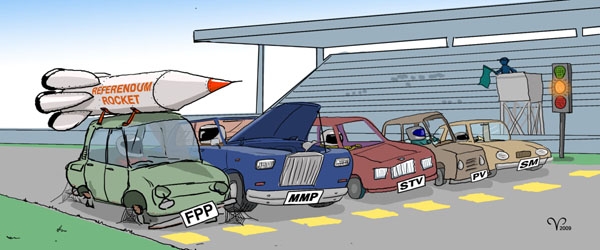
cartoon Majorlook Productions
It would be like lining up the 15-year-old family hack at Bathurst, without even checking the dipstick.
Mixed member proportional is about to be compared with a yet-to-be-determined range of other systems, with no indication that the reasonable alternative of simply tuning-up the existing system will be considered.
If the doctrine of continual improvement had been applied to the mixed member proportional system, there now would be no cause to spend $55 million on electoral navel-gazing, never mind the cost of implementing any new system.
At least in 1986, the money was spent on a royal commission, and one that did a particularly thorough job of evaluating the options and communicating its findings—the present referendum-only process could all too easily degenerate into a popularity contest.
A tiny South Seas democracy shouldn’t need to replace its electoral system twice in little more than two decades. But public discontentment has been fuelled by deep distain for an unnecessarily large parliament bloated by an unnecessarily large proportion of list members, who are seen as non-accountable.
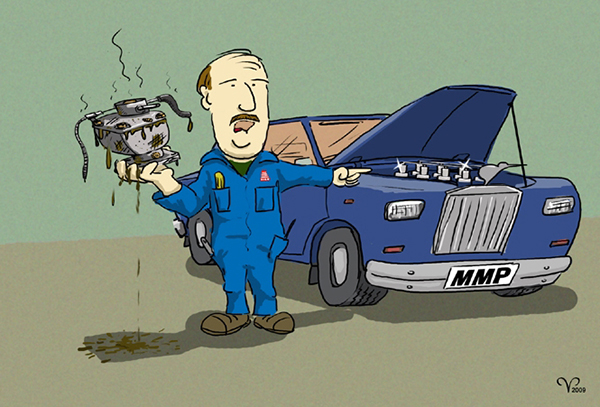
Mahurangi Motors: ‘Yeah, no, John, the ’96 model came out with the good ol’ vote-guzzling FPP carbie—you won’t believe the economy with 1 2 3 Tune-Up MMP fitted.’ cartoon Majorlook Productions/Mahurangi Magazine
Even with a two-referendum, six-year process, only the first two years will be involve any sort of exploration of voting system alternatives—after 2011 it becomes a two-horse race.
The first referendum should result in the majority wanting to consider another electoral system—it is undemocratic to not consider alternatives. The danger though is that unless the government includes a tuned‑up MMP in the alternatives, unmodified MMP will likely be pipped in a first-past-the-post showdown by one of the alternatives, which will include first-past-the-post.
A well-conceived process would require that preferential voting is used to rank the alternatives—a first-past-the-post showdown risks the vote being hopelessly split between similar options, potentially allowing first-past-the-post to come through the middle and win without majority support—its forté, in fact!
This puts those who value the proportionality introduced by MMP in an invidious position. The best strategy for preventing a reintroduction of first past the post, might well be to vote for it in 2011 and against it in 2014, in the distinct possibility that it will win the 2011 round.
This is on the assumption that, if it is first-past-the-post that goes head-to-head with mixed member proportional in 2014, the latter is likely to win.
However, if mixed member proportional is pitted against the supplementary member system, all bets are off and Aotearoa might be back with first-past-the-post, dressed up as lamb.
1 2 3, tune-up MMP !