
Open-ground indigenous plants establishment trials
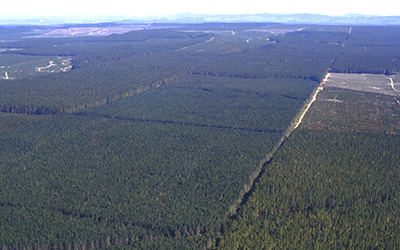
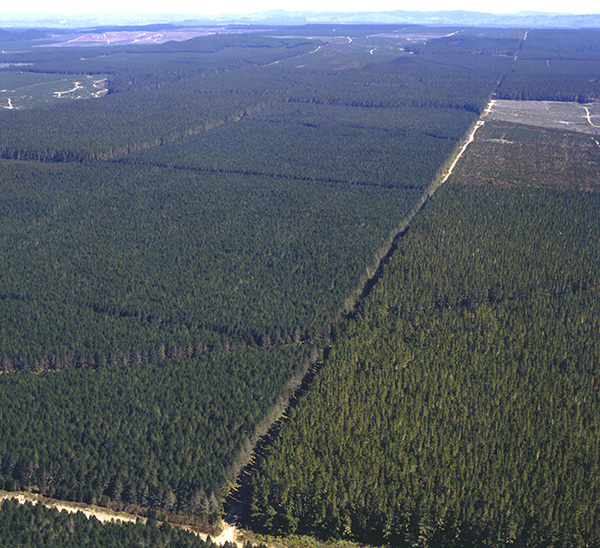
Carbon Consumer: While exotic forests are good, indigenous forests can sequester carbon dioxide even longer, including as quality timber that can last centuries. photographer Jonathan Barran
Aotearoa leads the world in radiata pine forestry. It also leads the world in radiata pine forestry nursery practices. Consequently, it is surprising that indigenous nursery practices have failed to piggyback on the success of the exotic forestry industry.
As might be expected, large-scale forestry requires economically-priced plants of consistent high quality and in large numbers—radiata pine seedlings cost less than 30 cents each.
Species indigenous to Aotearoa can cost 10 times more—$3.30 each for a potted seedling. But not only is the seedling cost higher, the total cost of establishing an area of self-maintaining plants can be exorbitant—about $180 000 for the six hectares of established indigenous vegetation needed under Rodney District Council rules for creating a residential title.
This price difference is responsible for a perception that indigenous species are somehow ‘special’, and unsuited to being raised economically by forestry methods. Forestry nurserymen with experience in raising both, know there are no blanket physiological differences between exotic and indigenous species. But until the Mahurangi Action Plan and the Sustainable Farming Fund open-ground trial initiated by Mahurangi Action, no scientifically designed comparisons of the two very different nursery methods had been conducted.
Forestry methods Predominant radiata pine nursery practice is to sow seed directly into open-ground beds. The roots are subsequently mechanically pruned, which results in a compact, rather than elongated, root mass. The plants are taken from the nursery bare-root (without soil), which is also the traditional manner of establishing vegetable seedlings, roses and fruit trees. An individual forestry nursery typically produces in excess of a million plants per year.
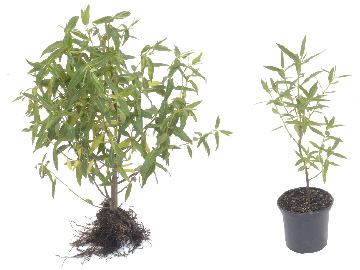
Sibling Rivalry: Samples of plants propagated at the same time from the same seed source. On average, the forestry-style plants (left) developed canopies and stems twice the diameter of the container-raised plants. photographer Jonathan Barran
Container methods Standard indigenous nursery practice is to germinate seed in plug trays and to then grow on the seedlings in plastic planter bags or pots, or in root trainers. Individual indigenous plant nurseries typically produce tens or hundreds of thousands of plants per year, as opposed to millions.
Contents
- Heading for Open-Ground
- Left to Market Forces
- Deforestation Catches Up With the Catchment
- Search for Silver Bullets
- Trial Transfers to Taupō
- Two and Three Times Diameter
- Tree Scientist’s Dream
- Toetoe Gets to Play
- War of the Weeds
- Transplantation Shock
- Less-Shocking Systems
- Survival at Sandspit Road
- Silver-Tongued Strategy
- Indigenous Forestry Strategy
- Sustainable Splash in Lake Taupō
- Growing Trees from the Tractor Seat
- So Much for Science
- Bottom Line
Indigenous nursery practices left to market forces
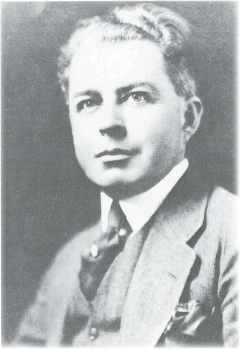
First Plan for Forestry: First director of forestry, Leon MacIntosh Ellis, brought to Aotearoa in 1920, from Canada, France and Scotland, a broad vision for forestry. photograph New Zealand Journal of Forestry (1989) 34(2): 15–18
Aotearoa’s vast exotic forestry industry didn’t just evolve. It specifically resulted from a 1925 government decision to plan for self-sufficiency, in the face of dwindling natural forests. And, by 1984, the Forest Service target of one million hectares of plantation forest was reached.
Although plantation radiata pine was highly visible face of the Forest Service, an integral part of its brief was the management of indigenous forest. While this mostly concerned naturally established forest, work began, in the 1960s on planting. But it was too late for a planted indigenous forestry infrastructure to develop. The Forest Service, from the late 1970s, fell victim to its unmitigated success as ideologically motivated forces mounted a determined bid to privatise state-owned forests. In 1987, the Forest Service was disestablished, delivering the future of forestry to the vagaries of market forces.
Critically, for the prospects of cranking up indigenous plantings with forestry methods, the Forest Service’s demise coincided for a surge of interest in restoration planting. Left to market forces, the modest demand for indigenous plants was met by small family-owned nurseries and the new production nurseries and garden centres that were, by then, beginning to eclipse them. Such domestic plant nurseries had a long supplied indigenous plants—shrubs and trees grown primarily for aesthetic rather than restoration purposes.
The production nurseries and garden centres were early to adopt the planter bag methods that had initially gained popularity in Latin America—part of the global plastic bag revolution that commenced in the late 1950s.
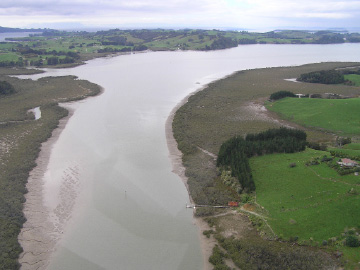
Worst-Silted Section: Mahurangi River above Dawson Landing is so choked with sediment that navigation by the Jane Gifford is severely tide-curtailed, in spite of such flat-bottomed scows being specifically designed to work the region’s shallow harbours. photograph Auckland Regional Council
An immediate issue with propagating potentially long-lived species in plastic bags was the root circling that all too readily occurs. Such root perversion is an anathema to forestry nurserymen, who understand the necessity of a sound root system for the attainment of mature, millable trees.
Two nurseries (one North Island, one South Island) persisted with open-ground, or forestry, nursery methods. But with planters—typically volunteers—increasingly unfamiliar with establishing bare-rooted plants, the market shrank until Taupō Native Plant Nursery, for example, was producing only harakeke, more or less regularly. Thus, in the absence of a government strategy, the infrastructure necessary to establish indigenous species on a forestry scale failed to arise ‘organically’, and three decades of potential momentum have been lost. Consequently, extent of indigenous amenity, restoration and production planting has been a fraction of what would been achieved with the same expenditure of, mostly public, money. The imperative for Forest Service-scale planting was patent, and nowhere more so than in the Mahurangi.
Mahurangi deforestation catches up with catchment
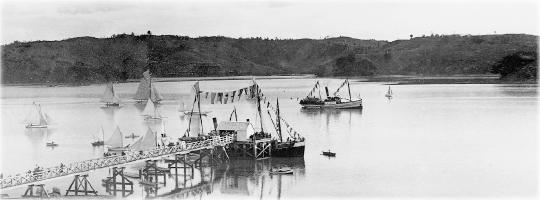
Beyond the Regatta: Mahurangi photographs from the early 1900s depict a largely denuded landscape. photographer Henry Winkelmann 1901 publication Jade River : A History of the Mahurangi
It was all quite counterintuitive. With the landscape looking greener than it had since the deforestation of the 1800s, how could the Mahurangi Harbour be choking to death?
Auckland Regional Council scientists had not anticipated the disturbing picture that they had built up, over 10 years. Their sampling programme had been designed to benchmark the Mahurangi and other estuaries, before significant development occurred in the respective catchments.
The regional council’s previous work on sediment had been concentrated on urban catchments, where the often-catastrophic impact of earthmoving on stream and estuary fauna was expected and well understood. Largely undeveloped, the Mahurangi’s good luck was to have been included in the benchmarking programme. The Mahurangi studies indicated that sediment-sensitive benthic communities of the harbour were becoming increasingly stressed—cockles and horse mussels in the areas sampled had ceased to breed. The proximate likely cause was an elevated sediment accumulation rate. But in the absence of any obvious increase in incoming soil, it was suspected that the harbour’s ability to shuck off its sediment had somehow reduced.
It is instructive to observe the plumes of mud-coloured water that run well out from the mouths of the neighbouring Pūhoi and Waiwera rivers after heavy rain events, in comparison to the relatively clear water off the Mahurangi Heads. The harbour’s tidal prism (flushing volume), in relation to its catchment area is much larger than is the case with the nearby Waiwera and Pūhoi estuaries, which are regularly flushed free. The Mahurangi, to its detriment, is all too efficient at retaining its sediment.
Regardless of the ultimate cause, the scientists determined that it was time to act. To ‘kick start’ the response, a five-year action plan with a regional council budget of nearly $3 million was announced. While it was portrayed as a joint initiative with Rodney District Council, there was to be no additional budget contribution from that quarter. The funding was targeted primarily at assisting pastoral property holders retire and restore riparian margins. Unsurprisingly, this was considered the obvious and immediate priority.
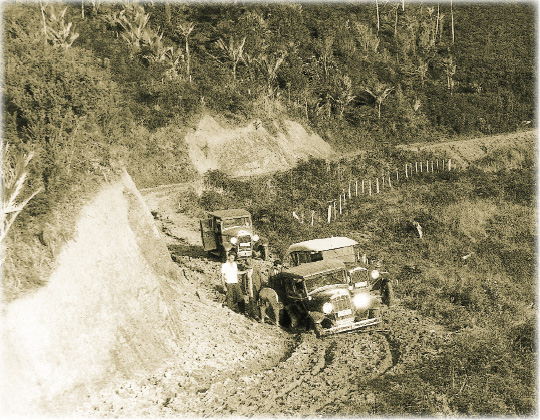
Mountains of Mud: ‘Warkworth in winter was an island in a sea of mud.’ publication Changing Times Kit de Latour
However, with the restoration of riparian margins alone calling for some 20–40 million plants, and even larger area of the catchment in need of retirement, it was clear to observers that a long-term strategy was called for. If the most erodible of southern-facing slopes were to be retired—say 10% of the third of the catchment that is of steep terrain—another 200 million plants were going to be needed.
Meantime, with a view to assisting volunteer groups to plant areas of public land, the regional council offered to help establish community nurseries. When Friends of the Mahurangi sought professional advice, it was less than encouraging. If the objective was to reduce costs, experienced nurserymen advised, having plants grown under contract by production nurseries was likely to be more effective. And while the Rodney district boasts a superb community nursery exemplar, at Tāwharanui Regional Park, it was thought unlikely that the same model would attract comparable dedication or make a quantifiable impression on the Mahurangi catchment, which is more than 20 times the land area. The hunt was on to find an economically sustainable means of reviving the harbour.
Historical footnote Large-scale deforestation of the Mahurangi catchment occurred in the mid to late 1800s, but the process spanned a century dating from the establishment of Gordon Browne’s spar station in 1832. Browne’s business received a setback when hmss Buffalo called in 1834—spoiling things, in his opinion, by paying local Māori too much for their labours extracting kauri spars. Things only got worse. When operating from Mercury Bay, two shiploads of his spars were condemned by the admiralty—Browne suffered a mental breakdown.
Mahurangi and the search for silver bullets
The local horticulturist’s opinion was compelling:
Harakeke’s the answer, I reckon.
Craig Hoskins had formed his view of the value of harakeke during a coast-crawling kayak expedition that took him from Whangaparāoa to the Bay of Islands. Observing the state of coastal vegetation at close quarters, and while camped on numerous beaches along the way, he marvelled at the versatility and resilience of harakeke. He was also perturbed by how much of the coastline sorely needed attention, in respect to its vegetation.
The notion that a large-scale harakeke nursery might be combined with wastewater re-use was put to Rodney District Council. Infrastructure planner Jo Floyd promptly offered that a trial might readily be conducted at the council’s Ōmaha plant—where treated effluent irrigates trees and grass, but with the bulk being supplied to the Ōmaha Golf Club for use in its subsurface irrigation system. Concurrently, Auckland Regional Council was urging Friends of the Mahurangi to consider establishing a community nursery. The regional council suggested the group seek the assistance of ecologist and indigenous species restoration contractor Rodney Straka. When learning of the offer of a trial site at Ōmaha, Rodney mentioned it might be suitable for open-ground methods.
A third strand was suggested by Waitakere City Council indigenous species restoration advisor Chris Ferkins, who had been encouraged by the results of establishing sites with a 50:50 mix of toetoe and other indigenous species, in achieving canopy closure earlier. This suggested that the faster growing toetoe, as opposed to harakeke, might be the magic bullet in driving down establishment costs.
Regardless of what trials were undertaken, Chris urged it was all-important that they be conducted scientifically—something he had not managed to achieve in respect to his checkerboard toetoe plantings. He recommended Dr David Bergin citing his particular flair for making the science accessible—the attractively designed and illustrated Indigenous Tree Bulletin series.
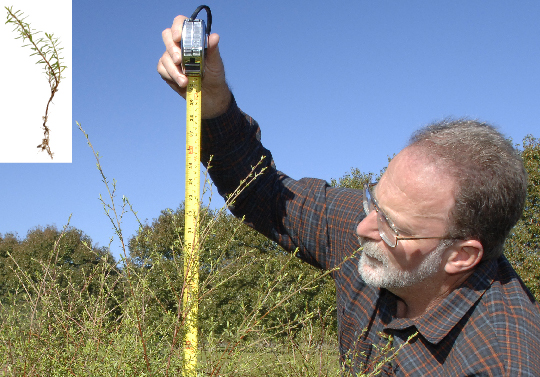
Almost a Metre: This kānuka grew 95cm in height in six months open-ground at the Ōmaha Wastewater Treatment Plant site, from a seedling of the size of those in the inset. photographer Jonathan Barran
Dr David Bergin was duly contacted. Serendipitously, his mentor Jaap van Dorsser had adapted the open-ground methods initially developed by the Forest Research Institute to raise eucalypts, to raise indigenous species. An application to the Ministry of Agriculture and Forestry’s Sustainable Farming Fund was successful, following an unsuccessful one to the Ministry for the Environment.
The trial originally sought to establish a pilot open-ground nursery that utilised treated wastewater for irrigation. However, after successfully producing one small crop of indigenous plants at the Ōmaha Wastewater Treatment Plant site, it was realised that a much larger but more narrowly-focussed trial was needed to provide a convincing comparison with the container methods, which are pervasive in indigenous plant nurseries. What was needed was for the plants to be raised by a nursery already equipped and experienced in open-ground methods.
Two nurseries on the volcanic plateau were contacted, in interests of their proximity to key project members. One, Taupō Native Plant Nursery, had the added advantage of having both open-ground and indigenous capability—the only other nursery with both capabilities is Appletons Tree Nursery, which is located in the South Island. Taupō Native Plant Nursery responded with enthusiasm, whereupon it was learned that that nursery had recently made the decision to step up its open-ground capability. This, potentially, was a perfect marriage of commercial and community interests.
Eucalypt Footnote The Forest Research Institute found eucalypts to be more demanding to raise than radiata pine. The methods that it developed in response also proved to be a superior for raising radiata pine, and thus became the standard method for that species.
Toetoe Footnote Chris Ferkins’ work, and the Hepburn Creek trial designed to test the concept, involves toetoe—specifically Cortaderia fulvida—and not the invasive, razor-sharp-leaved South American pampas.
From Ōmaha, the trial transfers to Taupō
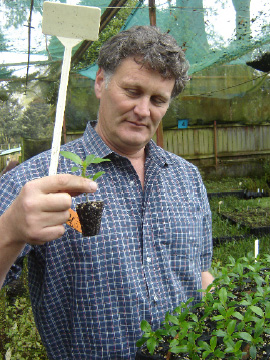
Consistent Methods: Taupō Native Plant Nursery’s Philip Smith holding a Mahurangi karamū seedling ready to be transferred to an open-ground bed. photographer Michael Bergin
Proving open-ground methods worked would be the easy part. The real challenge was always going to be to subsequently get anybody to take a blind bit of notice. In particular, nurseries needed to be convinced to invest in the equipment and expertise required to raise indigenous species open-ground.
Transferring to Taupō, aside from ensuring a more focussed and robust trial, guaranteed that the work would be noticed, given the high profile of the Taupō Native Plant Nursery.
Fortunately for the initiative, a cornerstone of the Sustainable Farming Fund’s approach is flexibility. Groups are urged to seek permission to change a project’s objectives, rather than persist down a particular path simply because that was the thinking encapsulated in the application. The fresh approach permitted a more focussed and robust comparison of open-ground and container nursery methods.
The focus was now squarely on comparing how well the plants establish—with hindsight, this should have the first step in kick-starting the open-ground, forestry-style methods. The economics of establishing indigenous species has to do with more than simply the cost of the plants. A much more useful measure is the cost of achieving canopy closure—the point at which the planted species are generally able to prevail in their competition with weeds.
Three methods compared
The three nursery raising methods are compared
- Large containers—PB3-sized polythene planter bags or pots
- Small containers—Hillson-sized root trainers
- Open-ground.
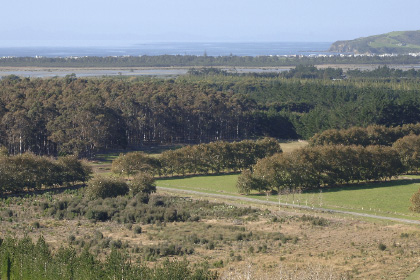
Wide Open-Ground Opportunity: The trial might have transferred to Taupō, but the under-utilised land at the Ōmaha wastewater treatment site could yet be deployed to produce millions of indigenous coastal plants, open-ground, to increase resilience to the inexorably rising sea level. photographer Jonathan Barran
PB3-sized planter bags and Hillson-sized root trainers are representative of the major container types commonly used for raising indigenous species.
Most indigenous revegetation species are raised in PB3 polythene planter bags or containers of similar size.
Root trainers are also a popular choice. These, by requiring less potting medium and space in the nursery are considerably cheaper than seedlings raised in pots or planter bags. Hillsons Rootrainers are the smaller of the two sizes in common use.
The open-ground technique being trialled is essentially that developed by the Forestry Research Institute in the 1960s and 1980s, adapted from the methods that have been standard practice for decades raising millions of radiata pine seedlings annually for the exotic forestry industry.
Six species trialled
Six indigenous species commonly used for restoration planting are trialled—three shrub hardwoods and three monocots. The three shrub hardwoods:
- karamū—Coprosma robusta
- koromiko—Hebe stricta
- mānuka—Leptospermum scoparium
The three monocot species:
- harakeke (flax)—Phormium tenax
- tī kōuka (cabbage tree)—Cordyline australis
- toetoe—Cortaderia fulvida
More than three methods and six species could have been included. However, with the need for at least 100 individuals to be established, 18 combinations calls for a minimum of 1800 plants to be propagated. And that only provides sufficient plants for one trial site.
In the event, more than 21 000 plants were propagated, which subsequently allowed for three quite different trial sites to be established and for filler species trials.
Propagation
When the Forest Research Institute raised indigenous species open-ground, seed was first germinated in seed trays before being lined out—transplanted into rows in the open-ground nursery beds. In the Taupō trial, germination was performed in plug trays, which is now standard container nursery practice. It is also standard practice in forestry nursery for species that cannot be grown reliably from seed, as can radiata pine—one of the reasons it can be produced so comparatively cheaply.
Seed was mostly collected in the Mahurangi, in consideration of the establishment trials being located in that catchment. The balance of the seed was of Auckland regional provenance.
Open-ground grows to two and three times diameter
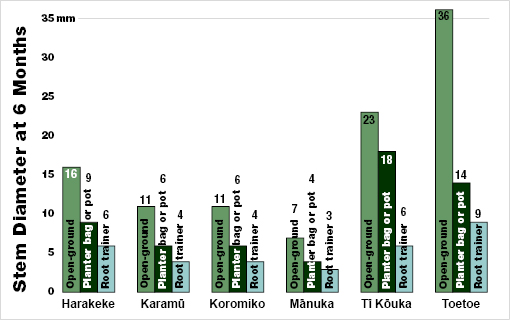
Stems Streets Ahead: After six months in the nursery, the stems of the open-ground plants, measured at the root collar, are respectively twice and three times the diameter of the potted and root trainer plants. bar chart data Mark Kimberley
First surprise was the pronounced difference in size.
After six months in the nursery, the average diameter of the stems of open-ground plants was twice that of the potted plants and three times that of the root trainers.
The canopies were similarly larger.
Canopy, of course, is the key to the size difference. Plant growth is primarily dependant on sunlight. Hence the more foliage, the more photosynthesis can occur, and hence the greater growth. The open-ground plants, having virtually unlimited elbow room, were able to grow to their full potential.
In contrast the container-grown plants, spaced according to the dictates of their containers, have only a limited canopy space—25 and 225 square centimetres respectively for root trainer (Hillson-sized) and potted (PB3-sized) as compared with 400, at the open-ground spacing used.
The height of the plants also emphasised the imperative for photosynthesis. The densely spaced container-grown plants were not proportionately shorter, reflecting the competition for sunlight. The result was spindly plants—in the case of the root trainers, extremely spindly.
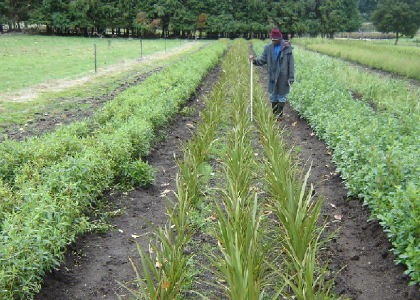
Many Measurements: Plant height, crown cover and stem diameter of at least 50 individuals of each six species by the three raising methods were recorded—3848 measurements. Pictured assisting is Tare Kaere, a forestry student from Vanuatu. photographer Michael Bergin
Measuring more than a few
In order to produce an accurate picture of the comparative growth rates, at least 50 specimens of each of the six species, of each of three raising methods were measured—nearly 1000 plants.
This measurement programme would later be dwarfed by the number of measurements, 6242, taken in the field after the plants were established, which is where the size difference, it could be said, really matters.
Root circling
As mentioned earlier, a significant concern with plants raised in containers is the phenomena of root circling. Root circling results from the universal response of plant roots to detour when encountering an impervious surface. Unfortunately, when the impervious surface is wall of cylindrical container, roots are unable to respond other than to grow in gradually, but never-the-less ever decreasing, circles—as the space for root growth diminishes.
Even more unfortunately when established, while the no-longer-constrained roots can finally resume their growth away from the stem, the spirals lack any mechanism for straightening. Instead, with the root growing ever thicker, self and mutual strangulation occurs.
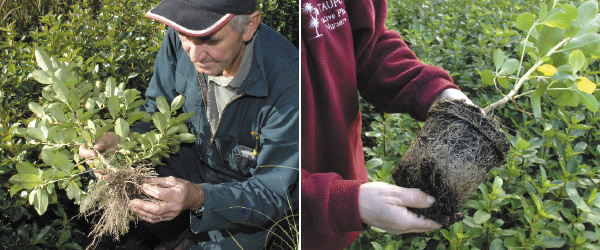
Roots Straight, Roots Circled: The open-ground plant on left displaying roots mechanically pruned rather than constrained to circle endlessly inside its plastic container. photographer Jonathan Barran
For monocots, the consequence of root circling is not nearly as injurious. But in species that rely on a well-developed buttress root system for support, the result can be catastrophic failure of the entire tree.
Root system distortion and quality of quantity of feeding roots are largely ignored where container-grown stock is used in revegetation programmes (Bergin and Gea 2007).
After six months in PB3-sized planter bags and pots, all species were displaying root circling, some to a pronounced degree.
Sandspit Road site a tree scientist’s dream
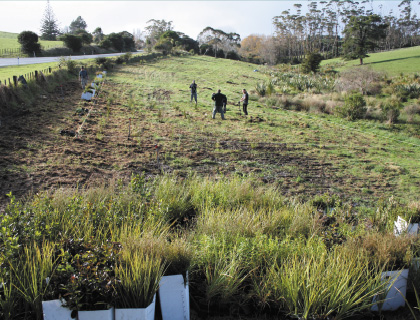
Textbook Trial Site: Sufficiently large to accommodate eight replications of the randomised trial layout, and next door to the Parsley Pot Café! photographer Michael Bergin
Indigenous plant scientists generally have to make do with what is on offer, by way of trial sites. Dr David Bergin’s wish list, for the open-ground and container-raised plants comparison, was for an area of reasonably consistent contour and soil type, and not so narrow as to expose to trials to too much edge effect, and in the Mahurangi catchment—in deference to the project’s initiator.
Mahurangi farmer Shelley Trotter had just the site. And not only did it meet the ideal trial criteria, it was also accessible, being beside Sandspit Road. There is even ample pull-off width beside the busy road for parking, and a café next door!
But wait, there’s more. The trial area nicely augments a riparian planting, created earlier, and establishes a significant length of indigenous vegetation to a roadside landscape that currently has little such cover.
The second site is quite different.
It is neither in the Mahurangi catchment, nor is it accessible. But those deficiencies it more than makes up for by bringing in two additional terrain types: River flat and steep exposed hillside. It is located in the Silverdale district and accommodates two blocks the size of that at Sandspit Road, and with similarly minimal edge effect.
The trials were laid out, in early July 2008, by Dr David Bergin, assisted by three of his offspring. The trial layout is a considerable exercise. In addition to the positions of each of the 7000 plants needing to accurately determined, and the appropriate 18 different options of species and nursery type were laid out for each row of 10 plants, for the planters.
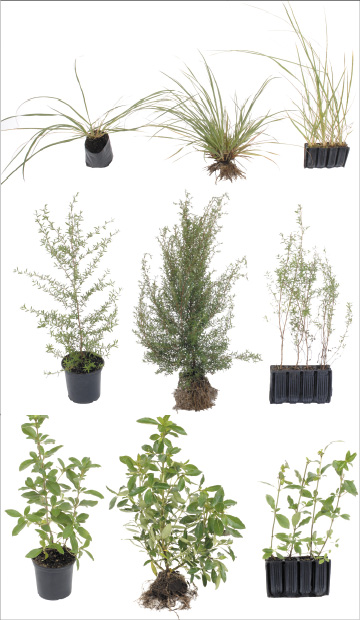
Head Start: The open-ground plants, centre, being on average twice the stem size of the potted plants, left, and three times that of the root trainers right. The question as to whether the open-ground plants retain their the initial advantage, after being established at the trial sites at Mahurangi and Silverdale, is about to be answered. photographer Jonathan Barran
The randomised and replicated layout was designed with the input of biometrics expert Mark Kimberley. In each block are sets of three rows of each species, randomly determined. The order of open-ground, PB3-sized container and root trainer, within those rows, is also determined randomised. The randomising ensures that bias, intentional or unconscious, does not influence the positioning of species or raising style.
Planting itself proved to be more time consuming than for normal restoration planting, including because the correct, rather than nearest to hand, plant is used and because the need to plant reasonably accurately to the 1.4-metre grid—ensuring a consistent space between the plants. The space factor becomes critical as the plants approach canopy closure. Planters were all employees of Scrub Growers, a participant in the open-ground project.
Edge effect Individuals at the edge of a trial are exposed to a somewhat different environment from those in the body of the trial. The impact of wind and browsing, for example, can be greater at the edges of a trial. In addition to avoiding elongated trail plots, additional rows of are established to buffer the trial plants.
Canopy closure The point at which the canopy of plants and/or trees becomes continuous, or closes, is the second of the two most important events in forest establishment. Until canopy closure occurs, there is considerable opportunity for competing weeds to overtop the plants being established. After the canopy becomes continuous, the most potentially troublesome competing species, being shade intolerant, will cease to threaten the planting.
(The first critical event, of course, is the initial establishment of plants, either naturally, by direct seeding or by transplanting seedlings.)
Direct seeding The obvious first question that should be asked when contemplating, for the first time, the establishment of indigenous trees or other indigenous vegetation is why start with transplants, rather than from seed? Not surprisingly, this approach has been attempted with a number of species, and on a number of occasions. Laying mānuka brush with ripe or ripening seed is one approach that has been used, with some success. Another approach is allowing mānuka and tōtara to regenerate through lightly grazed pasture.
While some of these approaches appear promising, to date consistent establishment on any scale has only been successful with nursery-raised plants.
Miscommunication means toetoe gets to play
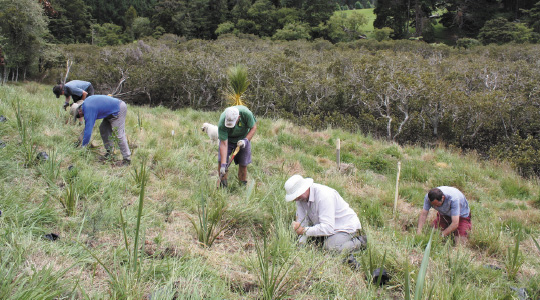
Hepburn First for Science: The efficacy of toetoe and harakeke as a filler species is scientifically trialled for the first time, on esplanade reserve land at Hepburn Creek. photographer David Bergin
Miscommunication can have entirely happy consequences. As mentioned earlier, one of the strands in the exploration that led to the open-ground and container-raised indigenous plants comparison was the proposition that toetoe planted 50:50 as a filler species would reduce the time and cost of achieving canopy closure.
Indigenous species restoration advisor Chris Ferkins, principal advocate of toetoe as a filler species, considers toetoe to be the optimal indigenous species both to achieve canopy closure, and to restore the damp, shade conditions enjoyed by indigenous ground-dwelling fauna.
Three factors are responsible for the high cost of establishing indigenous species, as compared with exotics:
- The cost of plants
- The cost of planting
- The cost of maintenance.
Depending on plant size and spacing, up to eight years of maintenance can be necessary to protect plants from competition by weeds—kikuyu the killer in the north, blackberry the bête noire of restoration planting the south.
An obvious strategy would be to combine toetoe produced open-ground cheaply and in high volumes as filler plants to drive down the average cost of plants and at the maintenance costs by much reducing the time to canopy closure.
If it worked, a pivotal breakthrough in establishing indigenous species will have been achieved.
In spite of the potential of open-ground toetoe-as-a-filler, it was reluctantly decided that adding that element to the open-ground and container-raised comparison would result in a trial with far too many variables.
The first priority had to be testing whether open-ground methods were indeed competitive with container methods that predominate.
Then, far too late in the year than planting should generally be contemplated, it was realised that, as a result of an earlier miscommunication, the project was obliged to take delivery a considerable surplus of plants raised for the trial, in PB3-sized containers. When it was then learned that a large proportion of the plants were toetoe, it was decided to make a virtue of the situation by establishing a 50:50 toetoe trial.
Because the trial would not also compare open-ground and root trainers, it only needed to be a third of the size initially contemplated.
At luck would have it, an esplanade reserve at Hepburn Creek, Mahurangi had recently been re-fenced. The contour and soil type was reasonably consistent, and a neighbouring property holder was motivated to help establish and care for the planting. Critically, given the lateness of the season, the neighbour was also able to supply water to the site.
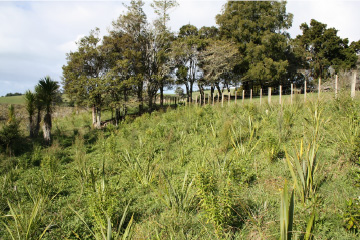
Too Soon to Say: Early indications are that while toetoe may prove to be a quicker filler than harakeke, it is initially much more vulnerable to smothering by competing grasses. photographer Michael Bergin
Then, the morning (20 November 2008) planting was to begin, it was realised that another opportunity was available. The high proportion of harakeke meant that the trial could be a three-way comparison:
- 50:50 toetoe and four other revegetation species
- 50:50 harakeke and four other revegetation species
- Six revegetation species including toetoe and harakeke.
There were several reasons for also trialling harakeke as a filler species. The main one was that harakeke, over many decades raised open-ground, had proved to be the singular species that was ‘bomb proof’ at the establishment stage. This is attributed to the fleshy root system of harakeke, which is not subject to the desiccation rates that bedevil most plants when bare-rooted. If there was a delay in the planting, of if the soil was unseasonably dry, harakeke survived when other species raised open-ground perished.
It was the reason that harakeke was the only open-ground species that Taupō Native Plant Nursery left in its catalogue.
Further reasons to include harakeke was that the vigour the displayed early in the Sandspit Road and Silverdale trials, relative to the toetoe, and the likelihood that it can be readily grown from seed, open-ground. If the expensive seedling plug stage can be eliminated, harakeke could be produced, potentially, as cheap as (chipboard!) radiata pine seedlings.
Chris has found that making every other plant a toetoe, checkerboard-style, weeds are beaten in around nine months. Then, because toetoe is light-dependant, it eventually bows out in favour of the taller growing shrubs and trees planted.
It’s not pampas Toetoe, in the northern part of the North Island is generally unloved. But in fact it is all but non-existent, compared with the invasive South American pampas, which tragically is now endemic. The quick way to identify this exotic pest is by the profusion of curled leaves at the base. The indigenous species don’t have these carpenter’s plane shaving –like leaves. Nor do they have the carpenter’s plane –sharp edges.
First plants face war of the weeds
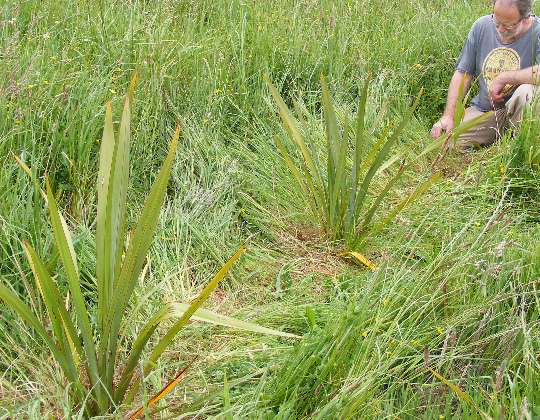
The War Go On: Potted (foreground) and open-ground (middle) harakeke established 17 months at Sandspit Road are safe from smothering. The root trainer –raised plants that have survived, one which Cimino kneels before, have suffered badly in their competition with weeds and are barely taller when they left the nursery. photography Majorlook Productions
Weeds were not part of the original equation. When designing the trial, the focus was squarely on a straight comparison of the establishment rates of open-ground, potted or bagged, and root trainer –raised plants. Comparative resilience to the impact of competing weeds, strictly speaking, should have been left to a subsequent, or additional, trial.
In the event, some early preferences of the property holder and planting contractor, and then the weeds themselves, determined that the trial would be a real world one—the plants being subjected to a high degree of competition from weeds. Strong competition from weeds, of course, is not an uncommon situation in restoration plantings.
The plants on three of the four sites were fully released in December 2008, but by that time, the smaller plants were difficult to discern amongst the competing grasses. The root trainer –raised toetoe were particularly difficult to locate, occasionally consisting of only two or three slender, light-deprived leaves. In spite of this, on the Silverdale river flat site, every individual was accounted for.
Weed growth on the steep hillside site at Silverdale was judged to not threaten the trial plants, which accordingly were not released.
Releasing was done by two methods:
- Mechanical—weed eater and hand sickle
- Chemical—glyphosate-based herbicide.
Mechanical methods were used to release the harakeke, tī kōuka and toetoe. These monocots are susceptible to the herbicides that can otherwise be used to control weeds and grasses competing with woody species. While there are techniques that can be used to minimise damage to monocots—harakeke is thought by some to be comparatively resistant—the risk to the trial were considered to be too great. A powerful weed eater with tungsten wire –filled cutting cord was used to clear the bulk of the competing vegetation; a hand sickle was used the clear the remaining vegetation from around the trial plants.
Eleven months on, as this report is written, the need for releasing is beginning to be assessed. Although seasonal weed growth has yet to peak, it is clear that most of the plants will survive the competition. It is equally apparent that the growth of most trial plants will be less than optimal, if there is no intervention.
In the next section, the extensive measurements taken will be discussed in detail, but the gamble to use minimal releasing appears to have paid off, in the pattern that is emerging.
Transplantation and the inevitable transplantation shock
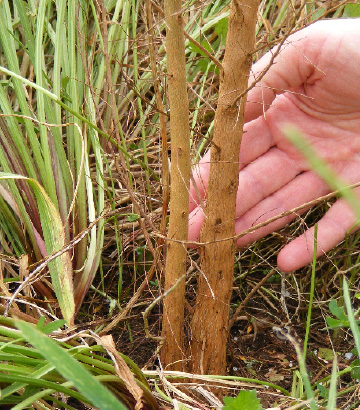
When They Are Good: Although mānuka is particularly subject to transplantation shock, as can be seen by this specimen (established 17 months) with its 25-millimetre stem, the species can do extremely well. photography Majorlook Productions
There is nothing intuitive about open-ground methods.
Why would plants be untimely ripped from the soil and replanted, when by starting life in a container of suitable media they can be eased into ground with minimal disturbance of, often delicate, root systems?
Open-ground, like democracy, could be said to be the worst system except all the others that have been tried.
Transplantation shock is the singular worst aspect of the open-ground system—some degree of shock is unavoidable when plants are bare-rooted. While the shock can be minimised, it cannot be eliminated altogether. It can range in impact from mild setback to a plant’s progress, to death.
Mānuka is particularly prone to transplantation shock—once it is lifted, the clock is running very fast. Harakeke, in contrast, barely seems to notice the indignity. This is probably largely because of its rhizomes—root–like underground stems—which resist desiccation when exposed to the air.
The factors involved with transplantation shock include:
- Physiology of the species
- Seasonal growth stage—vegetative flushing
- Weather when lifting and planting
- Weather subsequent to planting
- Soil moisture content during and subsequent to planting.
Clearly, all these factors also affect container-raised plants, and probably in inverse proportion to the size of the container, relative to the size of the plant.
A number of strategies exist to reduce the transplantation shock to open-ground plants:
- Choice of species
- Lifting mid winter
- Antitranspirant applied to foliage
- Hygroscopic gel applied to roots
- Plants stored and transported chilled
- Minimising exposure during planting
- Minimising elapsed time between lifting and planting.
Because of the higher degree of planning and knowledge required, a rapid change from container to wholly open-ground methods is most unlikely. However, open-ground plants could rapidly become mainstream in the establishment of indigenous species, if introduced a strategy to reduce establishment costs as a high volume, low cost, quickly planted filler species.
In a word: Harakeke—but more of that later.
Open-ended quest for less-shocking systems
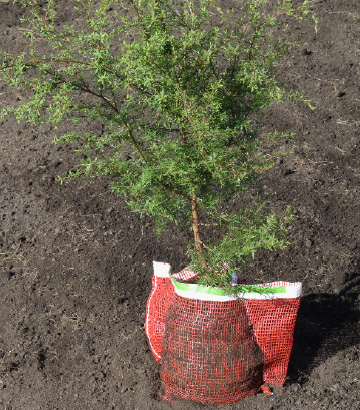
It’s Okay to Mock: A crude mock-up of the eNZopen™ hybrid open-ground container concept. photographer Jonathan Barran
There are no end of alternatives.
The landscaping industry in particular, and particularly in the United States, has spawned myriad containers designed to prevent root circling, the best known of which are the various root trainers.
To prevent or reduce root circling, the following mechanisms are employed:
- Toxic container linings
- Vertical grooves to ‘train’ roots downward
- Air ‘pruning’
- Fabric pruning.
The term air pruning is a misnomer, in that root growth is inhibited, rather than pruned—as it is, mechanically, in the open-ground method—by coming into contact with air. This, of course, is the typical plant response, evolved to keep root growth underground.
Similarly, root growth can be inhibited chemically—copper-based coatings are successfully used on the inside of containers.
Proprietary synthetic fabric pots of a weave that allows roots to initially penetrate but subsequently severe, is also in commercial use.
Regardless of the method used, the effect is to inhibit growth of that section of root. The plant, in response, produces new root by branching at a point, or points, further back on that particular lateral.
The Rocket™Pot system developed by Trentcom APS in Victoria, Australia, uses a patented system whereby the constantly curving surfaces of the container direct root growth towards apertures, where air inhibits further growth. The system appears well suited to the landscaping industry, where the higher cost of plants can readily be absorbed.
It is relatively easy to successfully air-inhibit root growth laterally, in that porous-walled containers can be arranged in the nursery with airspace between the individual containers.
It is much more difficult to prevent root growth on the underside of containers. Lack of light, of air circulation and over abundance of moisture encourages unwanted root growth—systems designed to air-inhibit the base of containers are expensive and irrigation needs to be finely managed.
Another concept, inspired by this project, is to use the undercutting technique central to the open-ground method, in concert with the a porous-walled, open-ended container.
So, rather than attempt to prevent root growth beneath the container, the hybrid concept envisages the pragmatic expedient of slicing beneath the ‘pot’, periodically.
While the system would well suit large-scale production, it could be operated on a small scale using a manual ‘peel’, in place of a $100 000 tractor-mounted undercutter.
It is envisaged that the open-ended container would be biodegradable so that it can be planted with the plant.
A particular virtue would be the freedom of the plant to take root wherever it was sat—assuming on ground that was neither extremely hard nor extremely dry, or both—and survive prolonged storage, scheduled or otherwise.
The trademark eNZopen™ has been obtained, with view to keeping the concept in the public domain.
The first stage of developing the system involves establishing a small number of plants in containers fabricated from a porous material—not necessarily biodegradable at that stage—in order to determine whether sound root systems can be produced. This initial work has been included the Tāne’s Tree Trust – Lake Taupō Protection Trust open-ground project.
Widely spaced two-year-old eNZopen™ trees, in combination with a large-volume low-cost open-ground filler such as harakeke, might be the closest thing to instant and affordable indigenous forestry, or restoration.
Resilience from day one.
Size matters in the battle for survival at Sandspit Road
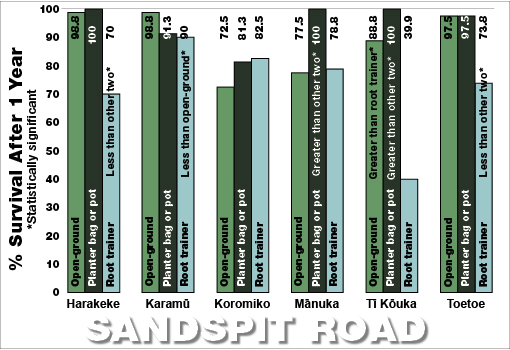
Head for the Bar: Open-ground plants hold their own with planter bag and potted, and surpass root trainer in the survival stakes—although none were literally staked! bar chart data Mark Kimberley
Survival appeared to be the biggest challenge. But rather than the open-ground, the most vulnerable proved to be the root trainer –raised plants.
This result, from the Sandspit Road trial, like so many aspects of the open-ground project, and the method itself, is entirely counter-intuitive. Logic would have suggested that the less a plant’s root system was disturbed during transplantation, the less transplantation shock, and associated mortality, would be involved.
The particular vulnerability of root trainer plants is the ease with which they can be dislodged, particularly the smaller of the two sizes in common use, Hillsons, which are used in the trial.
Te kōuka (cabbage tree) is vastly over-represented in the plants recorded as missing or dead. Te kōuka roots are known to be of particularly interest to pūkeko, suggesting that the indigenous swamp hen is the main culprit. The trial situation whereby an entire row can consist of lightweight, root trainer te kōuka, and the adjacent wetland, must present unprecedented convenience for pūkeko—illustrated by the pattern of greatest losses being contiguous and at the end of the row closest to the water.
In four of the six species, planter bag or potted plants (PB3-size) suffered negligible losses. However only in three species did the open-ground plants boast negligible losses.
The one open-ground species that outperformed the planter bag or potted plants was karamū, which is known to strike very readily. But it did not excel by much—98.8% survival rate, compared to the competition at 91.3% and 90% respectively.
Open-ground and root trainer mānuka suffered uniformly large losses compared to 100% survival of the PB3-sized containers. This would appear to reflect the famous sensitivity of mānuka to having its root system disturbed.
The largest losses from a single species were of koromiko—open-ground fared worst, at 72.5%—probably the result of browsing by rabbits.
Given that the open-ground plants received no additional treatment aimed at reducing transplantation shock, the trial results shows them as having comparable survival rates to planter bag or potted plants, and far superior to those of the Hillson-sized root trainers.
Although the survival rates of potted plants were somewhat better, they were also twice the price.
With a little more work, open-ground seems set to make up for lost ground.
Open-ground harakeke silver-tongued strategy
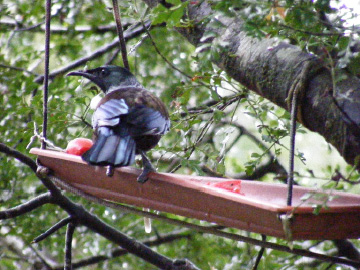
From the Editor’s Desk: This particular tūī, pampered with persimmon by the editor’s partner, may not personally be enthusiastic about being mobilised for the open-ground harakeke initiative. photographer Cimino Cole
A tūī sings heartily from his harakeke perch. The harakeke stands on steep, grazed hillside. Tūī and open-ground harakeke—the elegantly simple symbol of an elegantly simple strategy, towards the goal of establishing a million hectares of sustainable indigenous forest.
The concept is to use the tūī as the silver-tongued salesman for a silver-bullet solution: Produce harakeke plants cheaply and in vast numbers—open-ground in large-scale, forestry-style nurseries—as a filler or nurse crop.
Most will assume that open-ground simply refers the establishment of indigenous forest on open ground. No matter it also refers to the nursery method—the whole approach is designed to insulate the audience from any underlying complexities.
The cost of plants, and the cost of establishing those plants, is the main barrier to large-scale indigenous forestry. By producing harakeke as efficiently as radiata pine seedlings and planting in high ratio to target species, the average cost per plant is driven down. By establishing high densities of large harakeke, weeds never threaten the plantings, even if they receive no further maintenance—this is all too often the case, sometimes resulting in total failure of the planting to establish. Biodiversity immediately benefits—as burgeoning populations of tūī deposit (mostly indigenous) seed below their favourite perch: Harakeke.
While it is simplicity itself, it is not a one-size-fits-all solution. Harakeke as a filler or nurse crop could form a valuable component of most establishment regimes. But even if it played no direct part in a specific project, the open-ground harakeke initiative would help float all indigenous forestry boats.
The passion for indigenous forestry, of course, is only partly about sustainable timber production. For most, if not all, it is the certainty that a flood of indigenous forestry will also help float the indigenous restoration boats, which struggle to avoid stranding in a fiscally drained landscape.
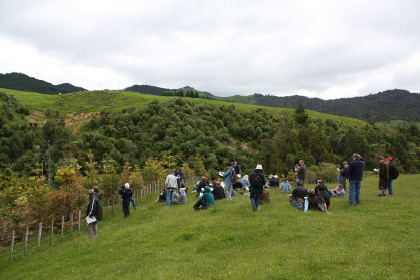
Eye-Watering: Although a sight for conference-sore eyes, this trial area, of indigenous forestry and restoration planting, at the Whatawhata Hill Country Research Station proved to be uneconomically expensive to establish. photographer Michael Bergin
The open-ground harakeke concept emerged over a few beers in the middle of an indigenous forestry conference, last week. It might have emerged half an hour earlier, but for the delay in getting The Buttery bar open. Or even a couple of hours earlier—during the plenary session that marked the end of the indoor half of the conference, and the beginning of two days of field trips. But epiphany can seldom be summoned by conference schedules. The gnawing sense of having failed to nail a national-strategy game changer had become excruciating, until the drought belatedly broke with the restocking of the bar, at the University of Waikato’s Bryant Hall.
Tāne’s Tree Trust, the principal conference organiser, is very big on field trips. A high percentage of its members are farmers—many of whom are also members of the New Zealand Farm Forestry Association—who have field days in their blood. A case could be made for scheduling the field trips ahead of the talkfest. Or maybe book-ending the indoors with the outdoors. The two field days underlined two recurring conference themes:
- The too-high cost of indigenous forestry establishment
- The need for good, accessible indigenous forestry demonstration sites.
The Mahurangi is already punching above its weight in both respects, but additional exciting possibilities abound, including demonstration sites alongside State Highway One. In addition to re-starting the open-ground production of indigenous species, Mahurangi could help launch the open-ground harakeke initiative. That would be an indigenous-forestry game changer.
Restoration depends upon
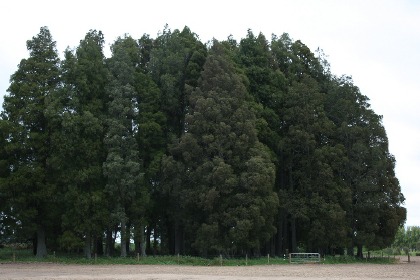
Protected Monoculture: A crowd of regrowth kahikatea securely protected from grazing dairy cattle by the stringently efficient Armstrong fence. photographer Michael Bergin
Indigenous forestry strategy Aotearoa was once a land of forests. That was before Māori settlers, with fire, and European settlers, with steel and fire, reduced the ancient forests in most regions to tiny remnants. It is hardly surprising that, when a powerful protection ethos evolved under the banner of conservation, the imperative was to protect, inviolate.
A vision for indigenous forestry has been slow to emerge, partly due to an almost religious reverence for the surviving remnant forest and partly to due to the perception that indigenous tree species were inherently slow growing. The spectacularly fast-growing, forestry-bred, radiata pine merely exacerbated the misapprehension.
The perception that indigenous trees were too slow growing would almost certainly have been dispelled had the Forest Service survived to develop indigenous forestry.
Indigenous forestry is logically the sole facilitator of large-scale indigenous forest restoration. Only by developing the infrastructure needed to establish indigenous forests on a large scale, is large-scale restoration possible, let alone affordable. While volunteer–raised and established indigenous plants can make an impressive difference in urban corners and in popular parks, only through economically viable indigenous forestry will a measurable percentage of marginal or unsustainable pasture be planted.
The key infrastructure required, and objective of the open-ground project, is forestry-scale nurseries producing indigenous plants and seedlings—it is thanks to exotic forestry that, in spite of the profound loss of indigenous stands, a third of Aotearoa is still forested.
Indigenous forestry is the friend of exotic forestry, pastoral farming, and the indigenous forest restoration—even the urban park, reserve or riparian margin.
Many more remnants, of original or regrowth forest could be protected and protected better, by combining indigenous forestry with restoration. The small, achingly attractive regrowth kahikatea stands that epitomise the Hauraki Plains and parts of the Waikato, and elsewhere, are a prime example. By carefully extracting the millable timber and planting the perimeter in successive bands of kauri, kahikatea, tōtara, harakeke and toetoe, a larger and healthier stand could be established. The kahikatea in the inner sanctum, which would achieve greater height and girth, could be protected legally in perpetuity.
- Conservation addressed.
- Biodiversity addressed.
- Sustainability addressed.
And all self-funded!
Since the disestablishment of the Forest Service in 1987, successive governments have failed to develop even an indigenous forestry strategy, much less a latter-day Indigenous Forestry Service. As much as the Forest Service deserved to be emulated, the establishment of a state-owned enterprise is both improbable and, arguably, undesirable—some form of hybrid corporation would be functionally better and socially more attractive.
A compelling national indigenous forestry strategy would include government involvement in a state–social enterprise: A one-stop indigenous forestry shop.
Indigenous Forestry Aotearoa?
Sustainable forestry splash in Lake Taupō
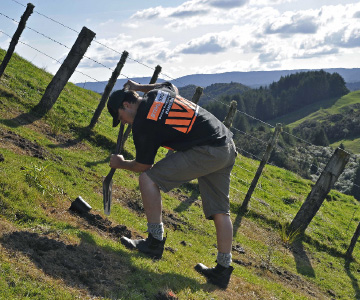
Steeped in Science: The characteristically hard-working Michael Bergin demonstrates the steepness of the Taupō trial site terrain. The trial seeks to compare establishment rates of pot-raised and open-ground plants. photographer Jonathan Barran
Sustainable Farming Fund is a misnomer. Because the fund benefits both farming and forestry sustainability projects, it richly deserves to be re-named.
The Ministry of Agriculture and Forestry, by dropping Fund from the fund’s title, and adding Forestry, would leave the obligatory three-letter acronym intact, and also avoid some awkward phasing—‘funded by Sustainable Forestry and Farming’ reads so much better than ‘funded by the Sustainable Farming Fund.’
Semantics aside, the Sustainable Farming Fund knows what it’s doing when it comes to facilitating effective sustainability projects. One of the requirements is for project information to be effectively disseminated—a major driver in taking the Mahurangi Magazine online.
One of the dissemination tools emphasised is field days, hence the ‘open-ground open day’ at Taupō Native Plant Nursery.
While field days preach partly to the converted, they do at least preach to the interested. One person acutely interested in the field day was Graeme Fleming, chief executive of the Lake Taupō Protection Trust.
Graeme explained to the 40 attendees how the trust plans, with its budget of $81 million over 15 years, to pre-empt Taupō going bottom up, in the manner of the Rotorua Lakes. The trust’s particular focus is nitrogen reduction. While there is a range of measures that a pertinent, a switch from agriculture to forestry is the signal land use change sought. The principal barrier to the inclusion of an indigenous forestry component, Graeme had soon learned, was the high cost of indigenous plants and their establishment.
Subsequently, Dr David Bergin has discussed the open-ground project with Graeme Fleming and protection trust director John Kneebone. An application to the trust (prepared by Dr David Bergin and Cimino Cole) for $150 000 was successful, enabling the open-ground versus container-raised trials to continue for a further three years.
The Taupō trials facilitate:
- The Mahurangi trials to be repeated in central volcanic plateau conditions
- Trials to be easily accessible by central volcanic plateau land holders and foresters
- Associated research, science and technology to be furthered.
The trial is being conducted by Tāne’s Tree Trust, a national organisation with a vision for the majority of property holders to be successfully planting and sustainably managing indigenous trees, for multiple uses, by 2020. Dr David Bergin is a trustee, and fellow trustee Roger MacGibbon is the project manager. One of Roger’s hats is managing director of the Xcluder Pest Proof Fence Company, 47-kilometres of whose product protects Maungatautari.
The first year of a trial is typically less than optimal. With Mahurangi open-ground project, the focus was initially on establishing a pilot nursery, at the Ōmaha wastewater treatment site. While a lot was learned by the project team, it belatedly occurred to them that more robust results could be obtained by are far as possible having the plants produced by an established nursery with open-ground and container-raised capability.
Similarly, the first year of the Lake Taupō Protection Trust trials is a little short of optimum. The site is not readily accessible by the target audience and has been established later in the year than is accepted best practice. However it is also valuable to test the extremes, provided that the early summer is not so drying that a large percentage of plants die.
Having some plants die, in a scientifically designed trial, is generally valuable in demonstrating what works and what doesn’t. This has been the happy result at Sandspit Road where there were appreciable losses amongst the root trainer –raised plants, but only small losses of those open-ground or planter bag (and pot) –raised.
The challenge for next year is locate a site in the Taupō catchment with accessibility as good as Mahurangi’s Sandspit Road, complete with a café as close, and as good—no pressure!
Maybe a Mahurangi Magazine reader will put their oar in at Taupō.
Serious indigenous forestry is growing trees from the tractor seat
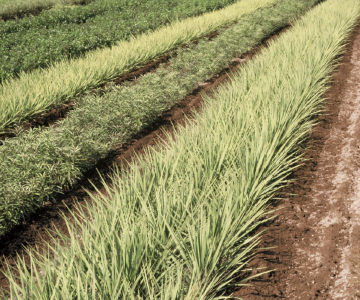
View from the Tractor Seat: Seedlings growing in open-ground beds at the Forest Research Institute in the 1980s. Most aspects of the operation were performed from the seat of a tractor. photographer Jonathan Barran
The scale is enormous. Radiata pine seedlings are produced, and planted by the million. But while scale is a factor, the main reason indigenous plants cost on average 10 times more than exotics is the labour-intensive production method. Radiata pine seedlings, in contrast, are literally grown from the tractor seat.
Preparing open-ground beds
Prior to full field cultivation, with a roller tiller, the subsoil may have to be loosened to ensure free drainage.
A bed-former is then deployed, similar to those used to prepare market garden beds.
(Confirmation that preparation of open ground beds is best done from the tractor seat was brought home at Ōmaha in the first year of the trials. Lacking a locally-available bed former of suitable width, the final bed formation was done manually. Not to put a too fine a point on it, the company and conversation were more memorable than the productivity.)
Sowing
Radiata pine is readily grown from seed directly sown in open-ground beds. This will also be possible for a number of indigenous species that, like radiata pine, are natural colonisers. Tōtara, being a coloniser, may be in this category. It is the predominant coloniser of pasture in Northland—including because, being comparatively unpalatable to sheep and cattle, it survives moderate grazing.
Harakeke is another coloniser that potentially can be grown readily from seed. It has the enormous advantage of suffering little transplantation shock and having an exceptional ‘shelf life’ between lifting and planting. Because it grows to a limited height, it is potentially invaluable, as a low cost filler species, in establishing target timber, amenity or restoration trees.
Other species, such as kauri, are not natural colonisers and establish better in other than full sunlight. Many indigenous species are also too frail as young seedlings to be suitable for growing open-ground directly from seed. This also applies to some exotic forestry species including eucalypts. Accordingly, such species are initially geminated and grown in plug trays indoors before being transplanted to open-ground beds.
Seed is drilled in straight rows at regular intervals. This aids subsequent root conditioning operations.
Currently in Aotearoa, plug-raised seedlings are manually transferred to open-ground beds. Transplanters designed to mechanically position up to 7000 vegetable seedlings per hour are being evaluated for forestry nursery use.
In the Mahurangi trials, both container and open-ground seedlings were raised in plugs.
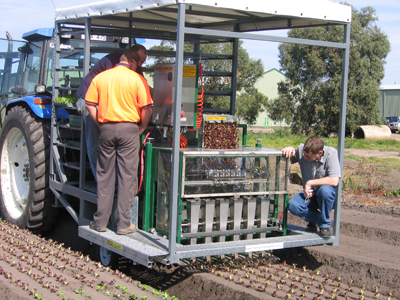
Victorian Solution: Transplant Systems field transplanter can place 7000 seedlings per hour. Those being planted here, however, are lettuce! photograph Transplant Systems
Root pruning
Aside from weed control, which can include both chemical and mechanical methods, the next intervention involves mechanical root pruning.
Undercutting is perhaps the most important mechanical operation in open-ground nursery practice as it largely determines the quality of the seedlings.
Undercutting causes a carbohydrate transfer from foliage to roots and therefore height growth is slowed and root growth is increased. The unconditioned root system of a seedling is impossible to extract from the nursery and does not transplant well.
When a seedling’s roots are conditioned by undercutting, wrenching and lateral root pruning, they respond by producing new roots from points further back along the severed roots.
Because of the impact on the plant, only one intervention should be performed at a time, with time allowed between for the seedlings to fully recover from the stress.
The other main intervention is lateral root pruning, whereby the lateral roots between the rows are pruned with self-aligning discs.
Pruning of lateral roots across the rows (cross-pruning) is desirable for some species, but does adds to production costs.
Lifting
Seedlings are lifted by hand—to date, mechanical lifting has proved damaging to delicate root systems.
Prior to lifting, the beds are worked by a reciprocating blade wider and thicker than the undercutting blade, inclined at 20° to gently lift and loosen soil and seedlings.
After lifting in handfuls, individual trees are teased apart and elongated roots trimmed.
Storage and transport
The seedlings, immediately after lifting, are packed wet into forestry boxes. These are fabricated from white fluted plastic sheet, which provides a measure of protection from the sun.
Ideally plants are stored and transported in cool storage at high humidity—desiccation, particularly of the root system is principal enemy of open-ground seedlings after lifting.
A subset of the trial involved seedlings held in cool storage for one week prior to transportation, but otherwise seedlings were transported in un-insulated white painted trucks and delivered within 24 hours of lifting.
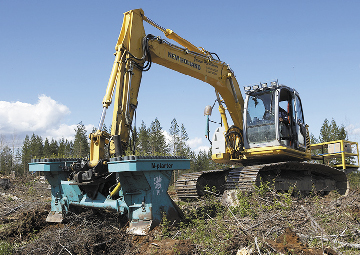
Top Gear: An M-Planter in action in Finland. The machine, excluding reloading, is recorded planting at up to 351 seedlings-per-hour. photograph Finnish Forest Research Institute
Planting
Forestry trees in Aotearoa are invariably planted manually.
In the United States, and subsequently in other countries including Australia, tractor-drawn furrow-forming tree planting implements have been used. The original machines were based on potato planters. Limitations include unsuitability for use on uneven terrain and undesirable consequences of furrow formation, including the drying out of ground.
In Finland, two different designs of furrow-less tree planting machine are in use. Being track, rather than wheel, -based, they are designed to cope with the range of terrain typical of Aotearoa.
In short
While much can be achieved in the context of urban and park restoration planting using the container methods that have prevailed since the 1970s, indigenous forestry means, as Jaap van Dorsser puts it, growing trees from the tractor seat.
Seed High-viability seed, resulting form intensive seed cleaning practices, is particularly important in direct sowing. If seed has low viability, appreciable gaps will result in the open-ground beds rendering the operation uneconomic.
High viability seed is particularly important in direct sowing. If seed has only low viability, so many gaps may result in the open-ground beds so as to render the operation uneconomic.
When raising monocots such as harakeke, seed viability is not nearly as critical. This is because several seeds can be planted in each interval to ensure a high probability of at least one successfully propagating. And if more than one seedling establishes, a useful clump results—whether subsequently planted intact or separated.
It is probable that various seed coating techniques available will render the seed of some indigenous species sufficiently manageable for direct sowing into open-ground beds.
Seedlings or plants Open-ground plants, or open-ground seedlings?
The correct term, if grown directly from seed, is seedling. However if the open-ground plant was first propagated in a plug tray, it is can correctly be called plant, or more technically, a transplant. When an open-ground nursery uses both methods, which generally will be the case, it will have open-ground plants and open-ground seedlings, which presents a problem of semantics when referring to them collectively.
In the indigenous forestry nursery context, seedling nicely conveys the phase of the plant.
That, and because plant is also used collectively for flora and to differentiate plants from trees and shrubs grasses—e.g. flax plant—the Mahurangi Magazine has simplified its open-ground terminology and standardised on seedling whenever it refers to open-ground seedlings, regardless of whether they are transplants.
Open-ground or bare-root While the term bare-rooted natives makes for racey headlines and titles, the Mahurangi Magazine judged that standardising on open-ground better conveys large-scale forestry-style seedling production.
So much to be trialled, so much for science

Telling the Scientists to Tell Us: While Copenhagen quibbles over a 1.5° or 2° target, British economist Baron Stern of Brentford, urges scientists to describe to the world just how unbearable warming of 4° or 5°, which is probably where temperatures are headed, would be. photograph Scanpix/EPA/DPA
At created quite an impression, not least of all with the owner. Three neighbouring, perfectly sound indigenous plants were summarily dug out of the ground, after being happily established there those last eight months.
Had the plants been dead or dying, no qualms would have been felt. It is instructive that field day attendees were somewhat shocked—the sanctity of an indigenous species had been violated! But by the simple expedient of actually investigating how well or otherwise the roots of plants had established into the surrounding ground, more was revealed in minutes than would have been in a lifetime of exhuming dead plants. The results nicely confirmed what Jaap van Dorsser has long stated about the comparative root performance of container and open-ground plants. The root system extended considerably farther from the open-ground plant, than from either of those container-raised.
The project demonstrates that open-ground seedlings are comparative with potted or planting bag in regard to establishment performance, and are potentially considerably cheaper to produce and to plant. It also demonstrates the vulnerability, to browsing and smothering, of Hillson-sized root trainer–raised plants. But while the trial has firmly established the relevance of the open-ground method in establishing indigenous species, it barely scratches the surface of open-ground aspects begging to be researched, developed and trialled.
Direct sowing
Radiata pine is readily grown from seed sown directly in open-ground nursery beds. This is because the seed used has of high viability and emerging seedlings cope well in the open.
Direct sowing is significantly more economic than raising seedlings indoors, in plug trays.
Developing techniques for similarly direct sowing key indigenous species, with the necessary attributes, is a priority.
Harakeke probably has an unassailable lead over other species because of these attributes:
- Valuable establishment species, including as a transitional filler
- Clumping is acceptable, allowing the multiple seeds to be sown
- Most-readily established indigenous species open-ground.
This last attribute is due to harakeke’s rhizomatous root system, which is relatively immune to desiccation during the transplantation stage.
Two-year seedlings
It is probable that by planting larger seedlings, establishment costs can be reduced.
A significant percentage of restoration planting fails within the first two years, typically by being overwhelmed by competing vegetation. It is possible that establishment regimes can be devised that require no maintenance, and that these will be competitive, even discounting the percentage that fail completely, with regimes entail a significant maintenance component.
The particular advantage that open-ground has over container-based methods is in respect to producing larger plants. Unlike container-raised seedlings, which require re-potting, a second year in the nursery adds only incrementally to the cost of producing open-ground seedlings.
To test this strategy, the establishment performance of two-year and one-year open-ground seedlings need to be compared.
Harakeke is the obvious candidate species, but other species could be included in the trial.
Density
Only a small number of trials have been conducted, or are underway, that evaluate the comparative performance of different establishment densities, and ultimately a wide range of trials need to be performed.
However, because of the suitability of harakeke to the open-ground method, establishment trials comparing various densities of harakeke is a priority.
Filler ratios
It seems highly likely that harakeke seedlings can be economically produced and established in high volumes. The higher the ratio of harakeke, then, the greater contribution it will make to reducing the average cost of establishing a plant. Assuming a 15:1 ratio, filler and succession seedlings costing 30cents and $1.50 respectively, the average cost is reduced to 37.5 cents per seedling.
High percentages of harakeke, say 24:1 through to 1:1, need to be trialled to determine if there is a tendency for a monoculture of harakeke to develop.
Hybrid open-ground
A simple, six-month proof of concept trial of the eNZopen™ container would determine if the configuration promotes the development of the necessary fibrous root mass. If it passed this first test, the concept could quickly and inexpensively be trialled to determine its potential role in low cost, low loss establishment regimes.
Strategic and focussed
British economist Nicholas Stern warns that global temperatures could rise by 5° by the end of the century, and render much of the world uninhabitable. Regardless of just how much the world heats up, there is an unquestionable and urgent need for reforestation on an unprecedented scale. But only by adopting and adapting forestry methods, can indigenous species form a significant component of the response in Aotearoa.
While there are many potential areas relating to the open-ground method that could be scientifically trialled, a strategic and focussed programme is imperative:
- Direct sowing of open-ground nursery beds
- Comparative cost and performance of establishing one-year-old and two-year-old seedlings
- Comparative cost and performance of establishing different densities of seedlings
- Comparative performance of different ratios of filler species
- Preliminary proof of concept trial of eNZopen™ system.
Meanwhile, trials similar to those in the Mahurangi have been established in the Lake Taupō catchment, in 2009, with more to be established this year and in 2011.
Open-ground and container-raised indigenous plants comparison bottom line
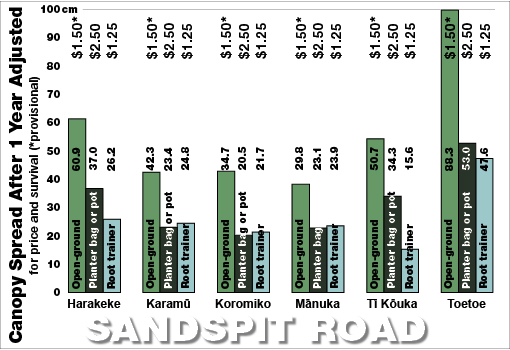
Spreading a Dollar Further: Adjusted to the provisional price paid for open-ground plants, and for survival, neither the more expensive but better surviving planter bag or pot, nor the cheaper but poorer surviving root trainer plants covered nearly as much ground. bar chart (unreviewed) Cimino Cole
Open-ground seedlings are more economic to establish. This is the overall finding of the open-ground and container-raised indigenous plants comparison conducted in the Mahurangi and Ōrewa catchments.
This Sustainable Farming Fund project sought to compare the establishment performance and economics of plants raised by three nursery methods:
- open-ground
- planter bag or pot
- Hillson-sized root trainer.
The open-ground method is universally used by the forestry industry, while container methods are used by garden and indigenous plant nurseries. The comparison demonstrates that there is no inherent need for indigenous species to be raised in containers. The only marked difference in establishment performance with Hillson-sized root trainer plants, which being smaller were subject to smothering by competing plants and to predation.
Economically, the open-ground plants greatly out-performed both root trainer and potted (or planter bag) plants. However, this is based on the somewhat nominal price charged for the open-ground plants:
- Open-ground
- $1.50
- Planter bag
- or potted (PB3-sized) $2.50
- Root trainer
- (Hillson-sized) $1.25
It is reasonable to expect that some open-ground –raised indigenous species, particularly any that can be grown from seed without a plug phase, can be produced at a cost somewhat closer to the $0.30 charged for high quality radiata pine seedlings.
For the Mahurangi Harbour to be restored to anything like its pre-deforestation state, millions of trees need to be established. For Aotearoa to act adequately on climate, millions of hectares of trees need to be established.
Only by adopting large-scale methods, such as open-ground nurseries, can indigenous species form a significant part of this new forest.
Appendix The data
Rabbits and Pukeko Take Toll: Browsing by rabbits appears to have caused the overall poorer survival of koromiko, at the Sandspit Road trial. The open-ground plants with their greater offering of foliage appear to have been particularly attractive. Root trainer tï köuka, on the other hand, just irresistible to pukeko. bar chart data Mark Kimberley
Survival appeared to be the biggest challenge. The survival of open-ground plants, because their roots are exposed during transplantation, presents a particular risk. But rather than the open-ground, the most vulnerable proved to be the root trainer –raised plants.
This trend, across the three trial sites, and like so many aspects of the open-ground project, and the method itself, is entirely counter-intuitive. Logic would have suggested that the less a plant’s root system was disturbed during transplantation, the less transplantation shock, and associated mortality, would be involved.
It is possible that in trials where plants were stringently free from competing grasses and other weeds, open-ground plants would exhibit a higher mortality than planter bag/potted or root trainer –raised plants. However, it was decided, including for purely pragmatic reasons, that the plants would be exposed to a level of competition that was broadly typical of indigenous plant establishment projects—as opposed to best practices, which are often not achieved in projects such as those funded under the Mahurangi Action Plan.
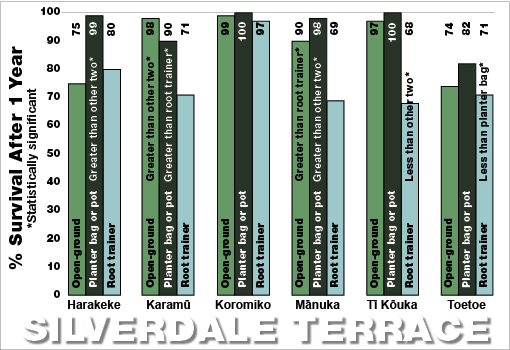
Where Weeds Were Worst: The rich soil of the Silverdale river terrace initially grew the most vigorous crop of competing grasses, compared with the other two sites. This is possibly the reason the grasses harakeke and toetoe fared comparatively poorly. bar chart data Mark Kimberley
The particular vulnerability of root trainer plants is the ease with which they can be dislodged, particularly the smaller of the two sizes in common use, Hillsons, which are used in the trial.
At Sandspit Road, tī kōukacabbage tree is vastly over-represented in the plants recorded as missing or dead. Tī kōuka roots are known to be of particularly interest to pūkeko, suggesting that the indigenous swamp hen is the main culprit there. The trial situation whereby an entire row can consist of lightweight, root trainer tī kōuka, and the adjacent wetland, must present unprecedented convenience for pūkeko—illustrated by the pattern of greatest losses being contiguous and at the end of the row closest to the water.
In four of the six species, planter bag or potted plants (PB3-size) suffered negligible losses. However only in three species did the open-ground plants boast negligible losses.
The one species that outperformed open-ground, over planter bag or potted plants, was karamū—it is known to strike very readily. But the difference over planter bag or potted (an average of a little less than six percent) was only statistically significant at the Silverdale Terrace site.
Open-ground and root trainer mānuka suffered uniformly large losses compared to 100% survival of the PB3-sized containers. This would appear to reflect the famous sensitivity of mānuka to having its root system disturbed.
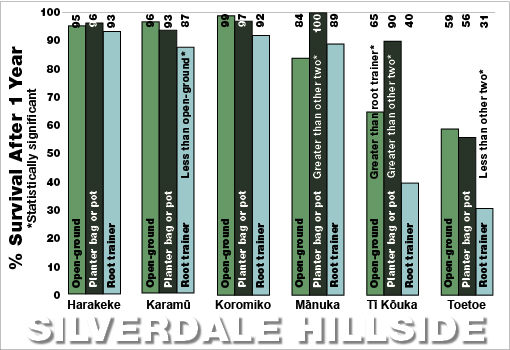
All Downhill: Because competing grasses were initially light on the relatively infertile hillside site, plants were not released. Subsequent paspalum growth, falling downhill under its own weight, swamped the leaves of tī kōuka and toetoe and is probably the cause of its higher mortality—stiffer harakeke leaves not as readily subdued. bar chart data Mark Kimberley
The largest losses from a single species were of koromiko—open-ground fared worst, at 72.5%—probably the result of browsing by rabbits.
Given that the open-ground plants received no additional treatment aimed at reducing transplantation shock, the trial results showing them having comparable survival rates to planter bag or potted plants, and far superior to those of the Hillson-sized root trainers, are very positive.
Statistical significance
Biometrician Mark Kimberley has determined that the following results are statistically significant:
Survival at Sandspit Road
- harakeke
- Survival of root trainer was less than open-ground and planter bag/pot
- karamū
- root trainer survival was less than open-ground
- mānuka
- planter bag/pot survival was greater than open-ground and root trainer
- tī kōuka
- planter bag/pot survival was greater than open-ground, open-ground greater than root trainer
- toetoe
- root trainer survival was less than open-ground and planter bag/pot.
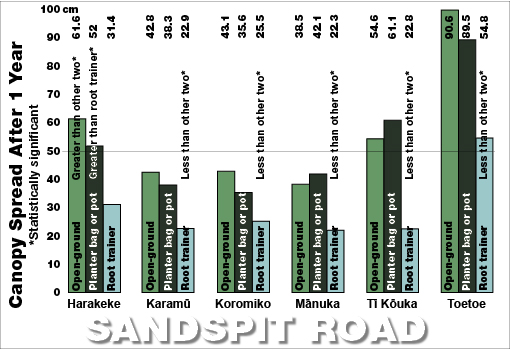
Serious Sandspit Spread: Open-ground spread significantly exceeded all root trainer plants in all species, and planter bag/potted (although only significantly in the case of harakeke) in all but two species: Mānuka, with its famously finicky root system and tī kōuka, inexplicably. bar chart data Mark Kimberley
Survival at Silverdale River Terrace
- harakeke
- Survival of planter bag/pot was greater than open-ground and root trainer
- karamū
- open-ground survival was greater than planter bag/pot, planter bag/pot greater than root trainer
- mānuka
- planter bag/pot survival was greater than open-ground, open-ground survival greater than root trainer
- tī kōuka
- root trainer survival was less than open-ground and planter bag/pot
- toetoe
- root trainer-raised survival was less than just planter bag/pot.
Survival at Silverdale Hillside
- karamū
- Survival of root trainer was less than just open-ground
- mānuka
- survival of planter bag/pot was greater than open-ground and root trainer plants.
- tī kōuka
- survival of planter bag/pot was greater than open-ground, open-ground greater than root trainer
- toetoe
- survival of root trainer-raised was less than open-ground and planter bag/pot.
Spread
The spread measurement is the average of the width of the foliage across is broadest axis, and the width of the axis at right angles to the first measurement.
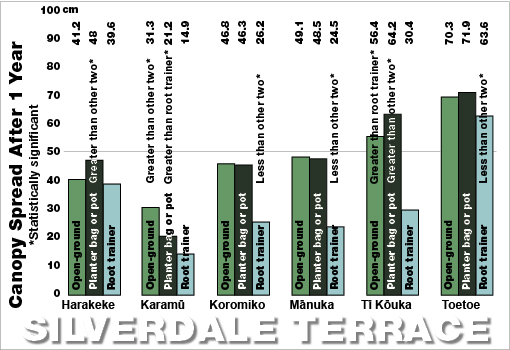
Uneven on the Terrace: In spread, open-ground plants hold their own with planter bag/potted, and significantly surpass root trainer. The relatively poor showing of harakeke is possibly due to smothering a critical growth period. bar chart data Mark Kimberley
While it is a broadly useful measurement within species, spread gives only a very rough comparison between species as different in form as toetoe and mānuka.
That said, toetoe was the standout, all the more impressive considering that little over 71% survived—when it is good, it is very, very good…
Spread at Sandspit Road
- harakeke
- Spread of open-ground was greater than planter bag/pot, planter bag/pot greater than root trainer
- karamū
- root trainer spread was less than open-ground and planter bag/pot
- koromiko
- ditto
- mānuka
- ditto
- tī kōuka
- ditto
- toetoe
- ditto.
Spread at Silverdale River Terrace
- harakeke
- Spread of planter bag/pot was greater than open-ground and root trainer plants
- karamū
- spread of open-ground was greater than planter bag/pot, planter bag/pot greater than root trainer
- koromiko
- root trainer spread was less than open-ground and planter bag/pot
- mānuka
- ditto
- tī kōuka
- spread of open-ground was greater than planter bag/pot, planter bag/pot greater than root trainer
- toetoe
- root trainer spread was less than open-ground and planter bag/pot.
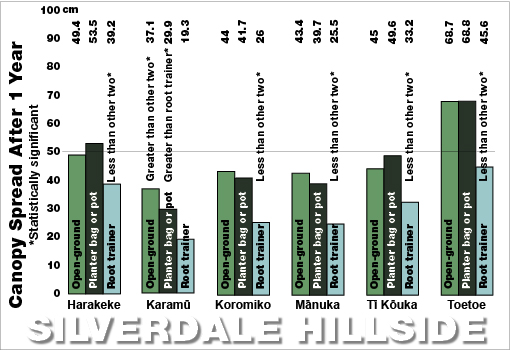
More Even on the Hill: Although the pattern on the hillside site was more even than on the terrace it is unclear why harakeke, which is generally regarded as bombproof, open-ground, spread so much better at Sandspit Road than at Silverdale. bar chart data Mark Kimberley
Spread at Silverdale Hillside
- harakeke
- Spread of root trainer was less than open-ground and planter bag/pot
- karamū
- spread of open-ground was greater than planter bag/pot, planter bag/pot greater than root trainer
- koromiko
- root trainer spread was less than open-ground and planter bag/pot
- mānuka
- ditto
- tī kōuka
- ditto
- toetoe
- ditto.
More measurements
It is clear that the trials should be measured at least once more, preferably before the spring growth surge in 2010.
This will determine whether significant mortality has resulted from the decision not to release in 2009, and whether the trend for open-ground to be greater in spread than planter bag/pot plants becomes statistically significant.