
Raising plants in open-ground beds
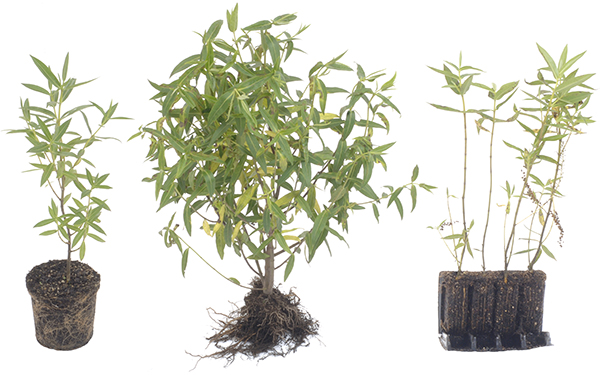
Sibling Rivalry: Samples of plants propagated at the same time from the same seed source. On average, the forestry-style plants, centre, developed canopies and stems twice the diameter of the container-raised plants, and even more so compared to the puny root-trainer raised plants, right. photographer Jonathan Barran
Raising plants open-ground can seem counterintuitive.
It is easy to imagine that the best start in life a plant can have is to be lovingly raised in a pot in a nursery, and then carefully planted.
But for foresters, raising plants in pots is downright … potty—exorbitantly expensive and resulting in trees prone to being wind-blown. Hence the open-ground and container-raised indigenous plants comparison.
The objective of the open-ground project is the rapid and widespread adaptation and transfer of the nursery methods used to raise forestry species exotic to Aotearoa to facilitate the production of indigenous plants…
- in larger quantities
- at lower prices, and
- of better quality…
…to greatly enhance sustainable land use options.
A three-year community-led Sustainable Farming Fund project to kick-start production of indigenous plants with open-ground methods was triggered by the former Auckland Regional Council’s Mahurangi Action Plan. The restoration of riparian margins alone calls for a staggering number of plants, some 20–40 million, but an even larger area of the catchment is in need of retirement. If the most-erodible of southern-facing slopes were to be retired—say 10% of the third of the catchment that is of steep terrain—another 200 million plants would be needed.
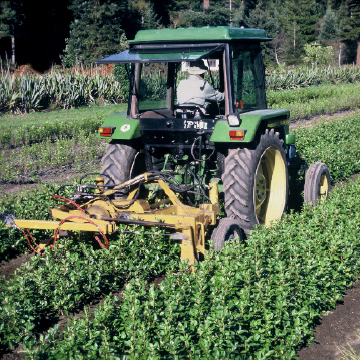
From the Tractor Seat: Jaap van Dorsser undercutting seedlings in open-ground beds at the Forest Research Institute in the 1980s. photographer Jonathan Barran
Cost and quantity High-quality radiata pine seedlings cost around 30 cents each. By exorbitant contrast, high quality indigenous plants cost around $3 each. Although scale does play a role, the principal cause of the price difference is the nursery methods used. Forestry plants are raised in open-ground beds utilising mechanisation—plants, in the words of legendary forestry nurseryman Jaap van Dorsser, that are:
grown from the seat of a tractor
The methods that underpin this project were pioneered by Mr van Dorsser in the 1960s, in response to a Forestry Research Institute directorate imperative to develop sustainable indigenous forestry methods. Then, and during the 1980s, tens of thousands of indigenous plants were successfully raised and established. However, trials were not undertaken comparing container-grown plants, because container methods were not considered by forestry nurserymen to be suitable for large-scale production.
Now retired, Mr van Dorsser is principal nursery advisor to the project. Dr David Bergin of Scion, the project’s research scientist, is well-known for his work with tōtara, pōhutukawa and dune restoration with indigenous sand-binding plants.
Quality There is awareness in the landscaping industry internationally of the long-term effects of the root circling that results when roots of container-grown plants contact the container. While an incidence of catastrophic failure in maturing trees can arguably be tolerated in revegetation plantings, it is a dead loss in landscaping and forestry scenarios.
Sustainable Farming Fund The bulk of the project’s cash funding, $135 000, was provided by the Ministry of Agriculture and Forestry’s Sustainable Farming Fund. The basis of the funding is that the balance of the project’s community of interest must provide a similar value, either in cash or in kind.
The former Rodney District Council’s pledge of $5000 in the first year of the project was crucial to the success of the application. Aside from the Auckland Regional Council being part of the project’s natural community of interest, the Auckland Region generally, not least of all the Auckland Regional Parks, will benefit from this initiative—to plant 10 percent of the regional park’s 37 000 hectares, for example, would involve more than 17 million plants.
Commercial uptake A key objective of the project, commercial uptake, received a substantial boost following collaboration with Taupō Native Plant Nursery. The nursery, it transpired, had made the strategic decision to acquire a site in the Auckland region where, in addition to producing container-grown plants, it could also produce open-ground plants on a large scale. The nursery saw open-ground as one way it could abreast of the burgeoning demand for indigenous plants.
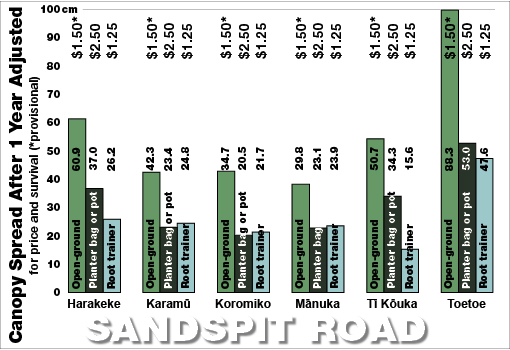
Spreading a Dollar Further: Adjusted to the provisional price paid for open-ground plants, and for survival, neither the more expensive but better surviving planter bag or pot, nor the cheaper but poorer surviving root trainer plants covered nearly as much ground. bar chart (unreviewed) Cimino Cole
The benefit to the nursery of the collaboration is that the trial provides the science layer to the nursury’s planned commercial initiative—invaluable when advising customers as to where and when open-ground plants might best be considered.
Bottom line The open-ground and container-raised comparison has convincingly demonstrated that open-ground is a more cost-effective method of establishing indigenous plants.
Larger quantities, at lower prices, and of better quality.
Lake Taupō Protection Trust The Lake Taupō Protection Trust is funding a further three-year trial comparing container and open-ground methods. While the establishment trials will be located in the Lake Taupō catchment, the benefit to the Auckland region will be almost as great as if they were undertaken in the Mahurangi catchment. The project manager is Tāne’s Tree Trust, on account of its national focus and standing.
See also Open-Ground Indigenous Plants Report
Mya on Open-Ground Indigenous Plants